
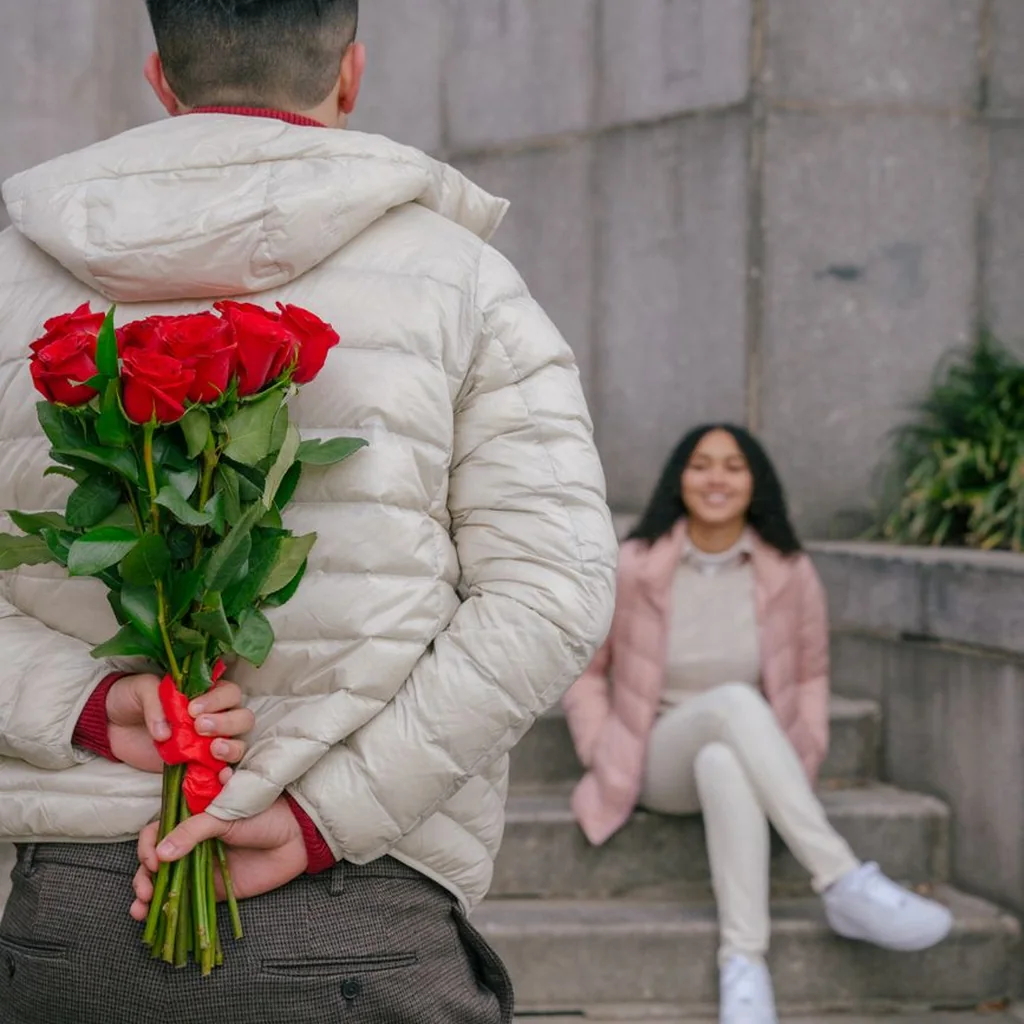
Photo: Budgeron Bach on Pexels
Dos ramos para una primera cita
Two Bouquets for a First Date
Carlos and Laura arrive at their first date with flowers and discover they have both brought each other a gift.
Three short parts. Read each part in Spanish first; tap “Show English” under a paragraph when you need the translation.


Part 1
Carlos llegó al café diez minutos antes de la hora. Llevaba un ramo de flores amarillas que había comprado en una tienda cerca de su casa. Era su primera cita con Laura y estaba un poco nervioso.
Show EnglishHide English
Carlos arrived at the café ten minutes early. He was carrying a bunch of yellow flowers that he had bought at a shop near his home. It was his first date with Laura, and he was a little nervous.
Cuando ella llegó, Carlos se levantó rápidamente para saludarla. Entonces vio que Laura también llevaba un ramo de flores, esta vez de color rosa.
Show EnglishHide English
When she arrived, Carlos quickly stood up to greet her. Then he saw that Laura was also carrying a bunch of flowers, this time pink ones.
—Parece que hemos tenido la misma idea —dijo Laura, sonriendo.
Show EnglishHide English
“It looks like we had the same idea,” Laura said with a smile.
Carlos se rio y le entregó su ramo.
Show EnglishHide English
Carlos laughed and handed her his bouquet.
—No sabía si te gustaban las flores, pero quería traerte algo.
Show EnglishHide English
“I didn’t know if you liked flowers, but I wanted to bring you something.”
—A mí me pasó lo mismo —respondió ella—. No sabía qué regalarte en una primera cita.
Show EnglishHide English
“I felt the same way,” she replied. “I didn’t know what to give you on a first date.”
Durante unos segundos, los dos miraron los ramos sobre la mesa. Después, Laura señaló las flores de Carlos.
Show EnglishHide English
For a few seconds, they both looked at the bouquets on the table. Then Laura pointed to Carlos’s flowers.
—Podemos ponerlas juntas en un vaso.
Show EnglishHide English
“We can put them together in a glass.”
Carlos miró hacia la barra, donde había varios vasos limpios, y luego volvió a mirar a Laura. Tomó los dos ramos y se levantó para buscar uno.
Show EnglishHide English
Carlos looked toward the counter, where there were several clean glasses, and then looked back at Laura. He picked up both bouquets and stood up to find one.
Part 2El ramo en la mesa(The Bouquet on the Table)
Carlos llegó a la barra con los dos ramos en las manos. El camarero le dio un vaso grande y lo llenó de agua. Carlos volvió a la mesa y puso en el vaso las flores amarillas y rosas. Algunas ramas eran largas y no cabían bien, pero, después de moverlas un poco, el ramo quedó bonito.
Show EnglishHide English
Carlos reached the counter with both bouquets in his hands. The waiter gave him a large glass and filled it with water. Carlos returned to the table and put the yellow and pink flowers in the glass. Some of the stems were long and did not fit well, but after he moved them around a little, the bouquet looked beautiful.
—Ahora parece un ramo de verdad —dijo Laura.
Show EnglishHide English
“Now it looks like a real bouquet,” Laura said.
—Sí, aunque no sé quién se lo va a llevar a casa.
Show EnglishHide English
“Yes, although I don’t know who’s going to take it home.”
Los dos se miraron y se echaron a reír. El vaso ocupaba casi todo el centro de la mesa, así que tuvieron que apartar las tazas y el menú. Mientras lo hacían, Laura vio una pequeña tarjeta atada a las flores de Carlos.
Show EnglishHide English
They looked at each other and burst out laughing. The glass took up almost the whole middle of the table, so they had to move their cups and the menu. While they were doing that, Laura saw a small card tied to Carlos’s flowers.
—¿También escribiste algo? —preguntó.
Show EnglishHide English
“Did you write something too?” she asked.
Carlos se puso rojo.
Show EnglishHide English
Carlos blushed.
—Sí, pero no estaba seguro de dártela.
Show EnglishHide English
“Yes, but I wasn’t sure about giving it to you.”
Laura tomó la tarjeta con cuidado. En ese momento, el camarero volvió para preguntarles si querían pedir algo, y Carlos escondió la tarjeta debajo del menú.
Show EnglishHide English
Laura carefully picked up the card. At that moment, the waiter came back to ask if they wanted to order anything, and Carlos hid the card under the menu.
Part 3La primera cita(The First Date)
El camarero les preguntó qué querían tomar. Laura pidió un café con leche y Carlos eligió un té. Cuando el camarero se alejó, Laura miró a Carlos y señaló el menú.
Show EnglishHide English
The waiter asked them what they wanted to drink. Laura ordered a coffee with milk, and Carlos chose tea. When the waiter walked away, Laura looked at Carlos and pointed to the menu.
—¿Puedo ver la tarjeta?
Show EnglishHide English
“Can I see the card?”
Carlos la sacó despacio y se la entregó. En la tarjeta había escrito: «Para Laura: espero que hoy sea el comienzo de algo bonito. Carlos».
Show EnglishHide English
Carlos slowly took it out and handed it to her. On the card, he had written: “For Laura: I hope today is the beginning of something beautiful. Carlos.”
Laura leyó el mensaje y sonrió.
Show EnglishHide English
Laura read the message and smiled.
—Es muy bonito. Y un poco romántico.
Show EnglishHide English
“It’s very beautiful. And a little romantic.”
—¿Demasiado romántico para una primera cita?
Show EnglishHide English
“Too romantic for a first date?”
—No —respondió ella—. Creo que es perfecto.
Show EnglishHide English
“No,” she replied. “I think it’s perfect.”
Después, Laura sacó un papel pequeño de su bolso. También había escrito un mensaje, pero todavía no se lo había dado.
Show EnglishHide English
Then Laura took a small piece of paper out of her bag. She had written a message too, but she had not given it to him yet.
—Entonces, yo también tengo algo para ti.
Show EnglishHide English
“Then I have something for you too.”
Carlos leyó: «Gracias por venir. Me alegra conocerte. Laura».
Show EnglishHide English
Carlos read: “Thank you for coming. I’m glad to meet you. Laura.”
Los dos se quedaron callados un momento, pero ya no estaban nerviosos. Hablaron de sus trabajos, de la música que les gustaba y de sus lugares favoritos de la ciudad.
Show EnglishHide English
They both stayed quiet for a moment, but they were no longer nervous. They talked about their jobs, the music they liked, and their favorite places in the city.
Al final, decidieron llevarse juntos el vaso con las flores y caminar hasta el parque. Las flores eran de los dos, y la cita también.
Show EnglishHide English
In the end, they decided to take the glass with the flowers together and walk to the park. The flowers belonged to both of them, and so did the date.
Practise this Spanish story
Vocabulary in context
Important words and phrases
primera cita
noun phrasefirst date
Tuvieron su primera cita en ese café.
They had their first date in that café.
estar un poco nervioso
adjective phraseto be a little nervous
Antes de entrar, estaba un poco nervioso.
Before going in, he was a little nervous.
ramo de flores
noun phrasebouquet of flowers
Le regaló un ramo de flores a su hermana.
He gave his sister a bouquet of flowers.
tener la misma idea
phraseto have the same idea
Parece que tenemos la misma idea.
It seems we have the same idea.
se levantó rápidamente
verb phrasestood up quickly
Se levantó rápidamente cuando lo llamaron.
He stood up quickly when they called him.
con cuidado
adverbial phrasecarefully
Abrió la caja con cuidado.
She opened the box carefully.
Carlos se puso rojo
verb phraseCarlos blushed
Se puso rojo cuando le hicieron un cumplido.
He blushed when they complimented him.
esconder
verbto hide
Escondió la nota en el cajón.
He hid the note in the drawer.
pedir algo
verb phraseto order something
¿Quieres pedir algo de beber?
Do you want to order something to drink?
se quedaron callados
verb phrasethey fell silent
Se quedaron callados un momento antes de responder.
They fell silent for a moment before answering.
caminar hasta el parque
verb phraseto walk to the park
Después de comer, caminaron hasta el parque.
After eating, they walked to the park.
el comienzo de algo bonito
noun phrasethe beginning of something nice
Ese viaje puede ser el comienzo de algo bonito.
That trip may be the beginning of something nice.
Check your understanding
Comprehension questions
Choose an answer, check it, then move to the next question.
Question 1 of 3
- Question 1: current not answered
- Question 2: not answered
- Question 3: not answered
Notice the language
Language notes
se la entregó
This pattern combines an indirect object pronoun with a direct object pronoun. When le or les is followed by lo, la, los, or las, le changes to se: "Carlos la sacó despacio y se la entregó." You can reuse it whenever you want to say that someone hands or gives something to another person: "Mi amiga perdió su bolígrafo y yo se lo devolví."
Mi amiga perdió su bolígrafo y yo se lo devolví.
My friend lost her pen, and I gave it back to her.
More Spanish stories to read next
La noticia del hermanito
The News About the New Baby
Lucía learns that a new baby is on the way and wonders how it will change her place in the family.
La cena cancelada
The Canceled Dinner
Daniel spends the day cooking a meal for friends, but one by one they message to say they cannot come.
El escritorio de pie
The Standing Desk
Laura tries a standing desk for the first time and finds it much harder than she expected.
La cometa y el viento
The Kite and the Wind
Daniel tries to fly his new kite on a windless afternoon and keeps looking for a way to get it into the air.