
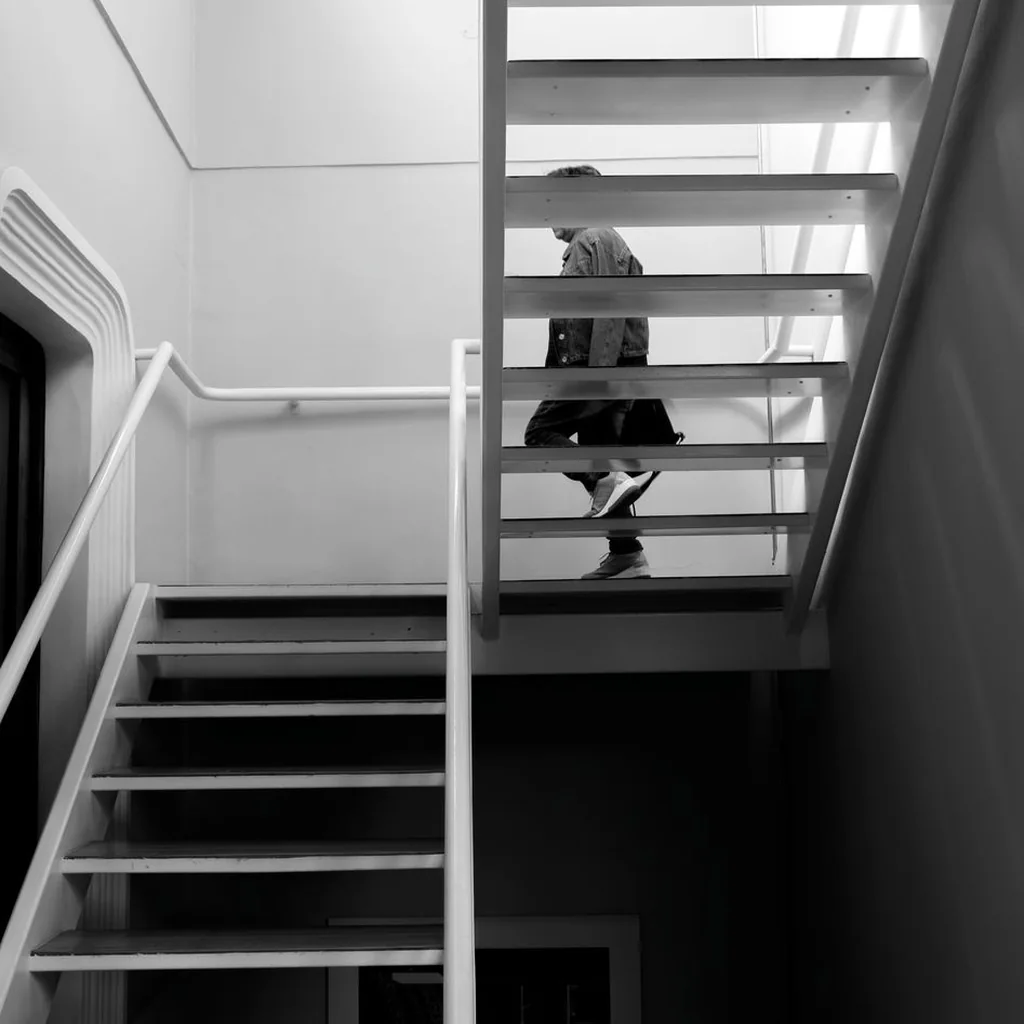
Photo: Antonio Mena on Pexels
Las escaleras del lunes
Monday’s Stairs
Marta takes the stairs for her health and meets her fit colleague Daniel, as they both try to make the climb seem easy.
Three short parts. Read each part in Spanish first; tap “Show English” under a paragraph when you need the translation.


Part 1
El lunes por la mañana, Marta decidió subir por las escaleras en lugar de coger el ascensor. Llevaba semanas diciéndose que debía moverse más, y aquel gesto le pareció una manera sencilla de empezar.
Show EnglishHide English
On Monday morning, Marta decided to take the stairs instead of the elevator. For weeks, she had been telling herself she needed to move more, and this seemed like a simple way to start.
En el segundo tramo, cuando ya notaba el corazón acelerado, se encontró con Daniel, su compañero de departamento. Él subía a paso ligero, con la camisa impecable y una botella de agua en la mano, como si acabara de salir a correr.
Show EnglishHide English
On the second flight, when she could already feel her heart racing, she ran into Daniel, her colleague from the department. He was climbing briskly, his shirt immaculate and a bottle of water in his hand, as if he had just come back from a run.
—¡Qué casualidad! —dijo Marta, intentando respirar con normalidad—. He pensado que hoy las escaleras eran una opción más saludable.
Show EnglishHide English
“What a coincidence!” Marta said, trying to breathe normally. “I thought the stairs would be a healthier option today.”
—Yo hago esto todos los días —respondió Daniel, aunque tenía la cara más roja de lo habitual—. Ni siquiera me cansa.
Show EnglishHide English
“I do this every day,” Daniel replied, though his face was redder than usual. “It doesn’t even tire me out.”
Marta asintió, fingiendo que no había tenido que apoyarse un instante en la barandilla.
Show EnglishHide English
Marta nodded, pretending she hadn’t just had to lean on the railing for a moment.
—A mí tampoco. Podríamos acelerar un poco, si no tienes prisa.
Show EnglishHide English
“Me neither. We could pick up the pace a little, if you’re not in a hurry.”
—Claro —contestó él, ajustándose el cuello de la camisa—. ¿Hasta el cuarto piso?
Show EnglishHide English
“Sure,” he replied, adjusting his collar. “Up to the fourth floor?”
Marta miró los escalones que aún les quedaban y se preparó para dar el siguiente paso.
Show EnglishHide English
Marta looked at the steps still ahead of them and prepared to take the next one.
Part 2El cuarto piso(The Fourth Floor)
Marta dio el siguiente paso y Daniel la siguió; ambos mantuvieron un ritmo que ninguno de los dos habría podido sostener durante mucho tiempo. Durante unos segundos no dijeron nada. Solo se oían sus respiraciones, cada vez más profundas, y el eco de los zapatos contra los peldaños.
Show EnglishHide English
Marta took the next step and Daniel followed. They both kept up a pace neither of them could have maintained for very long. For a few seconds, they said nothing. All they could hear was their breathing, growing deeper, and the echo of their shoes against the steps.
Al llegar al cuarto piso, Marta se apartó hacia la pared y sonrió, todavía sin recuperar del todo el aliento.
Show EnglishHide English
When they reached the fourth floor, Marta moved over to the wall and smiled, still not quite catching her breath.
—Bueno, no ha sido tan terrible.
Show EnglishHide English
“Well, it wasn’t so terrible.”
—En absoluto —dijo Daniel, apoyando discretamente una mano en la barandilla—. Aunque quizá podríamos haber ido un poco más deprisa.
Show EnglishHide English
“Not at all,” Daniel said, discreetly resting a hand on the railing. “Though perhaps we could have gone a little faster.”
—Por supuesto. No quería dejarte atrás.
Show EnglishHide English
“Of course. I didn’t want to leave you behind.”
Él soltó una risa breve, demasiado sincera para parecer una simple cortesía. Entonces Marta observó que la botella de agua estaba casi vacía.
Show EnglishHide English
He let out a brief laugh, too sincere to seem like mere politeness. Then Marta noticed that the water bottle was nearly empty.
—¿Seguro que haces esto todos los días?
Show EnglishHide English
“Are you sure you do this every day?”
Daniel miró la botella, como si acabara de descubrirla.
Show EnglishHide English
Daniel looked at the bottle as if he had only just noticed it.
—Digamos que lo intento. Pero normalmente subo solo hasta aquí y luego cojo el ascensor.
Show EnglishHide English
“Let’s just say I try. But I usually only come up as far as here, then take the elevator.”
Marta arqueó una ceja.
Show EnglishHide English
Marta raised an eyebrow.
—¿Y mañana? ¿Volvemos a fingir que nos resulta facilísimo?
Show EnglishHide English
“And tomorrow? Shall we pretend again that it’s incredibly easy for us?”
Part 3Avanzar despacio(Taking It Slowly)
Daniel sonrió, ya sin intentar disimular el cansancio.
Show EnglishHide English
Daniel smiled, no longer trying to hide how tired he was.
—Mañana podemos hacerlo, pero a un ritmo razonable. Si seguimos así, acabaremos llegando al despacho con la dignidad por los suelos.
Show EnglishHide English
“We can do it tomorrow, but at a reasonable pace. If we keep this up, we’ll reach the office with our dignity in tatters.”
—Me parece bien —respondió Marta—. La idea era mejorar mi salud, no demostrar que puedo competir contigo.
Show EnglishHide English
“Sounds good to me,” Marta replied. “The idea was to improve my health, not prove I can compete with you.”
—Menos mal. Porque yo tampoco estaba compitiendo.
Show EnglishHide English
“Thank goodness. Because I wasn’t competing either.”
Se quedaron un momento en silencio, recuperando el aliento. Luego Daniel bebió el último sorbo de agua y señaló el pasillo.
Show EnglishHide English
They stood silently for a moment, catching their breath. Then Daniel drank the last sip of water and gestured toward the corridor.
—¿Vamos?
Show EnglishHide English
“Shall we?”
—Sí, pero despacio. Y, si alguno necesita parar, lo dice sin hacerse el héroe.
Show EnglishHide English
“Yes, but slowly. And if either of us needs to stop, we say so instead of playing the hero.”
—Trato hecho.
Show EnglishHide English
“Deal.”
Subieron el último tramo con más calma, hablando de cualquier cosa. El esfuerzo seguía notándose, pero ya no tenían que fingir que les resultaba fácil.
Show EnglishHide English
They climbed the last flight more calmly, talking about all sorts of things. They could still feel the effort, but they no longer had to pretend it was easy.
Al llegar a la oficina, Marta dejó el bolso sobre la mesa y se sentó, satisfecha. Daniel apareció un minuto después, todavía colorado.
Show EnglishHide English
When they reached the office, Marta set her bag on the desk and sat down, satisfied. Daniel appeared a minute later, still flushed.
—Para ser nuestro primer día oficial, no ha estado mal.
Show EnglishHide English
“For our first official day, that wasn’t bad.”
—No —dijo Marta—. Mañana repetimos, pero sin mentirnos.
Show EnglishHide English
“No,” Marta said. “We’ll do it again tomorrow, but without lying to ourselves.”
Y, por una vez, los dos aceptaron que ir más despacio también era una forma de avanzar.
Show EnglishHide English
And, for once, they both accepted that going more slowly was also a way of moving forward.
Practise this Spanish story
Vocabulary in context
Important words and phrases
a paso ligero
phrasebriskly; at a quick pace
Subió a paso ligero para no perder el tren.
He went up briskly so as not to miss the train.
recuperar el aliento
phraseto catch one's breath
Necesito un minuto para recuperar el aliento.
I need a minute to catch my breath.
apoyarse en la barandilla
phraseto lean on the railing
Se apoyó en la barandilla para descansar un momento.
He leaned on the railing to rest for a moment.
a un ritmo razonable
phraseat a reasonable pace
Podemos ir a un ritmo razonable sin agotarnos.
We can go at a reasonable pace without exhausting ourselves.
hacerse el héroe
phraseto act like a hero; to show off
No hace falta hacerse el héroe; avisa si necesitas parar.
There is no need to act like a hero; say so if you need to stop.
disimular el cansancio
phraseto hide one's fatigue
Intentó disimular el cansancio, pero se le notaba en la voz.
He tried to hide his fatigue, but it showed in his voice.
dejarte atrás
phraseto leave you behind
No te preocupes; no voy a dejarte atrás.
Don't worry; I am not going to leave you behind.
dignidad por los suelos
phraseself-respect in tatters; completely humiliated
Salió de la reunión con la dignidad por los suelos.
He left the meeting with his dignity in tatters.
fingir que
phraseto pretend that
No hace falta fingir que todo va bien.
There is no need to pretend that everything is fine.
por una vez
phrasefor once
Por una vez, decidió escuchar a los demás.
For once, he decided to listen to other people.
Check your understanding
Comprehension questions
Choose an answer, check it, then move to the next question.
Question 1 of 3
- Question 1: current not answered
- Question 2: not answered
- Question 3: not answered
More Spanish stories to read next
El pajarillo bajo el árbol
The Little Bird Beneath the Tree
After finding a baby bird on the pavement, Clara weighs whether to intervene as she watches for its parents.
El último asiento
The Last Seat
On a crowded bus, a man and a woman politely insist that the other take the last seat, even as the journey continues.
La jaula abierta
The Open Cage
Nico finds the classroom hamster’s cage open and must decide whether to tell anyone before recess.

Como un loro
Like a Parrot
Álvaro notices his little sister copying him and must decide how to encourage her to find her own voice.