

Back to Elementary (A2) stories

Unlock the Complete Learning Experience

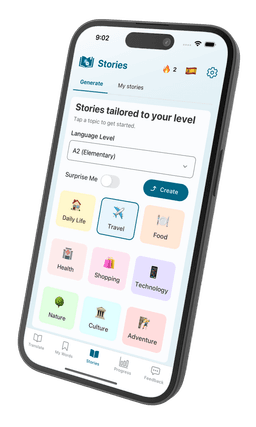
You're reading free stories on our website. Get the mobile app for audio narration, speaking practice, vocabulary saving, personalised stories, instant translations, and progress tracking.

Download on the App StoreGet it on Google Play
Audio
Translations
Progress

El misterio del baile antiguo

Elementary (A2)
5 min read

📖 You are reading the free text version. Get our mobile app for 🎧 audio narration, 💬 speaking practice, 🔄 instant translations, and 💾 vocabulary saving to enhance your learning experience.

En un pequeño pueblo, Marta decidió aprender un baile tradicional que casi nadie conoce. Durante la fiesta del pueblo, el baile siempre fue parte importante, pero ahora pocos jóvenes lo recuerdan.

Marta fue a la casa de su abuela para pedir ayuda. Su abuela le mostró cómo bailar y le enseñó la música antigua. Marta practicó mucho todos los días en la plaza del pueblo.

Un día, al empezar la fiesta, Marta invitó a todos a verla bailar. Al principio, la gente miraba con sorpresa porque el baile era muy diferente. Pero poco a poco, más personas se animaron a unirse y bailar con ella.

Al final, el baile tradicional volvió a ser parte importante de la fiesta. Marta estaba feliz porque ayudó a su pueblo a recordar una parte especial de su cultura. Ahora, cada año, el baile antiguo es una celebración que atrae a muchos visitantes.

Practise this Spanish story

Vocabulary in context

Important words and phrases

  • baile tradicional

    noun phrase

    traditional dance

    En mi país hay un baile tradicional muy conocido.

    In my country, there is a very well-known traditional dance.

  • fiesta del pueblo

    noun phrase

    village festival

    La fiesta del pueblo empieza por la tarde.

    The village festival starts in the afternoon.

  • pedir ayuda

    verb phrase

    to ask for help

    Si no entiendo algo, puedo pedir ayuda.

    If I do not understand something, I can ask for help.

  • abuela

    noun

    grandmother

    Mi abuela vive cerca de mi casa.

    My grandmother lives near my house.

  • practicó mucho

    verb phrase

    practiced a lot

    Ella practicó mucho antes de la clase.

    She practiced a lot before the class.

  • plaza del pueblo

    noun phrase

    village square

    Nos vemos en la plaza del pueblo.

    Let's meet in the village square.

  • con sorpresa

    adverbial phrase

    with surprise

    La gente lo miró con sorpresa.

    People looked at it with surprise.

  • poco a poco

    adverbial phrase

    little by little

    Poco a poco, aprendí el paso nuevo.

    Little by little, I learned the new step.

  • unirse

    verb

    to join

    Mis amigos quieren unirse a la clase.

    My friends want to join the class.

  • volver a ser

    verb phrase

    to become again; to return to being

    Después de la lluvia, la calle volvió a ser tranquila.

    After the rain, the street became quiet again.

Check your understanding

Comprehension questions

Choose an answer, check it, then move to the next question.

Question 1 of 3

  1. Question 1: current not answered
  2. Question 2: not answered
  3. Question 3: not answered
¿Para qué fue Marta a la casa de su abuela?Why did Marta go to her grandmother's house?

Notice the language

Language notes

grammar

volver a ser

Use volver a + infinitive to say that something becomes again or returns to a state. In the story, "El baile tradicional volvió a ser parte importante de la fiesta" means it became important again. You can reuse this pattern in many situations: "Después de la lluvia, la calle volvió a ser tranquila."

  • El baile tradicional volvió a ser parte importante de la fiesta.

    The traditional dance became an important part of the festival again.

Keep reading

More Elementary (A2) Stories
SpanishElementary (A2)