Back to Elementary (A2) stories

Unlock the Complete Learning Experience

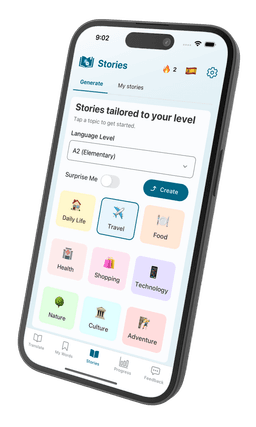
You're reading free stories on our website. Get the mobile app for audio narration, speaking practice, vocabulary saving, personalised stories, instant translations, and progress tracking.

Download on the App StoreGet it on Google Play
Audio
Translations
Progress

La isla misteriosa

Elementary (A2)
5 min read

📖 You are reading the free text version. Get our mobile app for 🎧 audio narration, 💬 speaking practice, 🔄 instant translations, and 💾 vocabulary saving to enhance your learning experience.

Un día, Ana y su hermano Luis decidieron explorar una isla cerca de su casa.

Tomaron un pequeño bote y navegaron durante una hora. Cuando llegaron, la isla parecía tranquila, pero había muchos caminos y árboles grandes.

Empezaron a caminar para descubrir lugares nuevos. De repente, escucharon un ruido extraño. Ana estaba un poco asustada, pero Luis quería investigar.

Siguiendo el sonido, llegaron a una cueva. Dentro, encontraron pinturas antiguas en las paredes que mostraban historias de personas que vivieron allí hace mucho tiempo.

De repente, la luz del sol comenzó a bajar y la cueva se oscureció. Decidieron regresar, pero no sabían el camino de vuelta. Ana usó su teléfono para buscar señales y, finalmente, encontraron el sendero hacia la playa.

Cuando llegaron al bote, estaban cansados pero felices por la aventura. Ana y Luis aprendieron que explorar puede ser emocionante pero también hay que estar preparados.

Ahora quieren regresar a la isla con más amigos y explorar otros lugares secretos.

Practise this Spanish story

Vocabulary in context

Important words and phrases

  • explorar

    verb

    to explore

    Vamos a explorar la isla.

    We are going to explore the island.

  • isla

    noun

    island

    La isla está cerca de nuestra casa.

    The island is near our house.

  • bote

    noun

    boat

    Tomaron un pequeño bote.

    They took a small boat.

  • descubrir

    verb

    to discover

    Quieren descubrir lugares nuevos.

    They want to discover new places.

  • ruido extraño

    phrase

    strange noise

    Escucharon un ruido extraño.

    They heard a strange noise.

  • investigar

    verb

    to investigate

    Luis quería investigar.

    Luis wanted to investigate.

  • cueva

    noun

    cave

    Entraron en la cueva.

    They went into the cave.

  • pinturas antiguas

    phrase

    ancient paintings

    Las pinturas antiguas estaban en las paredes.

    The ancient paintings were on the walls.

  • camino de vuelta

    phrase

    way back

    No sabían el camino de vuelta.

    They did not know the way back.

  • playa

    noun

    beach

    Llegaron a la playa.

    They arrived at the beach.

  • regresar

    verb

    to return

    Decidieron regresar.

    They decided to return.

Check your understanding

Comprehension questions

Choose an answer, check it, then move to the next question.

Question 1 of 3

  1. Question 1: current not answered
  2. Question 2: not answered
  3. Question 3: not answered
¿A dónde decidieron ir Ana y Luis?Where did Ana and Luis decide to go?

Notice the language

Language notes

grammar

empezar a + infinitivo

Use "empezar a" + infinitive to say that an action begins. It is very common in Spanish for starting an activity. You can reuse it with many verbs: "Empezaron a caminar para descubrir lugares nuevos." This means they began walking to discover new places.

  • Empezaron a caminar para descubrir lugares nuevos.

    They started walking to discover new places.

Keep reading

More Elementary (A2) Stories
SpanishElementary (A2)