
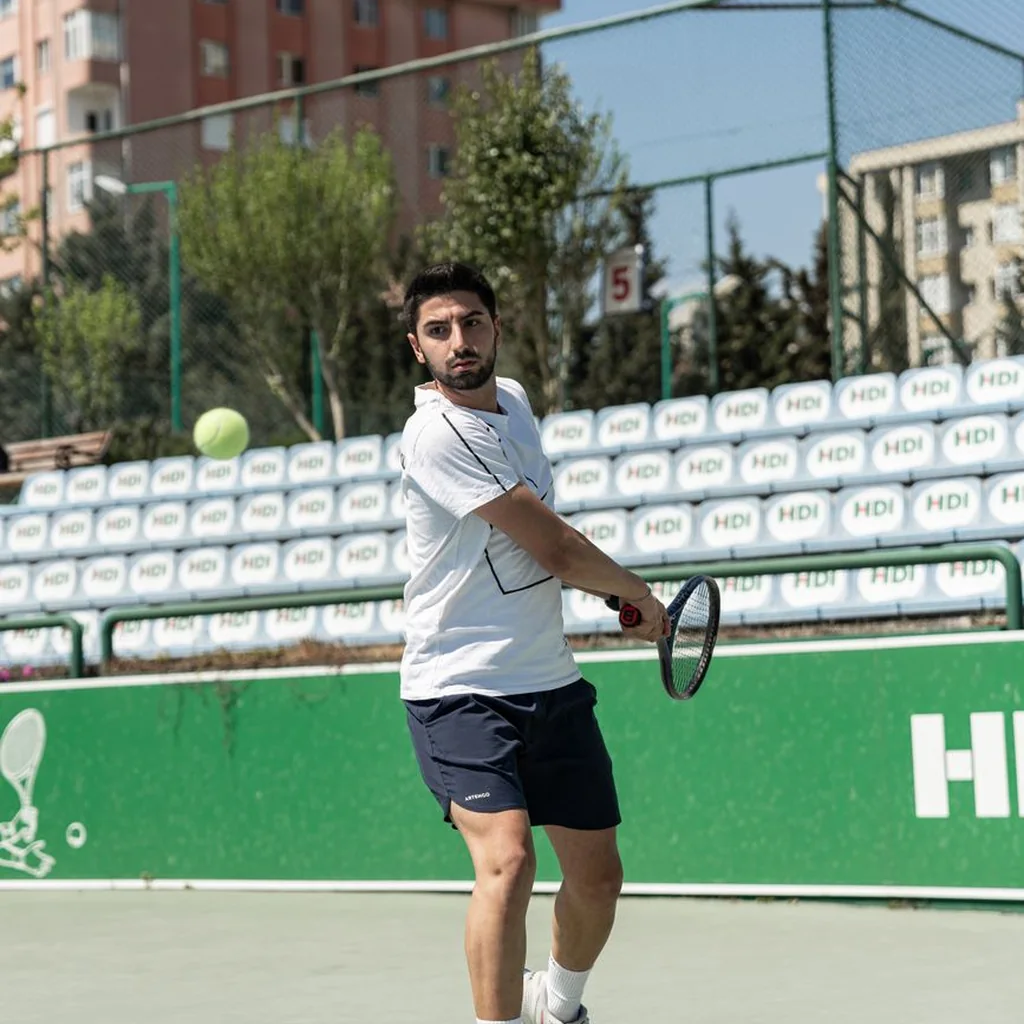
Der Donnerstag auf dem Platz
Thursday on the Court
Lukas and Wolfgang play their weekly tennis match before work on a damp court, and Lukas believes he usually beats Wolfgang narrowly.
Three short parts. Read each part in German first; tap “Show English” under a paragraph when you need the translation.


Part 1
Lukas zog den Reißverschluss seiner Tennistasche zu und sah auf die Uhr. Es war kurz vor acht, der Platz noch feucht vom nächtlichen Regen, und Wolfgang stand bereits am Netz und prüfte mit der Schuhspitze eine Pfütze.
Show EnglishHide English
Lukas zipped up his tennis bag and looked at his watch. It was just before eight, the court was still damp from the overnight rain, and Wolfgang was already standing at the net, testing a puddle with the tip of his shoe.
„Die Linie gilt trotzdem“, sagte Lukas.
Show EnglishHide English
“The line still counts,” Lukas said.
„Schade. Ich hatte gehofft, wir könnten sie heute für ungültig erklären.“
Show EnglishHide English
“Too bad. I was hoping we could declare it void today.”
Seit Jahren spielten sie jeden Donnerstag vor der Arbeit. Meistens gewann Lukas knapp, was Wolfgang mit einer Gelassenheit hinnahm, die Lukas immer für Sportsgeist gehalten hatte.
Show EnglishHide English
For years, they had played every Thursday before work. Lukas usually won by a narrow margin, which Wolfgang accepted with a composure Lukas had always taken for good sportsmanship.
An diesem Morgen lief es zunächst anders. Wolfgang traf die Bälle früh, schickte Lukas erst nach links, dann nach rechts und nahm ihm mit einem lässigen Stoppball den ersten Satz ab. Lukas blieb keuchend am Netz stehen.
Show EnglishHide English
That morning, things went differently at first. Wolfgang met the balls early, sending Lukas first to the left, then to the right, and took the first set from him with a casual drop shot. Lukas stood at the net, panting.
„Hast du heimlich trainiert?“
Show EnglishHide English
“Have you been training in secret?”
„Nein. Ich bin nur früh ins Bett.“
Show EnglishHide English
“No. I just went to bed early.”
Im zweiten Satz führte Wolfgang fünf zu zwei. Dann schlug er zweimal ins Netz, setzte einen einfachen Ball ins Aus und entschuldigte sich nach einem Vorhandfehler mit einem Blick zum Himmel, als hätte die Sonne ihn geblendet. Dabei lag der Platz noch im Schatten.
Show EnglishHide English
In the second set, Wolfgang was leading five–two. Then he hit the net twice, sent an easy ball out, and after a forehand error apologized with a glance at the sky, as if the sun had blinded him. The court was still in the shade.
Lukas kannte diese Fehler. Sie kamen oft, wenn Wolfgang vorne lag, und immer sah er hinterher ein bisschen zu betont zerknirscht aus.
Show EnglishHide English
Lukas knew these mistakes. They often came when Wolfgang was ahead, and afterward he always looked a little too conspicuously crestfallen.
Beim Seitenwechsel trank Lukas einen Schluck Wasser. „Sag mal, seit wann verziehst du eigentlich bei fünf zu zwei deine Vorhand?“
Show EnglishHide English
During the changeover, Lukas took a sip of water. “Tell me, since when do you shank your forehand at five–two?”
Wolfgang drehte den Schläger in der Hand. „Heute wohl seit ungefähr fünf Minuten.“
Show EnglishHide English
Wolfgang turned the racket in his hand. “Today? For about five minutes, I guess.”
„Und die letzten Jahre?“
Show EnglishHide English
“And the last few years?”
Wolfgang sah ihn an, dann legte er den Schläger auf die Bank.
Show EnglishHide English
Wolfgang looked at him, then laid his racket on the bench.
Part 2Ehrlich auf dem Platz(Honest on the Court)
„Die letzten Jahre?“, wiederholte Wolfgang und strich sich mit dem Handtuch über den Nacken. „Du willst jetzt nicht ernsthaft jedes Spiel durchgehen.“
Show EnglishHide English
“The last few years?” Wolfgang repeated, wiping the back of his neck with his towel. “You’re not seriously going to go through every match now.”
„Nein. Mir reicht, wenn du mir dieses erklärst.“
Show EnglishHide English
“No. It’s enough if you explain this one.”
Wolfgang setzte sich. „Am Anfang hast du dich über jeden Fehler so geärgert, dass man kaum noch mit dir reden konnte. Einmal hast du deinen Schläger gegen den Zaun geworfen.“
Show EnglishHide English
Wolfgang sat down. “At first, you got so angry about every mistake that it was almost impossible to talk to you. Once, you threw your racket against the fence.”
„Das war einmal.“
Show EnglishHide English
“That was once.”
„Ja. Danach habe ich ein bisschen nachgegeben, wenn du kurz davor warst, wieder dichtzumachen. Und irgendwann habe ich mir das wohl angewöhnt.“
Show EnglishHide English
“Yes. After that, I started giving you a little leeway when you were on the verge of shutting down again. And at some point, I suppose I got into the habit.”
Lukas stellte die Wasserflasche ab. „Ein bisschen? Ich habe zu Hause erzählt, ich hätte dich fast jede Woche geschlagen.“
Show EnglishHide English
Lukas set down his water bottle. “A little? I told people at home I’d beaten you almost every week.”
„Hast du ja auch.“
Show EnglishHide English
“You did.”
„Wolfgang.“
Show EnglishHide English
“Wolfgang.”
„Gut. Nicht immer unter ganz gleichen Bedingungen.“ Wolfgang rückte zur Seite, aber Lukas blieb stehen. „Ich wollte donnerstags Tennis spielen und mir nicht jedes Mal anhören, was du alles falsch machst.“
Show EnglishHide English
“All right. Not always under quite the same conditions.” Wolfgang moved aside, but Lukas stayed where he was. “I wanted to play tennis on Thursdays and not have to listen to you going on about everything you were doing wrong every time.”
Lukas nahm seinen Schläger fester in die Hand. „Dann spiel jetzt ordentlich. Von mir aus gewinnst du den nächsten Satz sechs zu null.“
Show EnglishHide English
Lukas gripped his racket more tightly. “Then play properly now. You can win the next set six–love, for all I care.”
„Wir stehen erst bei fünf zu drei. Aber ich weiß, was du meinst.“
Show EnglishHide English
“We’re only at five–three. But I know what you mean.”
Sie gingen zurück auf den Platz. Wolfgang schlug auf, und Lukas brachte den ersten Ball mit Mühe zurück. Den nächsten setzte er ins Netz. „War der jetzt ehrlich?“, fragte er.
Show EnglishHide English
They went back onto the court. Wolfgang served, and Lukas managed to return the first ball. He sent the next one into the net. “Was that one honest?” he asked.
„Meiner schon.“
Show EnglishHide English
“Mine was.”
Lukas verschlug auch den folgenden Ball. Als Wolfgang nach einem Aufschlagfehler zum zweiten Aufschlag ansetzte, hob Lukas die Hand. „Warte. Woher soll ich denn jetzt wissen, ob du es wirklich ernst meinst?“
Show EnglishHide English
Lukas mishit the next ball too. When Wolfgang went to take his second serve after a fault, Lukas raised his hand. “Wait. How am I supposed to know now whether you’re really trying?”
Part 3Den Schläger lässt du am Stück(Keep Your Racket in One Piece)
Wolfgang ließ den Ball in der Hand liegen. „Gar nicht. Ich könnte dir natürlich versprechen, jeden Schlag mit letzter Kraft zu spielen, aber dann müsste ich nachher vermutlich direkt zum Arzt.“
Show EnglishHide English
Wolfgang let the ball rest in his hand. “You can’t. I could, of course, promise to play every shot with all my strength, but then I’d probably have to go straight to the doctor afterward.”
Lukas verzog den Mund. „Du weißt genau, was ich meine.“
Show EnglishHide English
Lukas pulled a face. “You know exactly what I mean.”
„Ja. Ich kann dir nur sagen, dass ich gewinnen will. Und du darfst meinetwegen jeden Ball anzweifeln, solange du ihn vorher zurückspielst.“
Show EnglishHide English
“Yes. All I can tell you is that I want to win. And you can doubt every ball if you like, as long as you return it first.”
Er schlug erneut auf. Diesmal erwischte Lukas den Ball sauber und setzte ihn dicht an die Seitenlinie. Wolfgang rannte los, kam mit dem Schläger noch heran und lenkte den Ball über das Netz, genau vor Lukas’ Füße.
Show EnglishHide English
He served again. This time Lukas hit the ball cleanly and placed it close to the sideline. Wolfgang ran for it, just reached it with his racket, and redirected the ball over the net, right in front of Lukas’s feet.
„Den hättest du auch ins Aus spielen können“, sagte Lukas.
Show EnglishHide English
“You could have hit that one out too,” Lukas said.
„Stimmt. Hätte dir das besser gefallen?“
Show EnglishHide English
“True. Would you have liked that better?”
Zwei Ballwechsel später war der Satz zu Ende. Wolfgang gewann sechs zu drei und setzte sich auf die Bank, während Lukas die Bälle einsammelte. Einen davon warf Lukas ihm zu; Wolfgang fing ihn erst beim zweiten Versuch.
Show EnglishHide English
Two rallies later, the set was over. Wolfgang won six–three and sat down on the bench while Lukas collected the balls. Lukas tossed one to him; Wolfgang caught it only on his second attempt.
„Wenigstens dabei bist du nicht besser geworden.“
Show EnglishHide English
“At least you haven’t got any better at that.”
„Ich lasse dich nur glauben, dass ich schlecht fange.“
Show EnglishHide English
“I’m just letting you think I’m bad at catching.”
Lukas schnaubte, dann setzte er sich neben ihn. Eine Weile hörten sie dem Kratzen der Besen auf dem Nachbarplatz zu.
Show EnglishHide English
Lukas snorted, then sat down beside him. For a while, they listened to the scrape of the brooms on the neighboring court.
„Nächsten Donnerstag wieder?“, fragte Wolfgang schließlich.
Show EnglishHide English
“Same time next Thursday?” Wolfgang finally asked.
„Klar. Und wenn ich anfange zu jammern, sag es mir.“
Show EnglishHide English
“Sure. And if I start whining, tell me.”
„Mach ich. Aber den Schläger lässt du am Stück.“
Show EnglishHide English
“I will. But you’ll keep your racket in one piece.”
Lukas steckte den letzten Ball in seine Tasche. „Abgemacht. Den brauche ich noch, um dich zu schlagen.“
Show EnglishHide English
Lukas put the last ball in his bag. “Deal. I still need it to beat you.”
Practise this German story
Vocabulary in context
Important words and phrases
für ungültig erklären
verb phraseto declare invalid
Der Schiedsrichter kann den Punkt für ungültig erklären, wenn der Aufschlag im Aus war.
The referee can declare the point invalid if the serve was out.
Gelassenheit
nouncomposure; calmness
Er nahm die Niederlage mit erstaunlicher Gelassenheit hin.
He took the defeat with remarkable composure.
mit einem lässigen Stoppball
prepositional phrasewith a casual drop shot
Mit einem lässigen Stoppball brachte sie den langen Ballwechsel zu Ende.
She ended the long rally with a casual drop shot.
keuchend
adjectivepanting
Nach dem Sprint stand er keuchend an der Grundlinie.
After the sprint, he stood panting at the baseline.
zerknirscht
adjectivecontrite; sheepish
Nach dem Fehler wirkte sie noch immer zerknirscht.
After the mistake, she still looked contrite.
nachgeben
verbto give in; to back off
Diesmal wollte er nicht nachgeben, obwohl der Druck groß war.
This time he did not want to give in, even though the pressure was great.
dichtmachen
verbto shut down; to clam up
Wenn man ihn unter Druck setzt, macht er schnell dicht.
When you put him under pressure, he shuts down quickly.
unter ganz gleichen Bedingungen
prepositional phraseunder exactly the same conditions
Unter ganz gleichen Bedingungen wäre das Ergebnis schwerer zu erklären.
Under exactly the same conditions, the result would be harder to explain.
mit letzter Kraft
prepositional phrasewith one's last ounce of strength
Er brachte den Ball mit letzter Kraft noch über das Netz.
He still got the ball over the net with his last ounce of strength.
anzweifeln
verbto question; to doubt
Man darf seine Version anzweifeln, sollte aber genau hinhören.
You may question his version, but you should listen carefully.
am Stück
adverbial phrasein one piece; intact
Bitte lass den Schläger am Stück.
Please keep the racket in one piece.
Check your understanding
Comprehension questions
Choose an answer, check it, then move to the next question.
Question 1 of 3
- Question 1: current not answered
- Question 2: not answered
- Question 3: not answered
Notice the language
Language notes
kurz davor sein, etwas zu tun
This construction means someone is on the verge of doing something or almost does it. It is formed with kurz davor sein + zu-infinitive and is useful for imminent actions and near misses. You can reuse it in many contexts, for example: "Ich war kurz davor, aufzugeben."
Ich war kurz davor, aufzugeben.
I was on the verge of giving up.
More German stories to read next

Die zerbrochene Schüssel
The Broken Bowl
In Lukas’s family kitchen, Lukas, Laura, and Finn are sweeping up an heirloom bowl that broke while they were secretly baking a birthday cake.
Der Apfelstand
The Apple Stand
At a market stand, Klaus asks Johanna about the small, misshapen apples, which cost three euros a kilo.
Die Treppe zum Café
The Staircase to the Café
Mia follows her grandmother down four flights of stairs to a café, while Oma insists she does not need the handrail.

Im Waldweg
On the Forest Path
On a quiet forest path, Uwe hears something large moving in the hazel bushes ahead and wonders whether to keep going or turn back.