
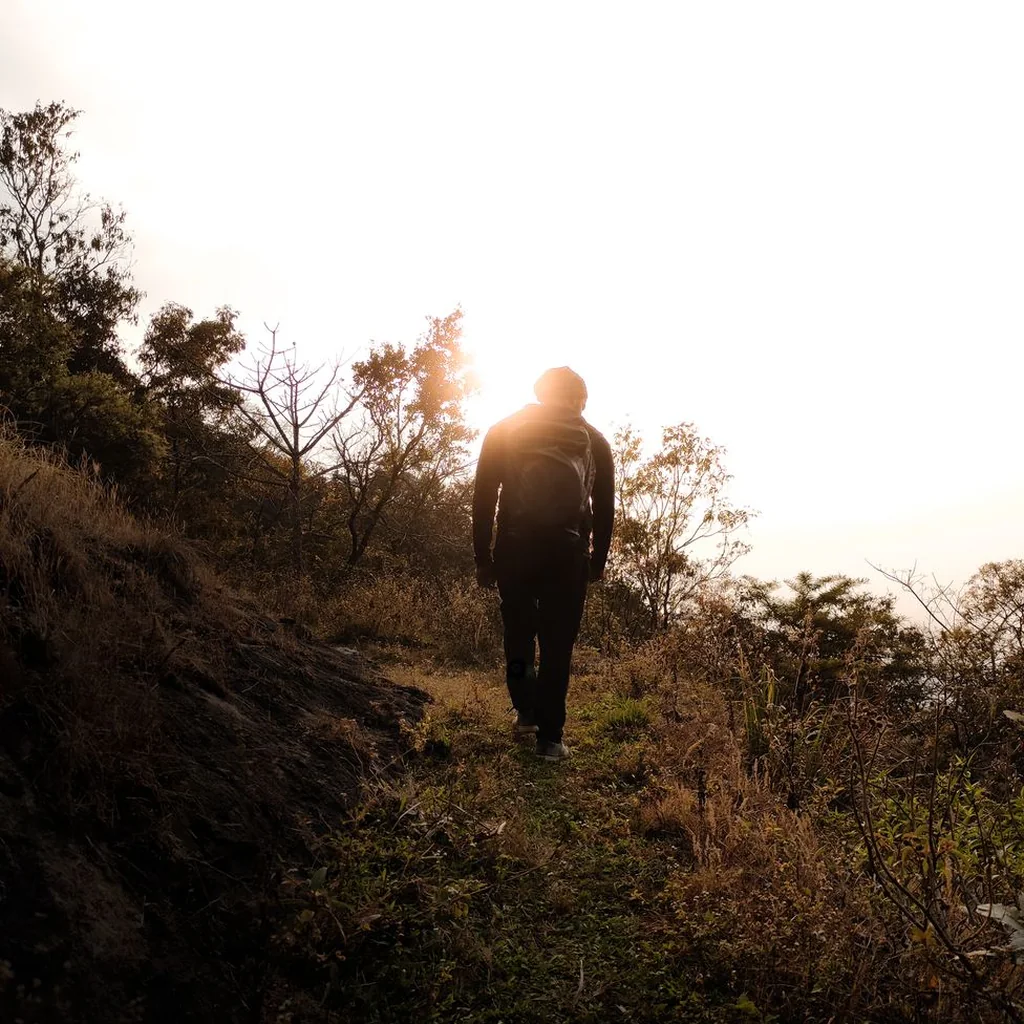
Photo: Gautham Krishnan on Pexels
Im Waldweg
On the Forest Path
On a quiet forest path, Uwe hears something large moving in the hazel bushes ahead and wonders whether to keep going or turn back.
Three short parts. Read each part in German first; tap “Show English” under a paragraph when you need the translation.


Part 1
Uwe hatte sich extra den Mittwoch freigenommen, weil er auf dem Waldweg sonst dauernd Leuten ausweichen musste. Heute war es so still, dass ihm schon das Knirschen seiner eigenen Schritte übertrieben laut vorkam. Er blieb stehen, trank einen Schluck Wasser und lauschte.
Show EnglishHide English
Uwe had specifically taken Wednesday off because otherwise he was constantly having to dodge people on the forest path. Today it was so quiet that the crunch of his own footsteps already seemed excessively loud. He stopped, took a sip of water, and listened.
Vorne, hinter einer Biegung, knackte es. Erst einmal, dann gleich mehrmals hintereinander; die Haselsträucher am Wegrand schwankten, als würde sich etwas ziemlich Großes hindurcharbeiten.
Show EnglishHide English
Up ahead, beyond a bend, something snapped. Once, then several times in quick succession; the hazel bushes beside the path swayed as if something pretty large were forcing its way through them.
Uwe schraubte die Flasche zu und verstaute sie im Rucksack. Ein Hund, dachte er, wobei ihm einfiel, dass Hunde selten so gründlich durchs Unterholz pflügten. Für ein Wildschwein war es vielleicht schon zu spät am Vormittag, aber was wusste er schon über Wildschweine?
Show EnglishHide English
Uwe screwed the cap back onto the bottle and stowed it in his backpack. A dog, he thought, then remembered that dogs rarely ploughed so thoroughly through the undergrowth. Perhaps it was already too late in the morning for a wild boar, but what did he know about wild boars?
Er machte zwei Schritte vorwärts. Das Rascheln hörte auf. Auch Uwe blieb stehen, was ihm sofort albern vorkam, und ließ die Hand am Reißverschluss seines Rucksacks liegen.
Show EnglishHide English
He took two steps forward. The rustling stopped. Uwe stopped too, which immediately seemed silly to him, and kept his hand on his backpack’s zipper.
Er zog sein Handy aus der Jackentasche, sah auf das dunkle Display und steckte es wieder ein. Wen hätte er auch anrufen sollen, und vor allem: weswegen?
Show EnglishHide English
He took his phone out of his jacket pocket, looked at its dark screen, and put it away again. Who would he have called, anyway, and more to the point, what for?
Der Weg zurück war derselbe, auf dem er gekommen war: breit, bequem und eine gute halbe Stunde lang leicht bergab. Gerade hatte er noch gefunden, dass er sich zur Abwechslung mal etwas zutrauen sollte. Nun stand er da und überlegte, wie er den Rückweg später beschreiben würde, ohne das Gestrüpp zu erwähnen.
Show EnglishHide English
The way back was the same one he had come along: wide, comfortable, and gently downhill for a good half hour. Just moments ago, he had thought that, for a change, he ought to be a little braver. Now he stood there wondering how he would describe the return journey later without mentioning the bushes.
Wieder krachte ein Ast, diesmal ganz in der Nähe. Uwe trat an den Rand des Weges und rief ein vorsichtiges „Hallo?“
Show EnglishHide English
A branch cracked again, this time very close by. Uwe stepped to the edge of the path and called out a cautious “Hello?”
Hinter den Blättern wurde es still. Dann sagte eine Stimme: „Ja, hallo. Einen Moment noch.“
Show EnglishHide English
It grew quiet behind the leaves. Then a voice said, “Yes, hello. Just a moment.”
Part 2Der Rucksack im Gebüsch(The Backpack in the Bushes)
Uwe wartete, die Hand noch am Reißverschluss seines Rucksacks. Zwischen den Zweigen erschien eine Frau mit zerzausten Haaren und einer roten Jacke. Sie zog rückwärts an etwas, das sich offenbar weigerte mitzukommen.
Show EnglishHide English
Uwe waited, his hand still on his backpack’s zipper. A woman with tousled hair and a red jacket appeared between the branches. She was pulling backward at something that apparently refused to come with her.
„Ich dachte schon, da wäre ein Wildschwein“, sagte Uwe.
Show EnglishHide English
“I was beginning to think there was a wild boar in there,” Uwe said.
„Das ist mein Rucksack.“ Sie gab ihm einen Ruck; ein Ast schnellte zurück, und die Frau verzog das Gesicht. „Wobei ich den Unterschied gerade auch nicht mehr so genau sehe.“
Show EnglishHide English
“It’s my backpack.” She gave it a tug; a branch sprang back, and the woman grimaced. “Though right now, I’m not so sure I can tell the difference either.”
Uwe ging näher heran. Der Rucksack hing mit einer Schlaufe an einem abgebrochenen Zweig fest. Daneben lag eine zusammengerollte Isomatte, die sich halb den Hang hinuntergeschoben hatte.
Show EnglishHide English
Uwe moved closer. The backpack was caught by a loop on a broken branch. Beside it lay a rolled-up sleeping mat that had slid halfway down the slope.
„Ich wollte nur kurz an den Rand“, sagte die Frau. „Dann ist mir das Ding vom Rücken gerutscht. Fragen Sie bitte nicht, wie.“
Show EnglishHide English
“I just wanted to step over to the edge for a moment,” the woman said. “Then the thing slipped off my back. Please don’t ask me how.”
„Hatte ich nicht vor.“ Uwe hielt den Zweig zur Seite, während sie die Schlaufe löste. Gemeinsam zogen sie den Rucksack auf den Weg; er war erstaunlich schwer.
Show EnglishHide English
“I wasn’t going to.” Uwe held the branch aside while she freed the loop. Together they pulled the backpack onto the path; it was surprisingly heavy.
„Laura“, sagte die Frau und streckte ihm die Hand hin. Uwe stellte sich ebenfalls vor. Dann sahen beide auf die Isomatte hinunter, die zwischen feuchten Blättern lag.
Show EnglishHide English
“Laura,” the woman said, holding out her hand. Uwe introduced himself too. Then they both looked down at the sleeping mat lying among the damp leaves.
„Die kriege ich schon“, sagte Laura. Sie setzte einen Fuß auf den Hang, rutschte ein Stück und griff hastig nach Uwes Arm. Ihre Schuhsohle war voller nasser Erde.
Show EnglishHide English
“I can get it,” Laura said. She put one foot on the slope, slipped a little, and hastily grabbed Uwe’s arm. The sole of her shoe was covered in wet earth.
Uwe hielt sie fest, bis sie wieder sicher stand. Laura wischte sich die Hand an der Hose ab und musterte den Hang, als hätte er sie persönlich hereingelegt.
Show EnglishHide English
Uwe held her until she was standing securely again. Laura wiped her hand on her trousers and studied the slope as if it had personally set her up.
Die Matte lag außer Reichweite, aber nicht weit genug entfernt, um sie einfach liegen zu lassen. Uwe nahm seinen Rucksack ab und sah sich nach einem Halt um.
Show EnglishHide English
The mat was out of reach, but not far enough away to simply leave behind. Uwe took off his backpack and looked around for something to hold on to.
Part 3Die Matte am Hang(The Mat on the Slope)
Uwe entdeckte am Wegrand einen jungen Baum, dessen Stamm gerade dick genug war, um sich daran festzuhalten. Er kniete sich hin und streckte den anderen Arm nach der Matte aus. Seine Fingerspitzen berührten den Rand, schoben ihn aber nur ein Stück weiter.
Show EnglishHide English
Uwe spotted a young tree beside the path, its trunk just thick enough to hold on to. He knelt down and stretched his other arm toward the mat. His fingertips touched the edge but only pushed it a little farther away.
„Das läuft ja hervorragend“, murmelte er.
Show EnglishHide English
“This is going wonderfully,” he muttered.
Laura legte sich flach neben ihn und spähte den Hang hinunter. „Wenn Sie mich an den Knöcheln festhalten, komme ich vielleicht dran.“
Show EnglishHide English
Laura lay flat beside him and peered down the slope. “If you hold me by the ankles, I might be able to reach it.”
„Und wer hält dann mich fest?“
Show EnglishHide English
“And who’s going to hold on to me, then?”
Sie sah ihn an. Dann mussten beide lachen, leise zuerst, bis Laura sich auf den Rücken drehte und mit der Hand gegen ihre Stirn schlug.
Show EnglishHide English
She looked at him. Then they both laughed, quietly at first, until Laura rolled onto her back and slapped her hand against her forehead.
„Ich habe Wanderstöcke im Rucksack.“
Show EnglishHide English
“I have trekking poles in my backpack.”
Es dauerte eine Weile, bis sie die beiden Stöcke zwischen Regenjacke und Brotdose gefunden hatte. Mit einem davon zog Uwe die Matte vorsichtig zu sich heran. Diesmal erwischte er den Riemen, bevor die Matte wieder wegrutschen konnte.
Show EnglishHide English
It took a while for her to find the two poles between her rain jacket and lunch box. Using one of them, Uwe carefully pulled the mat toward himself. This time he caught the strap before the mat could slide away again.
Laura klopfte die Erde ab und befestigte die Matte am Rucksack. Sie prüfte noch einmal, ob der Verschluss hielt, und zog den Riemen ein Stück fester. „Ich hatte mir vorgenommen, heute mal ganz allein zurechtzukommen.“
Show EnglishHide English
Laura brushed off the dirt and fastened the mat to her backpack. She checked once more that the clasp was secure and tightened the strap a little. “I’d planned to manage completely on my own today.”
„Immerhin waren Sie allein hier unten.“ Uwe reichte ihr den zweiten Stock. „Das muss man auch erst mal schaffen.“
Show EnglishHide English
“At least you were on your own down there.” Uwe handed her the second pole. “That’s an accomplishment in itself.”
Sie schulterte den Rucksack, zog beide Träger fest und bedankte sich. An der nächsten Weggabelung wollte sie nach links, Uwe nach rechts. Bis dahin gingen sie zusammen und unterhielten sich; das Knirschen ihrer Schritte störte ihn nicht mehr.
Show EnglishHide English
She put on her backpack, tightened both shoulder straps, and thanked him. At the next fork, she was going to turn left and Uwe right. Until then they walked together and chatted; the crunch of their footsteps no longer bothered him.
An der Gabelung winkte Laura ihm zu. Uwe ging weiter bergauf und ließ sich Zeit.
Show EnglishHide English
At the fork, Laura waved to him. Uwe continued uphill, taking his time.
Practise this German story
Vocabulary in context
Important words and phrases
ausweichen
verbto avoid; step aside from
Radfahrende müssen Fußgängern oft ausweichen.
Cyclists often have to avoid pedestrians.
durchs Unterholz pflügen
verb phraseto plow through the undergrowth
Das Wildschwein pflügte durchs Unterholz, ohne stehen zu bleiben.
The wild boar plowed through the undergrowth without stopping.
zur Abwechslung
adverbial phrasefor a change
Zur Abwechslung nehmen wir heute den langen Weg.
For a change, we'll take the long route today.
sich etwas zutrauen
verb phraseto trust oneself to do something; to dare to do something
Du solltest dir mehr zutrauen.
You should trust yourself more.
das Knirschen
nounthe crunching; crunch
Das Knirschen des Schnees war im ganzen Tal zu hören.
The crunching of the snow could be heard all over the valley.
außer Reichweite
adverbial phraseout of reach
Die Karte lag außer Reichweite auf dem Schreibtisch.
The map lay out of reach on the desk.
festhalten
verbto hold on
Halt dich beim Abstieg gut fest.
Hold on well while going down.
zurechtkommen
verbto manage; cope
Mit der Situation komme ich inzwischen gut zurecht.
I can manage the situation quite well now.
Weggabelung
nounfork in the trail
An der Weggabelung biegen wir links ab.
At the fork in the trail, we turn left.
sich Zeit lassen
verb phraseto take one's time
Lass dir Zeit, wir haben keinen Termin.
Take your time, we don't have an appointment.
Check your understanding
Comprehension questions
Choose an answer, check it, then move to the next question.
Question 1 of 3
- Question 1: current not answered
- Question 2: not answered
- Question 3: not answered
Notice the language
Language notes
ohne ... zu + Infinitiv
An ohne ... zu clause says that an action happens without another action taking place. Its understood subject is often the subject of the main clause, but context can supply another person. In the story, Uwe wonders how he would describe his return journey „ohne das Gestrüpp zu erwähnen“—without mentioning the bushes. In „Er ging weiter, ohne sich umzudrehen“, he continued walking without turning around.
Er ging weiter, ohne sich umzudrehen.
He kept walking without turning around.
More German stories to read next
Der schief hängende Mond
The Crooked Moon
Thomas stands beside Mia’s bed, trying to keep her asleep by humming while she reaches for his sleeve whenever he stops.
Der Donnerstag auf dem Platz
Thursday on the Court
Lukas and Wolfgang play their weekly tennis match before work on a damp court, and Lukas believes he usually beats Wolfgang narrowly.
Die zerbrochene Schüssel
The Broken Bowl
In Lukas’s family kitchen, Lukas, Laura, and Finn are sweeping up an heirloom bowl that broke while they were secretly baking a birthday cake.
Der Apfelstand
The Apple Stand
At a market stand, Klaus asks Johanna about the small, misshapen apples, which cost three euros a kilo.