
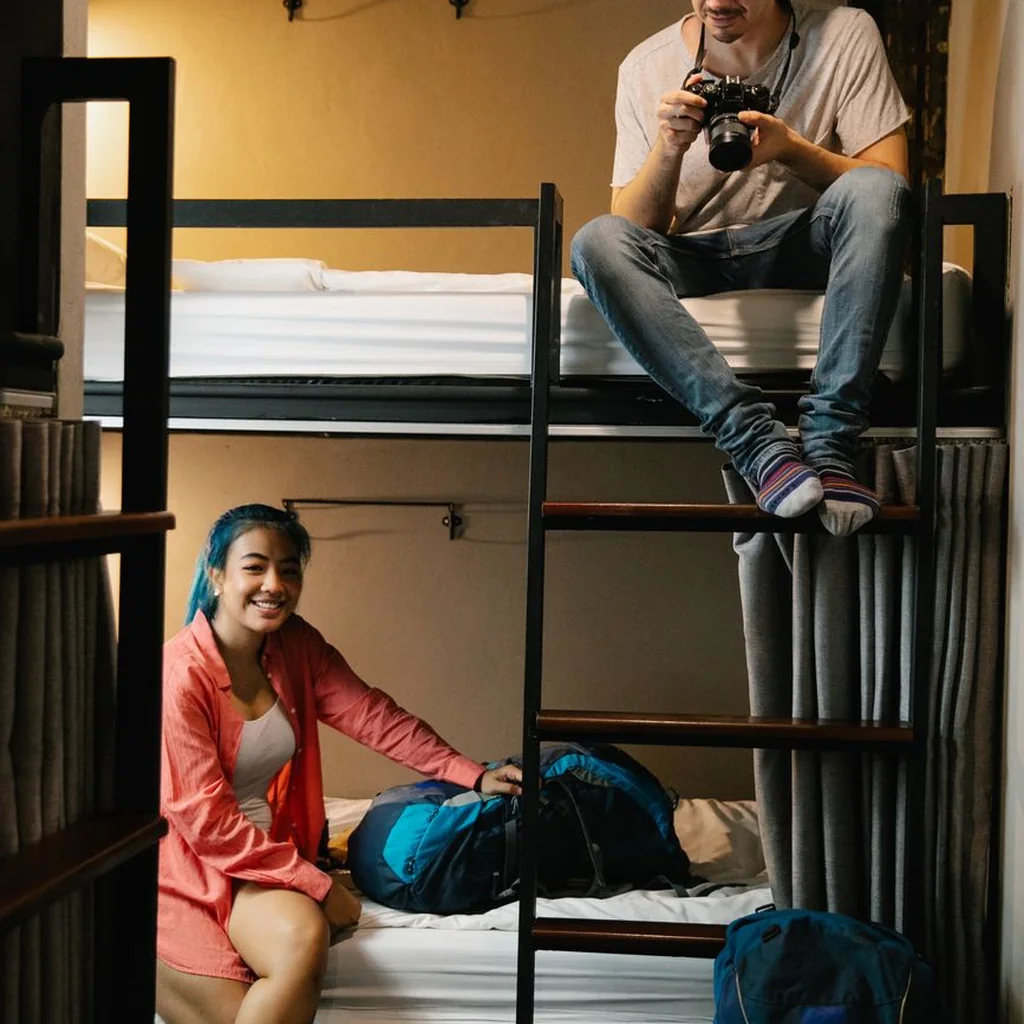
Photo: George Pak on Pexels
Das falsche Bett im Hostel
The Wrong Bed at the Hostel
Leyla returns to her hostel room to find that someone has slept in her bed and left a blue T-shirt there.
Three short parts. Read each part in German first; tap “Show English” under a paragraph when you need the translation.


Part 1
Als Leyla am Abend in ihr Hostelzimmer zurückkommt, möchte sie nur noch schlafen. Sie hat den ganzen Tag die Stadt zu Fuß erkundet und ihre Beine sind müde.
Show EnglishHide English
When Leyla returns to her hostel room in the evening, all she wants to do is sleep. She has explored the city on foot all day, and her legs are tired.
Doch als sie zu ihrem Bett am Fenster geht, bleibt sie stehen. Die Decke liegt auf dem Boden, das Kissen ist zerdrückt und auf dem Bettlaken liegen ein paar dunkle Haare.
Show EnglishHide English
But when she walks over to her bed by the window, she stops. The blanket is on the floor, the pillow is squashed, and there are a few dark hairs on the bedsheet.
Leyla sieht sich um. Am Morgen hat sie ihr Bett ordentlich gemacht. Außerdem liegt jetzt ein blaues T-Shirt darauf, das ihr nicht gehört.
Show EnglishHide English
Leyla looks around. In the morning, she made her bed neatly. Also, there is now a blue T-shirt on it that does not belong to her.
Im unteren Bett gegenüber sitzt eine Frau und liest. Leyla zeigt auf das T-Shirt. „Hast du gesehen, wer in meinem Bett war?“
Show EnglishHide English
A woman is sitting in the lower bunk opposite, reading. Leyla points to the T-shirt. “Did you see who was in my bed?”
Die Frau legt ihr Buch weg. „Ja, vorhin hat dort jemand geschlafen. Ich dachte, das Bett wäre frei.“
Show EnglishHide English
The woman puts her book down. “Yes, someone was sleeping there earlier. I thought the bed was free.”
„Aber mein Rucksack steht doch direkt daneben“, sagt Leyla.
Show EnglishHide English
“But my backpack is right next to it,” Leyla says.
„Ich weiß. Vielleicht hat die Person ihn nicht gesehen.“ Die Frau schaut auf die Uhr. „Sie ist gerade ins Bad gegangen.“
Show EnglishHide English
“I know. Maybe the person didn’t see it.” The woman looks at the clock. “She just went to the bathroom.”
Leyla hebt das T-Shirt mit zwei Fingern hoch. Sie möchte freundlich bleiben, aber sie ärgert sich. Muss sie jetzt in einem Bett schlafen, das jemand anderes benutzt hat?
Show EnglishHide English
Leyla lifts the T-shirt with two fingers. She wants to stay friendly, but she is annoyed. Does she have to sleep in a bed that someone else has used?
Da öffnet sich die Tür und eine Frau mit nassen Haaren kommt herein. Leyla hält das T-Shirt hoch und spricht sie an.
Show EnglishHide English
Just then, the door opens and a woman with wet hair comes in. Leyla holds up the T-shirt and speaks to her.
Part 2Das falsche Bett(The Wrong Bed)
„Entschuldigung, gehört dir das?“, fragt Leyla und zeigt der Frau das blaue T-Shirt.
Show EnglishHide English
“Excuse me, is this yours?” Leyla asks, showing the woman the blue T-shirt.
„Oh ja, danke.“ Die Frau nimmt es und lächelt kurz. Dann sieht sie Leylas Gesicht. „Ist etwas nicht in Ordnung?“
Show EnglishHide English
“Oh yes, thanks.” The woman takes it and smiles briefly. Then she sees Leyla’s face. “Is something wrong?”
„Du hast in meinem Bett geschlafen.“ Leyla zeigt auf das zerdrückte Kissen. „Ich bin schon seit gestern hier.“
Show EnglishHide English
“You slept in my bed.” Leyla points to the squashed pillow. “I’ve been here since yesterday.”
Die Frau schaut erst zum Bett, dann zu dem Rucksack daneben. „Das tut mir leid. Ich heiße Andrea. An der Rezeption hat man mir gesagt, ich soll das Bett am Fenster nehmen.“
Show EnglishHide English
The woman looks first at the bed, then at the backpack beside it. “I’m sorry. My name is Andrea. At reception, they told me to take the bed by the window.”
„Das ist aber mein Bett“, sagt Leyla. Sie hört selbst, wie scharf ihre Stimme klingt. Andrea wird rot und streicht das Laken glatt.
Show EnglishHide English
“But that’s my bed,” Leyla says. She can hear how sharp her voice sounds. Andrea turns red and smooths the sheet.
„Bitte mach das nicht“, sagt Leyla schnell. „Es ist ja trotzdem benutzt.“
Show EnglishHide English
“Please don’t do that,” Leyla says quickly. “It’s still been used.”
Für einen Moment sagt niemand etwas. Dann nickt Andrea. „Du hast recht. Kommst du mit zur Rezeption? Wir können nach frischer Bettwäsche fragen.“
Show EnglishHide English
For a moment, nobody says anything. Then Andrea nods. “You’re right. Will you come with me to reception? We can ask for fresh sheets.”
Unten erklärt Andrea, was passiert ist. Der Mann an der Rezeption prüft die Bettenliste und schüttelt den Kopf. „Das war mein Fehler. Andrea, dein Bett ist das neben der Tür.“
Show EnglishHide English
Downstairs, Andrea explains what happened. The man at reception checks the bed list and shakes his head. “That was my mistake. Andrea, your bed is the one by the door.”
Er öffnet den Schrank hinter sich. „Ich hole euch frische Bettwäsche.“ Doch dann sucht er weiter und schaut unter den Tresen.
Show EnglishHide English
He opens the cupboard behind him. “I’ll get you fresh sheets.” But then he keeps looking and checks under the counter.
Part 3Ein frisches Bett in der Stadt(A Fresh Bed in the City)
„Hier ist nur noch ein frischer Kissenbezug“, sagt der Mann. „Die anderen Sachen sind im Wäscheschrank neben dem Bad. Ich hole sie gleich.“
Show EnglishHide English
“There’s only one clean pillowcase left here,” the man says. “The other things are in the linen cupboard next to the bathroom. I’ll get them right away.”
Er geht den Flur entlang und kommt mit einem sauberen Laken und einem Deckenbezug zurück. Er gibt alles Leyla. „Es tut mir leid, dass ihr wegen meines Fehlers herunterkommen musstet.“
Show EnglishHide English
He walks down the hall and comes back with a clean sheet and a duvet cover. He gives them all to Leyla. “I’m sorry you had to come downstairs because of my mistake.”
„Danke“, sagt Leyla. Auf dem Weg nach oben trägt Andrea das Laken. Vor der Zimmertür bleibt sie stehen.
Show EnglishHide English
“Thanks,” Leyla says. On the way upstairs, Andrea carries the sheet. She stops in front of the room door.
„Ich hätte den Rucksack sehen müssen“, sagt sie. „Und es tut mir leid, dass ich dein Bett benutzt habe.“
Show EnglishHide English
“I should have seen the backpack,” she says. “And I’m sorry I used your bed.”
Leyla atmet aus. „Ich war ziemlich unfreundlich. Ich war müde und habe mich einfach geärgert.“
Show EnglishHide English
Leyla breathes out. “I was pretty unfriendly. I was tired and just got annoyed.”
„Das verstehe ich“, sagt Andrea. „Ich hätte mich auch geärgert.“
Show EnglishHide English
“I understand,” Andrea says. “I would have been annoyed too.”
Zusammen beziehen sie das Bett frisch. Die Frau im unteren Bett schaut von ihrem Buch auf und zeigt Andrea, wo ihr eigenes Bett ist. Dort legt Andrea ihre Tasche ab.
Show EnglishHide English
Together, they put fresh sheets on the bed. The woman in the lower bunk looks up from her book and shows Andrea where her own bed is. Andrea puts her bag there.
Später liegen alle drei im Dunkeln. Andrea flüstert: „Gute Nacht, Leyla.“
Show EnglishHide English
Later, all three are lying in the dark. Andrea whispers, “Good night, Leyla.”
„Gute Nacht“, antwortet Leyla. Das saubere Kissen fühlt sich kühl an. Sie schließt die Augen und freut sich darauf, morgen die Stadt weiter zu erkunden.
Show EnglishHide English
“Good night,” Leyla replies. The clean pillow feels cool. She closes her eyes and looks forward to exploring more of the city tomorrow.
Practise this German story
Vocabulary in context
Important words and phrases
zu Fuß erkundet
verb phraseexplored on foot
Ich habe die Altstadt zu Fuß erkundet.
I explored the old town on foot.
müde
adjectivetired
Nach dem langen Tag bin ich müde.
After the long day, I am tired.
zerdrückt
adjectivecrushed; squashed
Das Kissen ist ganz zerdrückt.
The pillow is completely squashed.
gehört dir das?
phraseDoes this belong to you?
Entschuldigung, gehört dir das?
Excuse me, does this belong to you?
tut mir leid
phraseI'm sorry
Es tut mir leid, dass ich dein Bett benutzt habe.
I'm sorry that I used your bed.
frische Bettwäsche
noun phrasefresh bedding
An der Rezeption haben wir frische Bettwäsche bekommen.
At reception, we got fresh bedding.
Bettenliste
nounbed allocation list
Der Mann an der Rezeption prüft die Bettenliste.
The man at reception checks the bed allocation list.
Wäscheschrank
nounlinen cupboard
Die Bettwäsche liegt im Wäscheschrank.
The bedding is in the linen cupboard.
schüttelt den Kopf
verb phraseshakes his head
Er schüttelt den Kopf und sagt, dass es ein Fehler war.
He shakes his head and says that it was a mistake.
sich ärgern
verb phraseto get annoyed
Ich ärgere mich, wenn jemand mein Bett benutzt.
I get annoyed when someone uses my bed.
Check your understanding
Comprehension questions
Choose an answer, check it, then move to the next question.
Question 1 of 3
- Question 1: current not answered
- Question 2: not answered
- Question 3: not answered
Notice the language
Language notes
Es tut mir leid, dass ...
Use this pattern to apologize and then explain the reason with a dass-clause. Example: 'Es tut mir leid, dass ich dein Bett benutzt habe.' It is a polite, reusable way to take responsibility for a problem.
Es tut mir leid, dass ich dein Bett benutzt habe.
I'm sorry that I used your bed.
More German stories to read next

Peters Rede für Gisela
Peter’s Speech for Gisela
At the sports club hall, Peter is about to give a speech celebrating Gisela, who is leaving her job as a coach after twenty years.
Das Licht bleibt noch am Tisch
The Light Lingers at the Table
At a café poetry reading, Michael is surprised when the poet asks him what a line of her poem means.

Der Zettel in der Manteltasche
The Note in the Coat Pocket
Johanna is about to donate her old winter coat when she finds an old note from Thomas in its pocket.

Die Blumen zum Geburtstag
The Birthday Flowers
At closing time, Jonas enters a flower shop to buy flowers for his neighbor after forgetting her birthday that morning.