
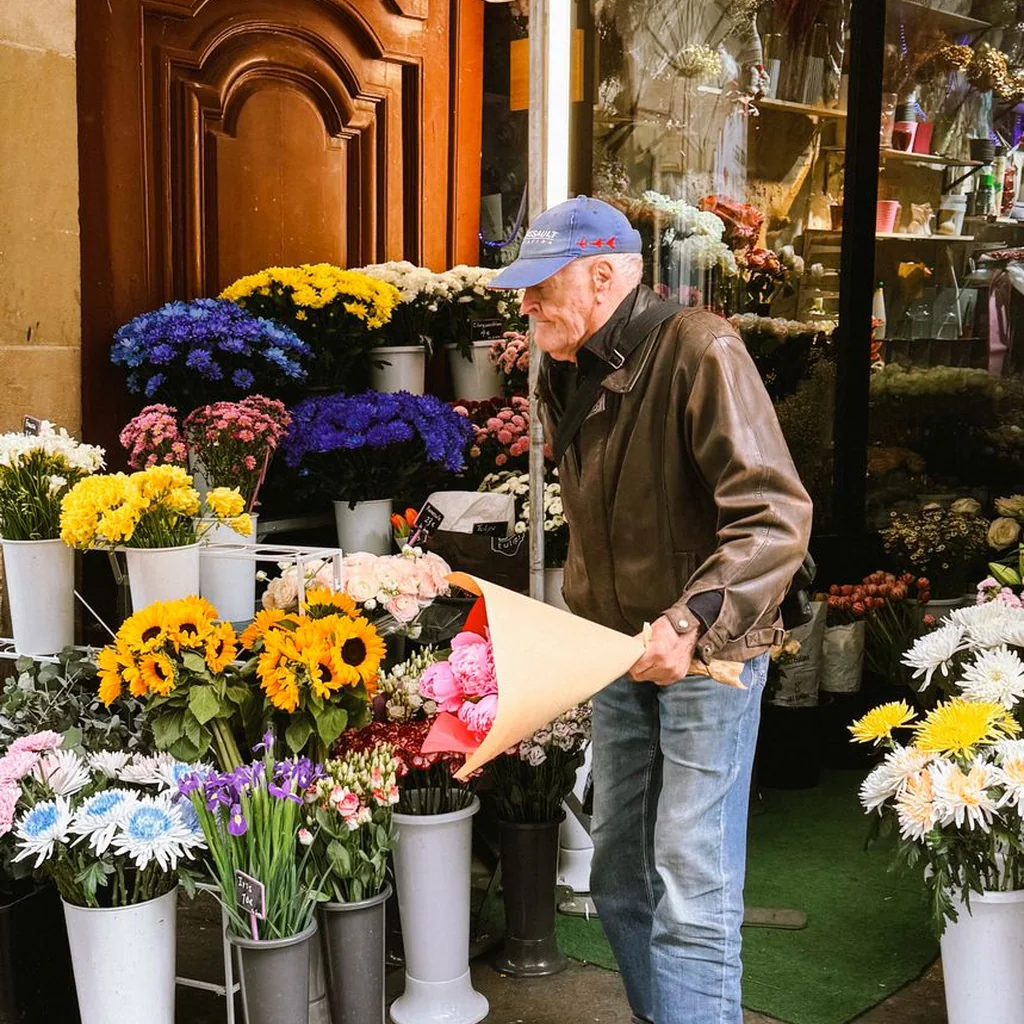
Photo: Yuliya Duzhaya on Pexels
Die Blumen zum Geburtstag
The Birthday Flowers
At closing time, Jonas enters a flower shop to buy flowers for his neighbor after forgetting her birthday that morning.
Three short parts. Read each part in German first; tap “Show English” under a paragraph when you need the translation.


Part 1
Jonas schob die Tür zum Blumenladen auf. Draußen wurde es schon dunkel, und die Verkäuferin räumte gerade die Eimer vor dem Laden weg.
Show EnglishHide English
Jonas pushed open the door of the flower shop. It was already getting dark outside, and the saleswoman was just putting away the buckets in front of the shop.
„Haben Sie noch offen?“, fragte er.
Show EnglishHide English
“Are you still open?” he asked.
„Für fünf Minuten“, sagte sie und lächelte. „Was suchen Sie denn?“
Show EnglishHide English
“For five more minutes,” she said with a smile. “What are you looking for?”
Jonas sah auf die Blumen vor sich. Eigentlich hatte er sich den ganzen Weg überlegt, was er sagen wollte. Jetzt fiel ihm nur ein: „Etwas für meine Nachbarin.“
Show EnglishHide English
Jonas looked at the flowers in front of him. He had actually spent the whole way thinking about what he wanted to say. Now all he could think of was: “Something for my neighbor.”
Er erzählte, dass er am Morgen ihren Geburtstag vergessen hatte. Sie hatte ihn im Treppenhaus noch freundlich daran erinnert, dass sie ihm am Abend Kuchen vorbeibringen wollte. Er war trotzdem ohne Glückwunsch zur Arbeit gegangen.
Show EnglishHide English
He explained that he had forgotten her birthday that morning. In the stairwell, she had kindly reminded him that she was going to bring him some cake that evening. Even so, he had gone to work without wishing her a happy birthday.
„Dann nehmen Sie doch diese Tulpen“, schlug die Verkäuferin vor. „Die halten noch lange.“
Show EnglishHide English
“Then why don’t you take these tulips?” the saleswoman suggested. “They’ll last a long time.”
Jonas nickte und suchte eine kleine Karte aus. Während die Verkäuferin den Strauß band, legte sie ganz unauffällig ein paar gelbe Blumen dazu. Er bemerkte es erst an der Kasse.
Show EnglishHide English
Jonas nodded and picked out a small card. As the saleswoman tied the bouquet, she quietly added a few yellow flowers. He only noticed them at the checkout.
„Oh, ich wollte eigentlich nur die Tulpen bezahlen.“
Show EnglishHide English
“Oh, I actually only wanted to pay for the tulips.”
„Das tun Sie auch“, sagte sie. „Die anderen schenke ich Ihnen. Sie würden morgen nicht mehr schön aussehen.“
Show EnglishHide English
“That’s all you’re paying for,” she said. “The others are a gift from me. They wouldn’t look nice tomorrow.”
Jonas bedankte sich und nahm den Strauß. Als er zur Tür ging, rief die Verkäuferin plötzlich: „Einen Moment, die Karte!“
Show EnglishHide English
Jonas thanked her and took the bouquet. As he was walking to the door, the saleswoman suddenly called out, “Wait a moment, the card!”
Part 2Die Blumen und die Geburtstagskarte(The Flowers and the Birthday Card)
Jonas drehte sich um. Auf dem Tisch neben der Kasse lag die kleine weiße Karte, die er vorhin ausgewählt hatte.
Show EnglishHide English
Jonas turned around. The small white card he had picked out earlier was lying on the table beside the checkout.
„Die hätte ich fast vergessen“, sagte er. Er nahm einen Stift und schrieb: „Alles Gute zum Geburtstag! Entschuldigung, dass ich heute Morgen nichts gesagt habe. Jonas“
Show EnglishHide English
“I almost forgot that,” he said. He picked up a pen and wrote: “Happy birthday! I’m sorry I didn’t say anything this morning. Jonas”
Die Verkäuferin steckte die Karte zwischen die Blumen. Dann gab sie ihm den Strauß zurück und schloss hinter ihm die Tür ab.
Show EnglishHide English
The saleswoman put the card among the flowers. Then she handed him the bouquet and locked the door behind him.
Zu Hause hörte Jonas Stimmen auf dem Flur. Seine Nachbarin Jana stand vor ihrer Wohnungstür und unterhielt sich mit einer anderen Frau. Auf einem Teller trug sie zwei Stücke Kuchen.
Show EnglishHide English
At home, Jonas heard voices in the hallway. His neighbor Jana was standing in front of her apartment door, talking to another woman. She was carrying two pieces of cake on a plate.
„Da sind Sie ja“, sagte Jana. „Ich wollte Ihnen gerade etwas vorbeibringen.“
Show EnglishHide English
“There you are,” Jana said. “I was just going to bring you something.”
Jonas hielt ihr die Blumen hin. „Alles Gute zum Geburtstag. Ich habe heute Morgen nur an den Termin beim Zahnarzt gedacht und Ihren Geburtstag völlig vergessen.“
Show EnglishHide English
Jonas held out the flowers to her. “Happy birthday. This morning I was only thinking about my dentist appointment and completely forgot your birthday.”
Jana nahm den Strauß, und die andere Frau lächelte. Doch als Jana an den Blumen roch, fiel die Karte heraus und rutschte unter den Schuh der Besucherin.
Show EnglishHide English
Jana took the bouquet, and the other woman smiled. But when Jana smelled the flowers, the card fell out and slid under the visitor’s shoe.
„Oh, tut mir leid!“, sagte die Frau und hob den Fuß. Auf der Karte war ein dunkler Abdruck zu sehen. Jonas sah Jana an und hoffte, dass sie seine Nachricht noch lesen konnte.
Show EnglishHide English
“Oh, I’m sorry!” the woman said, lifting her foot. There was a dark mark on the card. Jonas looked at Jana and hoped she could still read his message.
Part 3Blumen und Kuchen(Flowers and Cake)
Jana hob die Karte auf und drehte sie um. Der Abdruck war auf der leeren Rückseite; vorne konnte man Jonas’ Nachricht gut lesen.
Show EnglishHide English
Jana picked up the card and turned it over. The mark was on the blank back; Jonas’s message was easy to read on the front.
Sie las sie und musste lachen. „Der Zahnarzt also. Ich dachte schon, Sie mögen mich nicht mehr.“
Show EnglishHide English
She read it and had to laugh. “So it was the dentist. I was starting to think you didn’t like me anymore.”
Jonas wurde rot. „Doch, natürlich! Ich habe mich schon den ganzen Tag darüber geärgert. Und jetzt stehe ich auch noch mit Blumen und einer schmutzigen Karte vor Ihrer Tür.“
Show EnglishHide English
Jonas blushed. “Of course I do! I’ve been annoyed with myself about it all day. And now I’m standing at your door with flowers and a dirty card, too.”
„Die Karte war meine Schuld“, sagte die Besucherin. „Und die Blumen sehen wirklich schön aus.“
Show EnglishHide English
“The card was my fault,” the visitor said. “And the flowers really do look lovely.”
Jana nickte. „Ich freue mich sehr darüber. Kommen Sie doch kurz herein, Jonas. Für ein Stück Kuchen reicht die Zeit bestimmt.“
Show EnglishHide English
Jana nodded. “I’m very happy about them. Why don’t you come in for a moment, Jonas? There’s surely time for a piece of cake.”
In der Küche stellte sie den Strauß in eine Vase. Die gelben Blumen ragten ein wenig über die Tulpen hinaus. Jonas erzählte, dass die Verkäuferin sie ihm geschenkt hatte.
Show EnglishHide English
In the kitchen, she put the bouquet in a vase. The yellow flowers reached a little higher than the tulips. Jonas explained that the saleswoman had given them to him.
„Dann danken Sie ihr bitte bei Gelegenheit von mir“, sagte Jana. Sie schnitt ihm ein großes Stück Kuchen ab und stellte es auf einen Teller.
Show EnglishHide English
“Then please thank her for me next time you see her,” Jana said. She cut him a large piece of cake and put it on a plate.
Jonas setzte sich zu den beiden Frauen an den Tisch. Diesmal dachte er nicht an den Zahnarzt, sondern genoss den Kuchen und das Gespräch.
Show EnglishHide English
Jonas sat down at the table with the two women. This time he wasn’t thinking about the dentist; he enjoyed the cake and the conversation.
Practise this German story
Vocabulary in context
Important words and phrases
noch offen
phrasestill open
Entschuldigung, haben Sie noch offen?
Excuse me, are you still open?
etwas für meine Nachbarin
phrasesomething for my neighbor
Ich suche etwas für meine Nachbarin.
I am looking for something for my neighbor.
ihren Geburtstag vergessen
verb phraseforgot her birthday
Ich habe ihren Geburtstag vergessen.
I forgot her birthday.
schlug die Verkäuferin vor
verb phrasesuggested
Die Verkäuferin schlug mir Tulpen vor.
The sales assistant suggested tulips to me.
an der Kasse
phraseat the checkout
An der Kasse bezahle ich mit Karte.
At the checkout, I pay by card.
bedankte sich
verb phrasethanked
Er bedankte sich für die Blumen.
He thanked her for the flowers.
vorbeibringen
verbto bring by; to drop off
Ich wollte ihr den Kuchen vorbeibringen.
I wanted to drop off the cake for her.
fiel die Karte heraus
verb phrasethe card fell out
Als ich den Umschlag öffnete, fiel ein Zettel heraus.
When I opened the envelope, a note fell out.
ein dunkler Abdruck
noun phrasea dark mark
Auf dem Papier war ein dunkler Abdruck.
There was a dark mark on the paper.
bei Gelegenheit
phrasewhen you get the chance
Ruf mich bei Gelegenheit an.
Call me when you get the chance.
Ich habe mich schon den ganzen Tag darüber geärgert.
verb phraseI have been annoyed about it all day.
Ich habe mich darüber geärgert, dass ich zu spät war.
I was annoyed that I was late.
Check your understanding
Comprehension questions
Choose an answer, check it, then move to the next question.
Question 1 of 3
- Question 1: current not answered
- Question 2: not answered
- Question 3: not answered
Notice the language
Language notes
Nehmen Sie doch diese Tulpen.
The particle doch can soften a suggestion or invitation. It makes the sentence sound friendly and encouraging rather than pushy. You can reuse it when you want to make a polite, helpful suggestion.
Nehmen Sie doch diese Tulpen.
Go ahead and take these tulips.
More German stories to read next

Das Haus mit der blauen Tür
The House with the Blue Door
On Saturday morning, Yasmin receives a message from a real estate website about a new house for sale in her area and recognizes her childhood home.

Das falsche Bett im Hostel
The Wrong Bed at the Hostel
Leyla returns to her hostel room to find that someone has slept in her bed and left a blue T-shirt there.

Peters Rede für Gisela
Peter’s Speech for Gisela
At the sports club hall, Peter is about to give a speech celebrating Gisela, who is leaving her job as a coach after twenty years.
Das Licht bleibt noch am Tisch
The Light Lingers at the Table
At a café poetry reading, Michael is surprised when the poet asks him what a line of her poem means.