
Photo: Nataliya Vaitkevich on Pexels
L’écharpe et les mailles du silence
The Scarf and the Stitches of Silence
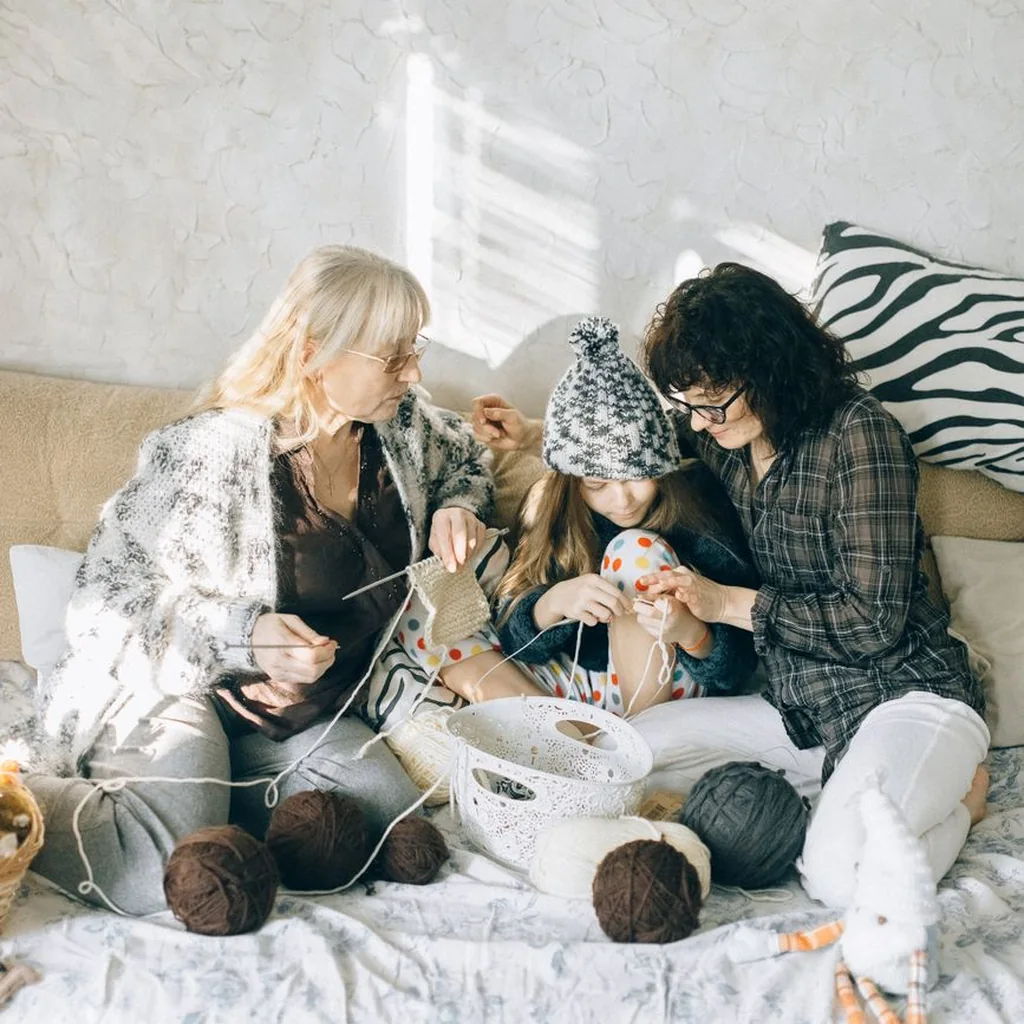
Céline’s grandmother has set out wool and knitting needles at her table to teach her granddaughter to knit, but her old needles keep clashing.
Three short parts. Read each part in French first; tap “Show English” under a paragraph when you need the translation.


Part 1
La grand-mère de Céline avait sorti deux pelotes de laine et deux paires d’aiguilles, dont ses vieilles aiguilles à elle, qui s’entrechoquaient dès qu’elle s’y mettait. Sur la table, entre les miettes du goûter et une tasse de thé oubliée, elle avait posé un carré bleu commencé la veille.
Show EnglishHide English
Céline’s grandmother had brought out two balls of wool and two pairs of knitting needles, including her own old needles, which clashed whenever she started knitting. On the table, among the crumbs from their afternoon snack and an abandoned cup of tea, she had set a blue square she had started the day before.
« On va faire une écharpe. Enfin, si tu ne changes pas d’avis au bout de trois rangs. »
Show EnglishHide English
“We’re going to make a scarf. Well, unless you change your mind after three rows.”
Céline tira une chaise tout contre la sienne. Elle avait demandé à apprendre après avoir retrouvé, au fond d’un tiroir, un bonnet que sa grand-mère lui avait tricoté quand elle était petite. Il lui allait encore, à condition de ne pas trop remuer les oreilles.
Show EnglishHide English
Céline pulled a chair right up beside hers. She had asked to learn after finding, at the back of a drawer, a hat her grandmother had knitted for her when she was little. It still fit, as long as she didn’t move her ears too much.
« Regarde bien. Tu passes l’aiguille là, tu enroules le fil autour et tu tires une boucle. »
Show EnglishHide English
“Watch carefully. You put the needle through here, wrap the yarn around it, and pull a loop through.”
La première maille se fit sans encombre. À la deuxième, le fil glissa ; sa grand-mère le rattrapa, recommença, puis pinça les lèvres lorsque la pointe de l’aiguille rata de nouveau la boucle.
Show EnglishHide English
The first stitch came easily. At the second, the yarn slipped; her grandmother caught it and tried again, then pressed her lips together when the needle’s point missed the loop once more.
« Ça va trop vite pour toi ? demanda-t-elle.
Show EnglishHide English
“Is this going too fast for you?” she asked.
— Pour moi, ça va. Pour toi, je ne sais pas. »
Show EnglishHide English
“It’s fine for me. I don’t know about you.”
Sa grand-mère leva les yeux. Céline regardait ses mains, sans sourire. La grand-mère posa l’ouvrage sur ses genoux, se frotta les doigts et prétexta qu’il faisait froid dans la pièce.
Show EnglishHide English
Her grandmother looked up. Céline was watching her hands, without smiling. Her grandmother laid the knitting on her lap, rubbed her fingers, and claimed that the room was cold.
« À ton tour, tiens. »
Show EnglishHide English
“Your turn. Here.”
Céline prit les aiguilles avec une application comique, les coinçant sous ses bras comme deux baguettes trop longues. Elle réussit une maille, puis une autre, avant de s’arrêter net : une boucle pendait sous le rang.
Show EnglishHide English
Céline took the needles with comical earnestness, tucking them under her arms like two overly long chopsticks. She managed one stitch, then another, before stopping dead: a loop was hanging below the row.
Part 2Le rang manqué(The Botched Row)
« Elle était déjà là, celle-là ? » demanda Céline en montrant la boucle.
Show EnglishHide English
“Was that one already there?” Céline asked, pointing to the loop.
Sa grand-mère rapprocha sa chaise. La maille avait filé sur deux rangs ; elle prit une aiguille et tenta de la remonter, mais la pointe repoussa la boucle au lieu de l’attraper.
Show EnglishHide English
Her grandmother pulled her chair closer. The stitch had dropped down two rows; she took a needle and tried to pick it back up, but the point pushed the loop away instead of catching it.
« Attends, je vais y arriver. Ne tire surtout pas. »
Show EnglishHide English
“Wait, I’ll get it. Whatever you do, don’t pull.”
Céline garda les mains immobiles pendant que sa grand-mère s’y reprenait. Au bout d’un moment, celle-ci posa l’aiguille sur la table, un peu trop fort pour que le geste passe inaperçu.
Show EnglishHide English
Céline kept her hands still while her grandmother tried again. After a while, she put the needle down on the table, a little too forcefully for the gesture to go unnoticed.
« Dans la boîte à couture, il y a un crochet. Ce sera plus facile avec ça. »
Show EnglishHide English
“There’s a crochet hook in the sewing box. It’ll be easier with that.”
Céline le trouva sous une poignée de boutons dépareillés. Sa grand-mère lui montra où le glisser, puis la laissa récupérer la boucle elle-même. Au bout de deux essais, la maille était revenue à sa place.
Show EnglishHide English
Céline found it under a handful of mismatched buttons. Her grandmother showed her where to slip it in, then let her pick up the loop herself. After two tries, the stitch was back where it belonged.
« Tu vois, dit-elle, tu te débrouilles.
Show EnglishHide English
“See,” she said, “you’re managing.”
— J’ai une prof qui ne lâche pas l’affaire. »
Show EnglishHide English
“I’ve got a teacher who won’t give up.”
Elles reprirent, Céline à son rang et sa grand-mère à son petit carré bleu. Le cliquetis revint, irrégulier d’abord, puis plus assuré du côté de Céline. Celle-ci leva son ouvrage pour le lui montrer.
Show EnglishHide English
They started again, Céline working on her row and her grandmother on her little blue square. The clicking returned, irregular at first, then more confident on Céline’s side. She held up her work to show her.
« Il y a quelque chose qui cloche ? »
Show EnglishHide English
“Is something wrong?”
Le bord se resserrait nettement. Sa grand-mère compta les mailles du bout de son aiguille : il en manquait trois. Elle regarda l’écharpe, puis la pelote encore presque intacte.
Show EnglishHide English
The edge was narrowing noticeably. Her grandmother counted the stitches with the tip of her needle: three were missing. She looked at the scarf, then at the ball of wool, still almost untouched.
« On peut défaire jusqu’à l’erreur, dit-elle. Ou bien on recommence. »
Show EnglishHide English
“We can undo it back to the mistake,” she said. “Or we can start over.”
Céline fit passer le fil entre ses doigts et resta un instant à examiner ses rangs.
Show EnglishHide English
Céline ran the yarn through her fingers and spent a moment examining her rows.
Part 3Le rang recommencé(The Row Started Again)
« On recommence, dit enfin Céline. Au moins, je sais déjà rattraper une maille. »
Show EnglishHide English
“Let’s start over,” Céline said at last. “At least I already know how to pick up a stitch.”
Elle tira sur le fil avec précaution. Les rangs se défirent les uns après les autres, et elle enroula la laine autour de la pelote, qui roula jusqu’au bord de la table.
Show EnglishHide English
She tugged carefully on the yarn. The rows came undone one after another, and she wound the wool around the ball, which rolled to the edge of the table.
« Doucement, tu vas tout emmêler », dit sa grand-mère en retenant la pelote.
Show EnglishHide English
“Easy, you’ll get it all tangled,” her grandmother said, stopping the ball.
Céline lui tendit les aiguilles pour monter les premières mailles. Sa grand-mère en fit quelques-unes, puis s’arrêta ; ses doigts n’arrivaient plus à garder le fil tendu. Elle posa l’aiguille et ouvrit la main.
Show EnglishHide English
Céline handed her the needles to cast on the first stitches. Her grandmother made a few, then stopped; her fingers could no longer keep the yarn taut. She put down the needle and opened her hand.
« Aujourd’hui, c’est toi qui vas devoir t’y coller. Viens, je te montre. »
Show EnglishHide English
“Today, you’ll have to do it yourself. Come on, I’ll show you.”
Elle guida les gestes de Céline, lui fit desserrer une boucle, en refaire une autre. Cette fois, personne ne se pressait. Quand les vingt mailles furent sur l’aiguille, Céline les compta deux fois.
Show EnglishHide English
She guided Céline’s movements, had her loosen one loop and make another. This time, no one was in a hurry. Once all twenty stitches were on the needle, Céline counted them twice.
« Le compte y est. Et si je serre moins ?
Show EnglishHide English
“That’s the right number. What if I don’t pull so tight?”
— Essaie. Tu verras bien au rang suivant. »
Show EnglishHide English
“Try it. You’ll see on the next row.”
Le thé avait refroidi ; Céline se leva pour en préparer une autre tasse. À son retour, sa grand-mère avait rapproché le carré bleu et défait les quelques mailles qu’elle venait d’y tricoter.
Show EnglishHide English
The tea had gone cold; Céline got up to make another cup. When she came back, her grandmother had drawn the blue square closer and undone the few stitches she had just knitted into it.
« Je le reprendrai un autre jour », dit-elle en le glissant dans la boîte.
Show EnglishHide English
“I’ll pick it up another day,” she said, slipping it into the box.
Céline se rassit et reprit son écharpe. Sa grand-mère suivait le mouvement des aiguilles, une main posée sur la tasse chaude. Au bout du rang, elles comptèrent ensemble : vingt mailles, et un bord presque droit.
Show EnglishHide English
Céline sat down again and picked up her scarf. Her grandmother followed the movement of the needles, one hand resting on the warm cup. At the end of the row, they counted together: twenty stitches, and an almost straight edge.
« Pas mal, dit Céline.
Show EnglishHide English
“Not bad,” Céline said.
— Ne prends pas la grosse tête. Tu as encore toute une écharpe devant toi. »
Show EnglishHide English
“Don’t get too big for your boots. You still have a whole scarf ahead of you.”
Practise this French story
Vocabulary in context
Important words and phrases
sans encombre
adverbial phrasewithout any trouble
La première maille se fit sans encombre.
The first stitch went smoothly.
prétexter
verbto use as an excuse; to claim as an excuse
Il prétexta un contretemps pour partir plus tôt.
He claimed a last-minute hitch as an excuse to leave early.
à condition de
conjunction phraseprovided that; on condition that
Je viendrai à condition de finir ce travail avant six heures.
I'll come provided that I finish this work before six o'clock.
s’y reprendre
verb phraseto try again; to have another go
Il a dû s’y reprendre trois fois pour ouvrir le cadenas.
He had to try three times to open the padlock.
ne pas lâcher l’affaire
idiomatic expressionto keep at it; not to give up
Elle ne lâche pas l’affaire tant qu’elle n’a pas trouvé une solution.
She doesn't give up until she has found a solution.
passer inaperçu
verb phraseto go unnoticed
Son malaise est presque passé inaperçu pendant la réunion.
His discomfort almost went unnoticed during the meeting.
cliquetis
nounclinking sound; clicking sound
On entendait le cliquetis des verres dans l’évier.
You could hear the clinking of glasses in the sink.
le compte y est
idiomatic expressionthe count is right; it all adds up
Trois billets, deux pièces : le compte y est.
Three bills, two coins: that adds up.
prendre la grosse tête
idiomatic expressionto get a big head; to become conceited
Après ce succès, il a commencé à prendre la grosse tête.
After that success, he started to get a big head.
se débrouiller
verb phraseto manage; to make do
Même sans plan, elle se débrouille toujours.
Even without a plan, she always manages.
Check your understanding
Comprehension questions
Choose an answer, check it, then move to the next question.
Question 1 of 3
- Question 1: current not answered
- Question 2: not answered
- Question 3: not answered
Notice the language
Language notes
à condition de + infinitif
À condition de + infinitive means “as long as” or “provided that”, when the subject of both parts is the same. It sets a condition for the main statement. In the story, the old hat still fits Céline « à condition de ne pas trop remuer les oreilles ».
Il lui allait encore, à condition de ne pas trop remuer les oreilles.
It still fit, as long as she didn’t move her ears too much.
More French stories to read next
La remise en jeu
Back in Play
At the gym, veteran Philippe hears that rookie Théo will start in his place on Saturday and is asked to teach him to defend inbound plays.
Le cœur rouge
The Red Heart
At two in the morning, Jade is awake in bed, scrolling through Arthur’s profile after agreeing to have coffee with him the next day.

Une place en première
A First-Class Seat
At the station, Juliette finds that her ticket and app assign her a first-class seat, though she paid for second class.

Le cours de danse
The Dance Class
At the back of a dance class, Mehdi tries to follow the music, hoping no one will notice that he is new to the class.