
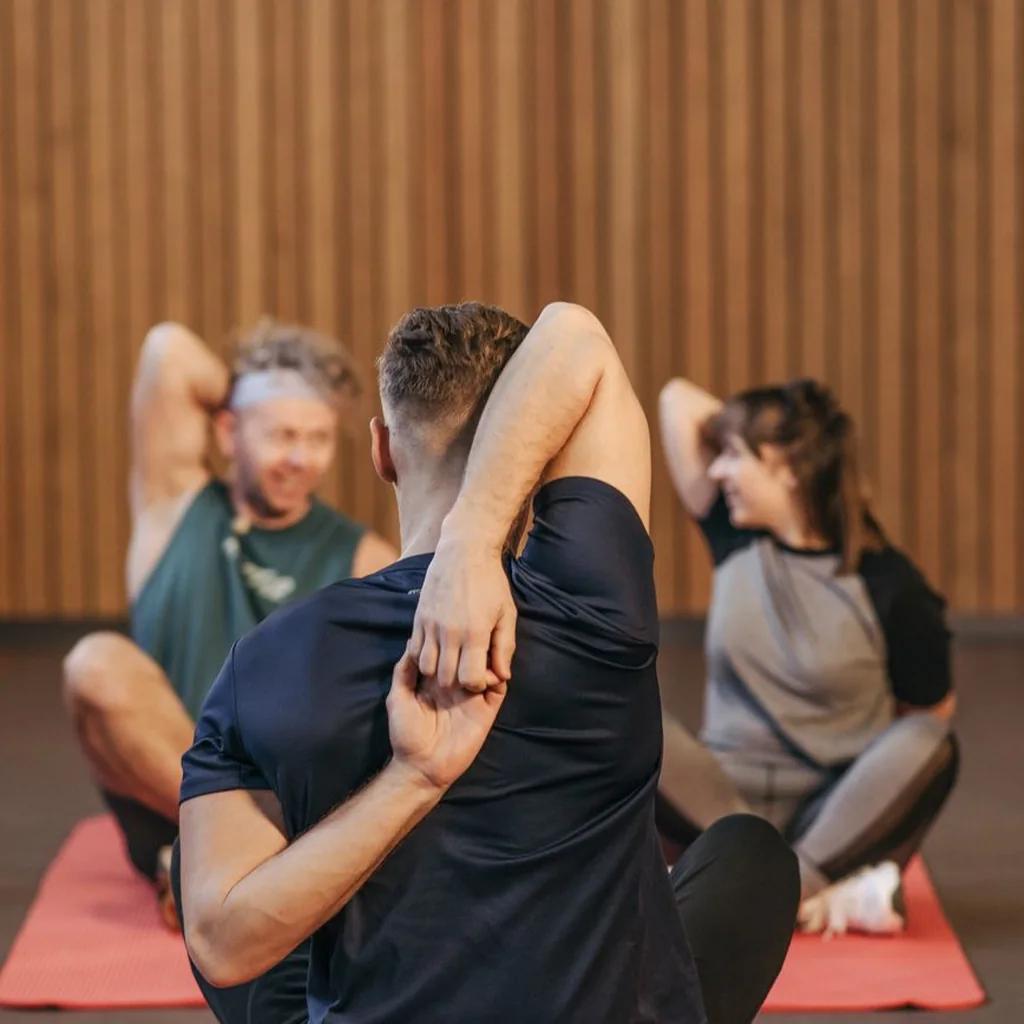
Photo: Pavel Danilyuk on Pexels
Le cours de danse
The Dance Class
At the back of a dance class, Mehdi tries to follow the music, hoping no one will notice that he is new to the class.
Three short parts. Read each part in French first; tap “Show English” under a paragraph when you need the translation.


Part 1
Au fond de la salle, Mehdi s’applique à suivre la musique. Devant lui, une rangée de dos se penche, se redresse et repart aussitôt. Il a choisi cette place pour être tranquille ; avec un peu de chance, personne ne remarquera qu’il découvre le cours.
Show EnglishHide English
At the back of the room, Mehdi concentrates on following the music. In front of him, a row of backs bends, straightens, and immediately starts again. He chose this spot so he could keep to himself; with a bit of luck, no one would notice he was new to the class.
« On garde les genoux souples ! » lance la professeure.
Show EnglishHide English
“Keep your knees soft!” the instructor calls out.
Mehdi desserre les dents et fléchit les jambes. Sa serviette glisse de son épaule ; il la rattrape de justesse, sans perdre le rythme. Au premier rang, une dame en rose lui adresse un sourire dans le miroir. Il le lui rend, reconnaissant.
Show EnglishHide English
Mehdi unclenches his teeth and bends his legs. His towel slips off his shoulder; he catches it just in time without missing the beat. In the front row, a woman in pink smiles at him in the mirror. He smiles back, grateful.
Puis la musique s’arrête. Tout le monde se tourne vers lui, sauf la dame en rose, qui fixe ses baskets avec une attention soudaine.
Show EnglishHide English
Then the music stops. Everyone turns to look at him, except the woman in pink, who suddenly stares intently at her sneakers.
« On va reprendre depuis le début », annonce la professeure.
Show EnglishHide English
“Let’s start again from the beginning,” the instructor announces.
Mehdi jette un coup d’œil à sa montre. Vingt-cinq minutes qu’il est là, et il croyait s’en sortir à peu près. Il se demande ce qui n’allait pas quand son voisin se penche vers lui.
Show EnglishHide English
Mehdi glances at his watch. He has been there for twenty-five minutes, and he thought he was doing more or less all right. He wonders what was wrong when the man next to him leans over.
« Vous avez fait tout le contraire. Quand on allait à droite, vous partiez à gauche. Et pour les bras, pareil. »
Show EnglishHide English
“You’ve been doing the exact opposite. When we went right, you went left. And the same with your arms.”
« Ah bon ? dit Mehdi. Pourtant, je regardais les autres. »
Show EnglishHide English
“Really?” says Mehdi. “But I was watching the others.”
Son voisin désigne le grand miroir. « Vous les regardiez là-dedans, non ? Il faut faire comme si votre reflet était à leur place. »
Show EnglishHide English
His neighbor points to the large mirror. “You were watching them in there, weren’t you? You have to act as if your reflection were in their place.”
Mehdi hoche la tête. La dame en rose ramasse sa bouteille avec un soin exagéré, puis remet longuement le bouchon en place.
Show EnglishHide English
Mehdi nods. The woman in pink picks up her water bottle with exaggerated care, then takes a long time putting the cap back on.
« Ça arrive », dit la professeure. « Venez devant, vous verrez mieux mes pieds. »
Show EnglishHide English
“It happens,” the instructor says. “Come up front; you’ll see my feet better.”
Elle lui fait signe de prendre la place libre juste à côté d’elle.
Show EnglishHide English
She gestures for him to take the empty spot right beside her.
Part 2Le demi-tour au miroir(The Turn in the Mirror)
Mehdi traverse la salle sous les regards, sa serviette coincée sous le bras. Arrivé devant, il découvre qu’il a maintenant une vue imprenable sur lui-même. La professeure baisse le son et se place à sa droite.
Show EnglishHide English
Mehdi crosses the room under everyone’s gaze, his towel tucked under his arm. When he gets to the front, he discovers that he now has an unobstructed view of himself. The instructor turns down the volume and stands to his right.
« Regardez mes pieds directement, pas dans le miroir. On part à droite, on revient, puis on lève le bras gauche. »
Show EnglishHide English
“Look directly at my feet, not in the mirror. We go right, come back, then raise the left arm.”
Il suit ses chaussures du regard. À droite, retour, bras gauche : cette fois, ça tient debout. Derrière lui, quelques personnes essaient de reprendre le mouvement ; la dame en rose lui lève le pouce.
Show EnglishHide English
He follows her shoes with his eyes. Right, back, left arm: this time, it works. Behind him, a few people try to pick up the movement again; the woman in pink gives him a thumbs-up.
« Voilà, vous l’avez ! dit la professeure. On remet la musique ? »
Show EnglishHide English
“There, you’ve got it!” says the instructor. “Shall we put the music back on?”
Mehdi n’a pas le temps de répondre. Le morceau repart et, pendant quelques mesures, il se débrouille. Il finit même par relever la tête. Dans le miroir, les bras montent ensemble, les siens compris.
Show EnglishHide English
Mehdi doesn’t have time to answer. The music starts again and, for a few bars, he manages. He even ends up lifting his head. In the mirror, everyone’s arms rise together, including his.
Il commence à se dire que l’affaire n’est peut-être pas si mal engagée. La professeure lui adresse un petit signe d’encouragement et enchaîne sur la suite.
Show EnglishHide English
He begins to think the situation may not be so hopeless after all. The instructor gives him a little encouraging nod and moves on to the next part.
Puis elle ajoute un demi-tour. Mehdi pivote avec les autres et se retrouve face au fond de la salle. Il cherche les pieds de la professeure du regard, mais elle est maintenant derrière lui.
Show EnglishHide English
Then she adds a half-turn. Mehdi pivots with the others and finds himself facing the back of the room. He looks around for the instructor’s feet, but she is now behind him.
« Continuez, vous y êtes presque ! » lance-t-elle.
Show EnglishHide English
“Keep going, you’re almost there!” she calls out.
À sa gauche, son ancien voisin fait un pas ; Mehdi le copie. Ils se heurtent de l’épaule. Le voisin s’excuse, bien qu’il n’y soit pour rien, et Mehdi recule en levant les mains, comme pour lui rendre le terrain.
Show EnglishHide English
To his left, the man who had been next to him at the back takes a step; Mehdi copies him. Their shoulders collide. The neighbor apologizes, although it wasn’t his fault, and Mehdi steps back with his hands raised, as if to give him room.
La professeure coupe de nouveau la musique. « Attendez, je vais vous montrer un truc pour le demi-tour. »
Show EnglishHide English
The instructor stops the music again. “Wait, I’m going to show you a trick for the half-turn.”
Part 3
Elle vient se placer devant Mehdi, face au fond de la salle comme lui. « Après le tour, vous gardez le pied droit devant. Regardez : droite, gauche, et on repart. »
Show EnglishHide English
She comes to stand in front of Mehdi, facing the back of the room just as he is. “After the turn, keep your right foot in front. Look: right, left, and off we go again.”
Il essaie sans musique, les yeux rivés sur les pieds de la professeure. Son voisin lui laisse un peu de place, puis se remet à côté de lui pour la deuxième tentative. Leurs épaules restent à bonne distance ; Mehdi souffle enfin.
Show EnglishHide English
He tries it without music, his eyes fixed on the instructor’s feet. His neighbor gives him a little room, then comes back beside him for the second try. Their shoulders stay a good distance apart; Mehdi finally exhales.
« On le fait tous ensemble, doucement », dit la professeure.
Show EnglishHide English
“Let’s all do it together, slowly,” the instructor says.
Cette fois, la dame en rose compte à voix basse. Mehdi s’accroche à sa voix jusqu’au demi-tour, garde son pied droit devant et repart. Il a un temps de retard, mais personne ne semble s’en soucier.
Show EnglishHide English
This time, the woman in pink counts quietly. Mehdi holds on to her voice until the half-turn, keeps his right foot in front, and starts again. He is one beat behind, but no one seems to mind.
La musique reprend. Au bout de quelques passages, il n’a plus besoin de regarder ses chaussures à chaque pas. Quand le morceau s’achève, il applaudit avec les autres, un peu surpris d’être arrivé au bout.
Show EnglishHide English
The music starts again. After a few repetitions, he no longer needs to look at his shoes at every step. When the song ends, he applauds with the others, a little surprised to have made it to the end.
La professeure annonce une pause avant les étirements. Mehdi récupère sa bouteille au fond de la salle et boit une longue gorgée. Son voisin l’y rejoint et lui montre son propre bras.
Show EnglishHide English
The instructor announces a break before the stretches. Mehdi retrieves his water bottle from the back of the room and takes a long drink. His neighbor joins him there and points to his own arm.
« Moi, j’ai mis trois cours à comprendre quoi en faire. Je cognais tout le monde. »
Show EnglishHide English
“It took me three classes to figure out what to do with mine. I kept hitting everyone.”
« Vous auriez pu me prévenir avant les vingt-cinq minutes », répond Mehdi.
Show EnglishHide English
“You could have told me before the twenty-five minutes were up,” Mehdi replies.
« Je croyais que vous faisiez une variante. »
Show EnglishHide English
“I thought you were doing a variation.”
Mehdi regarde la salle, puis pose sa bouteille près du premier rang. Quand la professeure rappelle le groupe, il s’installe à côté de son voisin et attend qu’elle montre le premier mouvement.
Show EnglishHide English
Mehdi looks around the room, then sets his bottle down near the front row. When the instructor calls the group back, he takes his place beside his neighbor and waits for her to show them the first move.
Practise this French story
Vocabulary in context
Important words and phrases
s’applique à suivre la musique
verb phrasemakes a real effort to follow the music
Au début du cours, il s’applique à suivre la musique.
At the start of the class, he makes a real effort to follow the music.
desserre les dents
verb phraseunclenches his jaw
Il desserre les dents avant de recommencer.
He unclenches his jaw before starting again.
de justesse
adverbial phraseby a hair; narrowly
Il rattrape sa serviette de justesse.
He catches his towel just in time.
du regard
adverbial phrasewith one’s eyes; visually
Il suit ses chaussures du regard.
He follows his shoes with his eyes.
vue imprenable
noun phraseunobstructed view
Depuis la première rangée, il a une vue imprenable sur la scène.
From the front row, he has an unobstructed view of the stage.
se débrouille
verb phrasemanages; gets by
Au début, il se débrouille, puis il gagne en assurance.
At first he manages, then he grows more confident.
n’est peut-être pas si mal engagée
expressionmay not be going so badly
L’affaire n’est peut-être pas si mal engagée.
The situation may not be going so badly after all.
à bonne distance
adverbial phraseat a proper distance
Ils restent à bonne distance l’un de l’autre.
They stay at a proper distance from each other.
à voix basse
adverbial phrasein a low voice
Elle compte à voix basse pour aider le groupe.
She counts in a low voice to help the group.
s’en soucier
verb phraseto care about it; to mind it
Il a perdu le rythme, mais personne ne s’en soucie.
He lost the rhythm, but nobody minds.
Check your understanding
Comprehension questions
Choose an answer, check it, then move to the next question.
Question 1 of 3
- Question 1: current not answered
- Question 2: not answered
- Question 3: not answered
Notice the language
Language notes
comme si + imparfait
French uses comme si to present an imagined or hypothetical situation. In this story, Mehdi’s neighbor asks him to imagine that his reflection is in the other dancers’ place. Example: « Il faut faire comme si votre reflet était à leur place. » The imperfect after comme si presents the situation as hypothetical.
Il faut faire comme si votre reflet était à leur place.
You have to act as if your reflection were in their place.
More French stories to read next
La dernière graine de basilic
The Last Basil Seed
On Sunday, Sarah plants the last basil seed from an almost empty packet in a pot on her kitchen windowsill.
L’écharpe et les mailles du silence
The Scarf and the Stitches of Silence
Céline’s grandmother has set out wool and knitting needles at her table to teach her granddaughter to knit, but her old needles keep clashing.
La remise en jeu
Back in Play
At the gym, veteran Philippe hears that rookie Théo will start in his place on Saturday and is asked to teach him to defend inbound plays.
Le cœur rouge
The Red Heart
At two in the morning, Jade is awake in bed, scrolling through Arthur’s profile after agreeing to have coffee with him the next day.