
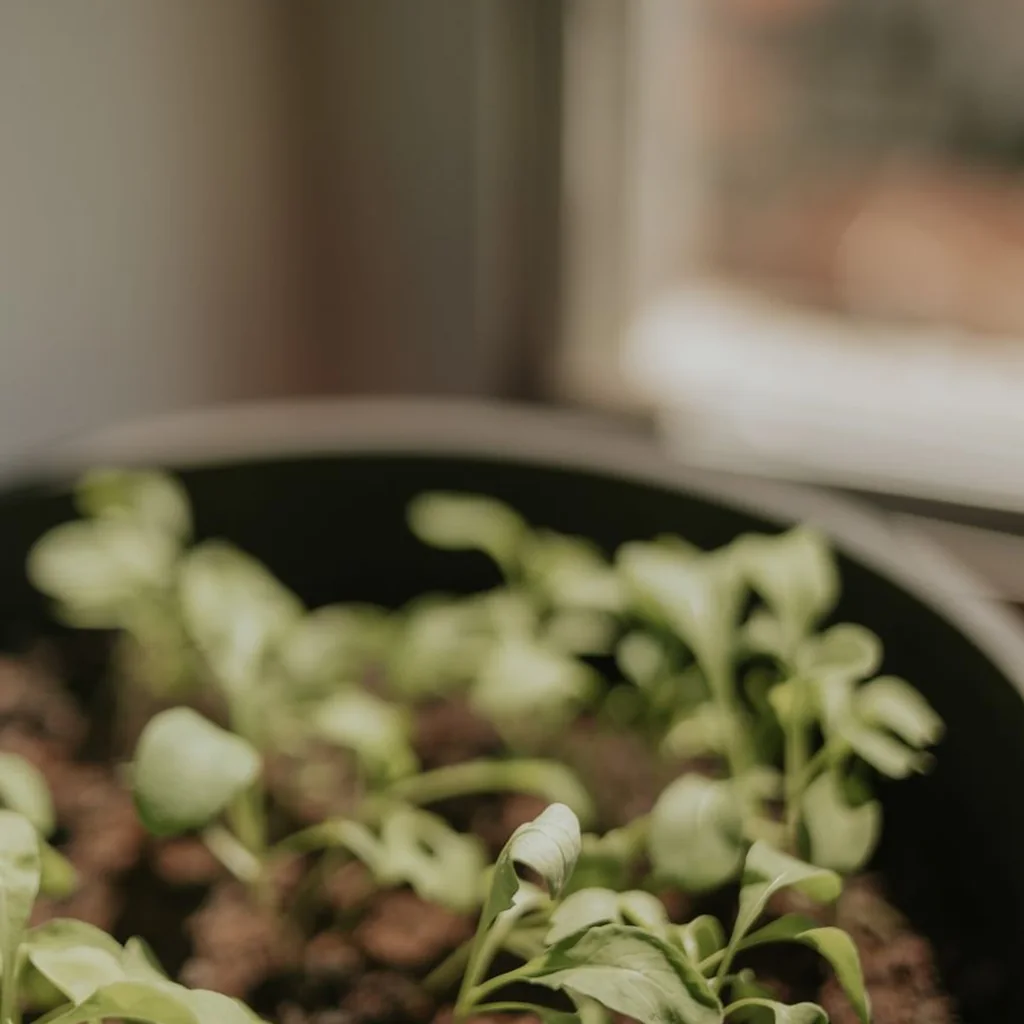
Photo: Letícia Alvares on Pexels
La dernière graine de basilic
The Last Basil Seed
On Sunday, Sarah plants the last basil seed from an almost empty packet in a pot on her kitchen windowsill.
Three short parts. Read each part in French first; tap “Show English” under a paragraph when you need the translation.


Part 1
Le dimanche, Sarah enfonça une graine de basilic dans un pot qu’elle posa sur le rebord intérieur de la fenêtre. Elle avait gardé le sachet presque vide depuis l’été précédent et s’était dit qu’il serait dommage de jeter la dernière graine.
Show EnglishHide English
On Sunday, Sarah pushed a basil seed into a pot and set it on the inside windowsill. She had kept the almost-empty packet since the previous summer and had thought it would be a shame to throw away the last seed.
Le lendemain matin, avant même de mettre la bouilloire en route, elle souleva le pot pour l’examiner sous toutes les coutures. La terre avait séché sur les bords ; elle y versa un fond de verre d’eau, puis essuya une coulure sur le rebord avec le coin d’un torchon.
Show EnglishHide English
The next morning, before even putting the kettle on, she lifted the pot to examine it from every angle. The soil had dried out along the edges; she poured in the last bit of a glass of water, then wiped a streak off the sill with the corner of a dish towel.
Le mardi, elle écarta un peu la terre du bout de l’ongle, juste à l’endroit où elle avait enfoui la graine. Elle se ravisa aussitôt et la remit en place, avec le soin de quelqu’un qui espère que personne ne l’a vu.
Show EnglishHide English
On Tuesday, she brushed a little soil aside with the tip of her fingernail, right where she had buried the seed. She immediately thought better of it and put the soil back, with the care of someone hoping no one had seen her.
Le mercredi, Guillaume, son voisin de palier, passa lui rendre un plat. Il la trouva penchée devant la fenêtre, une tasse à la main, les yeux rivés sur le pot.
Show EnglishHide English
On Wednesday, Guillaume, her next-door neighbor, stopped by to return a dish. He found her bent over the window, a cup in her hand, her eyes fixed on the pot.
« Tu surveilles quoi ?
Show EnglishHide English
“What are you keeping an eye on?”
— Du basilic.
Show EnglishHide English
“Basil.”
— Il se fait discret. »
Show EnglishHide English
“It’s keeping a low profile.”
Sarah lui montra le sachet. Guillaume lut les indications, le retourna et lui demanda quand elle avait semé sa graine.
Show EnglishHide English
Sarah showed him the packet. Guillaume read the instructions, turned it over, and asked her when she had sown the seed.
« Dimanche. Et avant que tu ne dises quoi que ce soit, je sais que ça ne pousse pas en trois jours. »
Show EnglishHide English
“Sunday. And before you say anything, I know it doesn’t grow in three days.”
Il leva les mains en signe d’innocence et lui rendit le sachet. Le jeudi et le vendredi, elle continua pourtant à inspecter le pot dès le réveil, avant de vaquer au reste de ses affaires.
Show EnglishHide English
He raised his hands in a gesture of innocence and gave her back the packet. On Thursday and Friday, though, she still inspected the pot as soon as she woke up, before getting on with the rest of her day.
Le samedi, en descendant les poubelles, elle croisa Guillaume, qui s’arrêta devant sa porte et désigna la cuisine d’un mouvement de tête.
Show EnglishHide English
On Saturday, as she was taking out the trash, she ran into Guillaume, who stopped in front of her door and nodded toward the kitchen.
« Alors, ton basilic ? Je peux aller voir ? »
Show EnglishHide English
“So, how’s your basil? Can I come and see?”
Part 2Le pot sur le rebord de la fenêtre(The Pot on the Windowsill)
Sarah hésita juste assez pour que Guillaume sourie, puis elle le laissa entrer. Le pot était toujours sur le rebord de la fenêtre, entre une éponge oubliée et une pile de courrier qu’elle repoussait depuis plusieurs jours.
Show EnglishHide English
Sarah hesitated just long enough for Guillaume to smile, then let him in. The pot was still on the windowsill, between a forgotten sponge and a pile of mail she had been putting off for several days.
« Tu vois, dit-elle, ça prend son temps.
Show EnglishHide English
“You see,” she said, “it’s taking its time.”
— Ou alors tu as planté un caillou. »
Show EnglishHide English
“Or maybe you planted a pebble.”
Il se pencha, les mains derrière le dos. Sarah attendit qu’il relève la tête pour lui dire que la graine était bien là, sous la surface, même si elle n’avait aucune envie de vérifier une deuxième fois.
Show EnglishHide English
He leaned over, his hands clasped behind his back. Sarah waited for him to look up before telling him that the seed was definitely there, under the surface, even though she had no desire to check a second time.
Guillaume prit le sachet et relut les instructions. « Il faut garder la terre humide, pas la noyer. »
Show EnglishHide English
Guillaume picked up the packet and reread the instructions. “You have to keep the soil moist, not drown it.”
Elle lui reprit le paquet. « Merci, j’avais déchiffré jusque-là. »
Show EnglishHide English
She took the packet back from him. “Thanks, I’d figured that much out.”
Il désigna le dessous du pot : une petite flaque s’était formée dans la soucoupe. Sarah alla la vider à l’évier pendant qu’il faisait mine d’examiner le courrier ; à son retour, il avait eu la décence de ne rien ajouter.
Show EnglishHide English
He pointed beneath the pot: a small puddle had formed in the saucer. Sarah went to empty it in the sink while he pretended to examine the mail; by the time she returned, he had had the decency not to add anything.
Le dimanche matin, elle tâta la terre avant d’arroser. Le lundi, elle se contenta de regarder ; le mardi, elle fit tourner le pot d’un quart de tour, histoire qu’il profite de la lumière de tous les côtés.
Show EnglishHide English
On Sunday morning, she felt the soil before watering it. On Monday, she just looked; on Tuesday, she turned the pot a quarter turn so it could get light from every side.
Chaque matin, jusqu’au samedi suivant, elle passa ainsi devant la fenêtre. Elle avait beau se pencher et changer d’angle, elle ne découvrait rien d’autre que de la terre.
Show EnglishHide English
Every morning until the following Saturday, she passed by the window like that. No matter how she leaned over or changed her angle, all she could see was soil.
Ce soir-là, Guillaume frappa chez elle avec le plat qu’elle lui avait prêté à son tour. En le posant, il jeta un coup d’œil vers la fenêtre.
Show EnglishHide English
That evening, Guillaume knocked at her door with the dish she had lent him in return. As he set it down, he glanced toward the window.
« Demain matin, je passe voir si ton locataire paie enfin son loyer. »
Show EnglishHide English
“Tomorrow morning, I’ll come by to see if your tenant has finally paid the rent.”
Sarah allait protester, mais il était déjà sur le palier. Elle regarda le pot, puis posa une deuxième tasse près de la bouilloire.
Show EnglishHide English
Sarah was about to protest, but he was already out on the landing. She looked at the pot, then set a second cup beside the kettle.
Part 3La petite pousse(The Little Sprout)
Le dimanche matin, Sarah se leva avant la sonnerie de son réveil. Elle alla jusqu’à la fenêtre en chaussettes et resta un moment immobile devant le pot. Au milieu de la terre, une petite boucle verte soulevait une miette sombre.
Show EnglishHide English
On Sunday morning, Sarah got up before her alarm went off. She walked to the window in her socks and stood motionless in front of the pot for a moment. In the middle of the soil, a little green loop was lifting a dark crumb.
Elle approcha le visage. Les deux feuilles étaient encore serrées l’une contre l’autre, mais cette fois, elle n’avait pas besoin de fouiller pour savoir que quelque chose poussait.
Show EnglishHide English
She leaned closer. The two leaves were still pressed together, but this time she didn’t need to dig around to know that something was growing.
Quand Guillaume frappa, elle ouvrit sans attendre. Il entra avec deux croissants dans un sac en papier et posa les yeux sur la deuxième tasse, près de la bouilloire.
Show EnglishHide English
When Guillaume knocked, she opened the door without waiting. He came in with two croissants in a paper bag and looked at the second cup beside the kettle.
« Tu m’attendais ?
Show EnglishHide English
“Were you expecting me?”
— J’avais mis de l’eau à chauffer, c’est tout. Viens voir. »
Show EnglishHide English
“I’d put the kettle on, that’s all. Come and see.”
Il se pencha sur le pot, puis rapprocha une chaise de la fenêtre pour mieux regarder. « Ah oui. Il a fini par sortir. »
Show EnglishHide English
He leaned over the pot, then pulled a chair closer to the window so he could get a better look. “Oh, yes. It finally came up.”
Sarah lui tendit ses lunettes, restées sur la table depuis sa visite de la veille. Il les mit et se pencha de nouveau, à quelques centimètres de la pousse.
Show EnglishHide English
Sarah handed him his glasses, which he had left on the table during his visit the day before. He put them on and bent over again, just a few inches from the sprout.
« Je retire ce que j’ai dit pour le caillou.
Show EnglishHide English
“I take back what I said about the pebble.”
— Tu peux le dire un peu plus fort, si tu veux. »
Show EnglishHide English
“You can say it a little louder, if you like.”
Il répéta sa phrase en articulant chaque mot, comme s’il s’adressait à quelqu’un de l’autre côté de la rue. Elle lui donna un petit coup d’épaule, assez pour lui faire frôler le rideau, puis écarta la chaise du rebord.
Show EnglishHide English
He repeated his sentence, enunciating every word as if he were talking to someone across the street. She gave him a small nudge with her shoulder, just enough to make him brush against the curtain, then moved the chair away from the sill.
Ils mangèrent les croissants debout dans la cuisine, en ramassant les miettes au fur et à mesure. Avant de partir, Guillaume demanda quand ils pourraient mettre le basilic dans une salade.
Show EnglishHide English
They ate the croissants standing in the kitchen, brushing up the crumbs as they went. Before leaving, Guillaume asked when they could put the basil in a salad.
Sarah lui désigna la porte avec son torchon ; il sortit en riant, et elle revint poser le pot bien à la lumière.
Show EnglishHide English
Sarah pointed him toward the door with her dish towel; he left laughing, and she went back to put the pot where it could get plenty of light.
Practise this French story
Vocabulary in context
Important words and phrases
sous toutes les coutures
adverbial phrasefrom every angle; very thoroughly
Elle a examiné le dossier sous toutes les coutures avant de répondre.
She examined the file from every angle before answering.
se ravisa aussitôt
verb phrasechanged her mind at once
Elle allait appeler le service client, puis se ravisa aussitôt.
She was about to call customer service, then changed her mind at once.
vaquer au reste de ses affaires
verb phrasego about the rest of one’s business
Après le rendez-vous, il est allé vaquer au reste de ses affaires.
After the appointment, he went about the rest of his business.
faire mine de
verb phraseto pretend to; to act as if
Il a fait mine de ne pas entendre la remarque.
He pretended not to hear the remark.
à son tour
adverbial phrasein turn; in return
Après son frère, elle a pris la parole à son tour.
After her brother, she spoke in turn.
déchiffrer
verbto decipher; to make sense of
J’ai enfin déchiffré le mode d’emploi.
I finally deciphered the instructions.
à quelques centimètres de
prepositional phrasea few centimeters from
Le chat s’est assis à quelques centimètres de la porte.
The cat sat a few centimeters from the door.
avoir beau
constructionto try in vain; no matter how much one does something
J’ai beau relire ce passage, je ne le comprends toujours pas.
No matter how many times I reread this passage, I still do not understand it.
finir par sortir
verb phraseto eventually come out
Après plusieurs essais, la pièce a fini par sortir.
After several tries, the part eventually came out.
prendre son temps
idiomto take its time; to be slow
Le printemps prend son temps cette année.
Spring is taking its time this year.
Check your understanding
Comprehension questions
Choose an answer, check it, then move to the next question.
Question 1 of 3
- Question 1: current not answered
- Question 2: not answered
- Question 3: not answered
Notice the language
Language notes
avoir beau + infinitif
This construction expresses concession: someone does something, but it does not lead to the expected result. It is often equivalent to “no matter how much,” “try as one might,” or “even if one does.” You can reuse it in many contexts: « J’ai beau relire ce message, je ne comprends toujours pas. »
Elle avait beau se pencher et changer d’angle, elle ne découvrait rien d’autre que de la terre.
No matter how much she leaned and changed angle, she discovered nothing but soil.
More French stories to read next
L’écharpe et les mailles du silence
The Scarf and the Stitches of Silence
Céline’s grandmother has set out wool and knitting needles at her table to teach her granddaughter to knit, but her old needles keep clashing.

La remise en jeu
Back in Play
At the gym, veteran Philippe hears that rookie Théo will start in his place on Saturday and is asked to teach him to defend inbound plays.
Le cœur rouge
The Red Heart
At two in the morning, Jade is awake in bed, scrolling through Arthur’s profile after agreeing to have coffee with him the next day.

Une place en première
A First-Class Seat
At the station, Juliette finds that her ticket and app assign her a first-class seat, though she paid for second class.