Back to Proficiency (C2) stories

Unlock the Complete Learning Experience

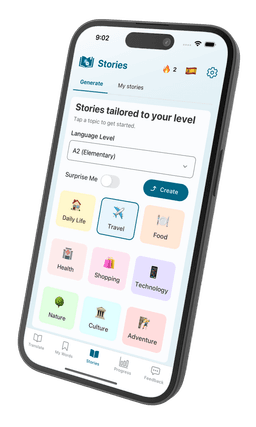
You're reading free stories on our website. Get the mobile app for audio narration, speaking practice, vocabulary saving, personalised stories, instant translations, and progress tracking.

Download on the App StoreGet it on Google Play
Audio
Translations
Progress

El misterio del mapa antiguo

Proficiency (C2)
5 min read

📖 You are reading the free text version. Get our mobile app for 🎧 audio narration, 💬 speaking practice, 🔄 instant translations, and 💾 vocabulary saving to enhance your learning experience.

En una ciudad llena de rascacielos y luces, Pablo encontró un mapa viejo en una librería olvidada.

El mapa no mostraba calles ni edificios, sino un camino hacia un lugar desconocido, marcado con símbolos extraños y una gran "X" roja.

Intrigado, Pablo decidió seguir el mapa después del trabajo. Caminó por calles, parques y hasta por túneles subterráneos. Cada señal lo llevaba más lejos de la ciudad y hacia un bosque antiguo.

El conflicto surgió cuando alcanzó un río ancho y caudaloso sin puente a la vista. No podía cruzar y sentía que el mapa lo había traicionado. Miró a su alrededor, buscando otra ruta, pero el bosque parecía interminable.

Entonces, recordó que llevaba una cuerda en su mochila. Usó la cuerda para asegurar una rama fuerte y cruzar con cuidado el río. Al otro lado, descubrió una pequeña cueva.

Dentro de la cueva, encontró una caja antigua con objetos de diferentes tiempos: monedas, cartas y un diario. Leyó las páginas y supo que el mapa era una invitación para descubrir historias olvidadas de la ciudad.

Al regresar, Pablo decidió escribir un libro con todo lo que había descubierto. No buscaba fama, sino que quería que más personas conocieran esos secretos y valoraran la historia que los rodea.

Su aventura terminó no con un tesoro material, sino con el descubrimiento del valor de las historias y la curiosidad por explorar lo desconocido.


Practise this Spanish story

Vocabulary in context

Important words and phrases

  • librería olvidada

    noun phrase

    forgotten bookstore

    Entró en una librería olvidada y encontró un atlas del siglo pasado.

    He entered a forgotten bookstore and found a century-old atlas.

  • camino hacia un lugar desconocido

    noun phrase

    path toward an unknown place

    El sendero parecía un camino hacia un lugar desconocido.

    The path seemed to lead toward an unknown place.

  • símbolos extraños

    noun phrase

    strange symbols

    Los símbolos extraños del manuscrito despertaron su curiosidad.

    The strange symbols in the manuscript awakened his curiosity.

  • túneles subterráneos

    noun phrase

    underground tunnels

    Los túneles subterráneos conectaban los antiguos almacenes.

    The underground tunnels connected the old warehouses.

  • río ancho y caudaloso

    noun phrase

    wide, fast-flowing river

    El río ancho y caudaloso bloqueaba el paso después de la lluvia.

    The wide, fast-flowing river blocked the way after the rain.

  • sin puente a la vista

    adverbial phrase

    with no bridge in sight

    Seguimos avanzando sin puente a la vista.

    We kept going with no bridge in sight.

  • buscar otra ruta

    verb phrase

    to look for another route

    Cuando la carretera se cerró, tuvieron que buscar otra ruta.

    When the road closed, they had to look for another route.

  • asegurar una rama fuerte

    verb phrase

    to secure a sturdy branch

    Antes de cruzar, aseguró una rama fuerte para no resbalar.

    Before crossing, he secured a sturdy branch so he would not slip.

  • historias olvidadas

    noun phrase

    forgotten stories

    El archivo conserva historias olvidadas que merecen leerse de nuevo.

    The archive preserves forgotten stories that deserve to be read again.

  • curiosidad por explorar lo desconocido

    noun phrase

    curiosity to explore the unknown

    Su curiosidad por explorar lo desconocido lo llevó más lejos de lo previsto.

    His curiosity to explore the unknown took him farther than expected.

Check your understanding

Comprehension questions

Choose an answer, check it, then move to the next question.

Question 1 of 3

  1. Question 1: current not answered
  2. Question 2: not answered
  3. Question 3: not answered
¿Por qué la cuerda fue crucial para Pablo?Why was the rope crucial for Pablo?

Notice the language

Language notes

grammar

no con ..., sino con ...

This structure corrects an expectation by contrasting two noun phrases or prepositional phrases. It is useful when you want to say that something is not one thing, but another. If the second part has its own verb, Spanish often uses "sino que" instead. Example: "No terminó con una derrota, sino con una lección importante." In the story, the pattern emphasizes that the ending is not material treasure, but a different kind of gain.

  • No terminó con una derrota, sino con una lección importante.

    It did not end with a defeat, but with an important lesson.

Keep reading

More Proficiency (C2) Stories
SpanishProficiency (C2)