Back to Upper Intermediate (B2) stories

Unlock the Complete Learning Experience

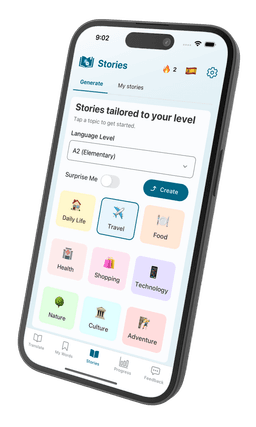
You're reading free stories on our website. Get the mobile app for audio narration, speaking practice, vocabulary saving, personalised stories, instant translations, and progress tracking.

Download on the App StoreGet it on Google Play
Audio
Translations
Progress

El misterio del lago escondido

Upper Intermediate (B2)
5 min read

📖 You are reading the free text version. Get our mobile app for 🎧 audio narration, 💬 speaking practice, 🔄 instant translations, and 💾 vocabulary saving to enhance your learning experience.

Una mañana clara, Lucía decidió explorar un bosque que nadie en el pueblo visitaba hace años. Había escuchado historias de un lago escondido, rodeado de altos árboles y lleno de aguas cristalinas. Quería descubrir la verdad por sí misma.

Con su mochila y mapa en mano, comenzó la aventura. Caminó entre caminos llenos de hojas, escuchó el canto de los pájaros, y disfrutó del aire fresco del bosque. Sin embargo, pronto se dio cuenta de que el mapa estaba incompleto y era difícil encontrar el lago.

Después de varias horas de caminata y dudas, Lucía vio un reflejo brillante entre los árboles. Siguiendo esa señal, llegó a un hermoso lago rodeado de flores y rocas. Pero allí no encontró solo belleza, también había una vieja cabaña con una puerta entreabierta.

Lucía sintió curiosidad y entró con cuidado. Dentro, encontró libros antiguos y objetos que indicaban que alguien había vivido allí haciendo estudios sobre la naturaleza. Sin embargo, no había nadie.

Decidió anotar todo lo que vio y luego regresar al pueblo para compartir el descubrimiento. Lucía no solo halló el lago escondido, sino también un lugar lleno de historias por contar y preservar. Su aventura no terminó con el descubrimiento, sino con la motivación de proteger ese secreto natural.


Practise this Spanish story

Vocabulary in context

Important words and phrases

  • explorar

    verb

    to explore

    Decidió explorar el bosque al amanecer.

    She decided to explore the forest at dawn.

  • lago escondido

    noun phrase

    hidden lake

    Encontraron un lago escondido detrás de las rocas.

    They found a hidden lake behind the rocks.

  • por sí misma

    adverbial phrase

    on her own

    Quería comprobarlo por sí misma.

    She wanted to check it for herself.

  • mochila

    noun

    backpack

    Llevaba agua y comida en la mochila.

    She carried water and food in her backpack.

  • en mano

    phrase

    in hand

    Entró en el sendero con el mapa en mano.

    She entered the path with the map in hand.

  • darse cuenta de

    verb phrase

    to realize

    Me di cuenta de que el sendero cambiaba de dirección.

    I realized that the path changed direction.

  • incompleto

    adjective

    incomplete

    El plano estaba incompleto, así que preguntó por otra ruta.

    The map was incomplete, so she asked for another route.

  • seguir esa señal

    verb phrase

    to follow that sign

    Decidieron seguir esa señal hasta llegar al río.

    They decided to follow that sign until they reached the river.

  • puerta entreabierta

    noun phrase

    slightly open door

    Vio una puerta entreabierta y llamó antes de entrar.

    She saw a slightly open door and knocked before entering.

  • con cuidado

    adverbial phrase

    carefully

    Abrió la caja con cuidado para no romperla.

    He opened the box carefully so as not to break it.

  • compartir el descubrimiento

    verb phrase

    to share the discovery

    Quiso compartir el descubrimiento con sus amigos.

    She wanted to share the discovery with her friends.

Check your understanding

Comprehension questions

Choose an answer, check it, then move to the next question.

Question 1 of 3

  1. Question 1: current not answered
  2. Question 2: not answered
  3. Question 3: not answered
¿Por qué le resultó difícil encontrar el lago al principio?Why was it difficult for her to find the lake at first?

Notice the language

Language notes

grammar

no solo..., sino también...

This structure is used to add a second idea that strengthens or expands the first one. It is very useful for contrast and emphasis. Form it with "no solo" + first idea, then "sino también" + second idea. Example: "La cabaña no solo era vieja, sino también misteriosa." In the story, it helps show that the place had both beauty and a hidden mystery.

  • La cabaña no solo era vieja, sino también misteriosa.

    The cabin was not only old, but also mysterious.

Keep reading

More Upper Intermediate (B2) Stories
SpanishUpper Intermediate (B2)