
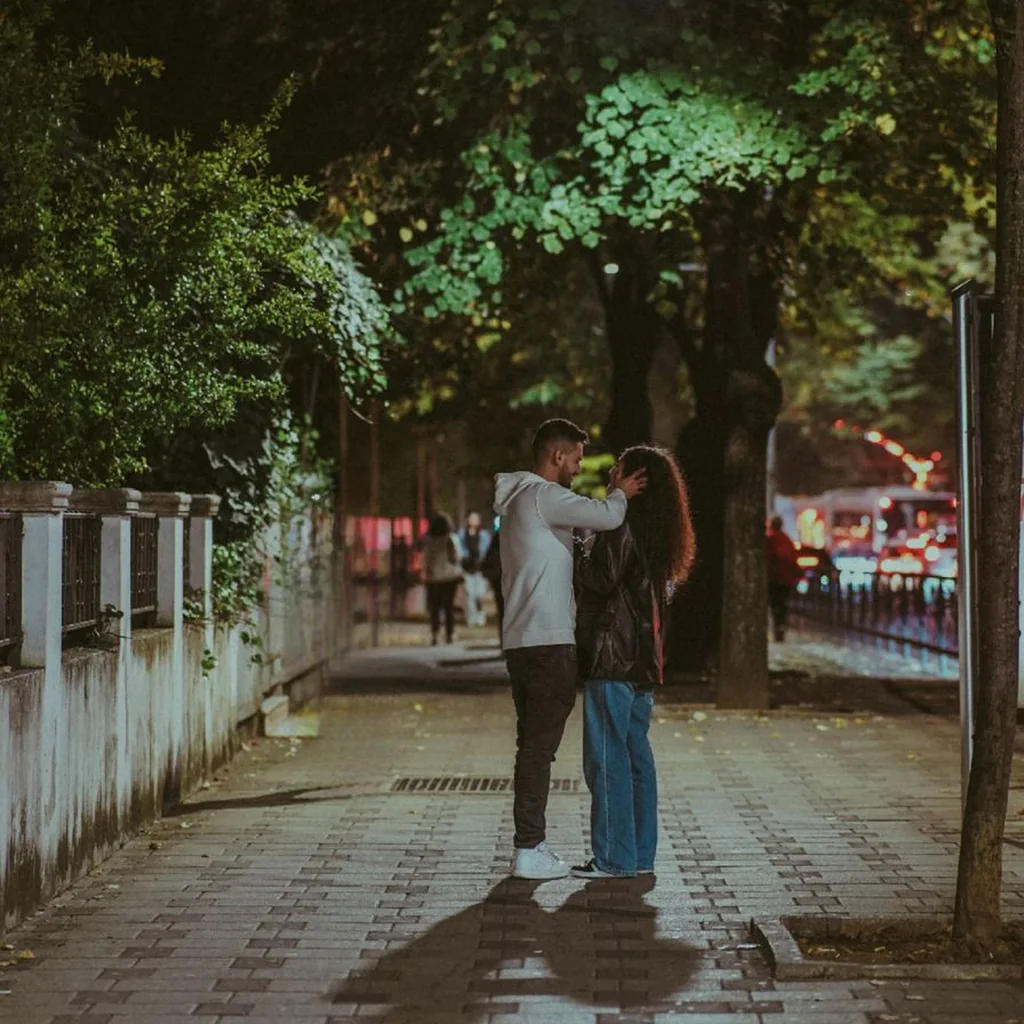
Photo: Ardit Mbrati on Pexels
Muy cerca
So Close
On an early date, Ana and Luis discover they grew up near each other and may have been in the same old neighborhood photo.
Three short parts. Read each part in Spanish first; tap “Show English” under a paragraph when you need the translation.


Part 1
Ana y Luis están en su segunda cita. Se encuentran en una cafetería pequeña y hablan de su infancia.
Show EnglishHide English
Ana and Luis are on their second date. They meet at a small café and talk about their childhoods.
—¿Dónde vivías cuando eras niño? —pregunta Ana.
Show EnglishHide English
“Where did you live when you were a child?” Ana asks.
—En la calle Sol, número doce. ¿Y tú?
Show EnglishHide English
“At 12 Sol Street. And you?”
Ana abre mucho los ojos.
Show EnglishHide English
Ana opens her eyes wide.
—¡Yo vivía en la calle Luna, número ocho!
Show EnglishHide English
“I lived at 8 Luna Street!”
Luis mira el mapa de su teléfono. Las dos calles están muy cerca, a solo dos calles de distancia.
Show EnglishHide English
Luis looks at the map on his phone. The two streets are very close, just two streets apart.
—Entonces vivíamos muy cerca —dice—. ¿Ibas al parque de la esquina?
Show EnglishHide English
“So we lived very close to each other,” he says. “Did you go to the park on the corner?”
—Sí, todos los sábados. También iba a la tienda de la señora Rosa.
Show EnglishHide English
“Yes, every Saturday. I also went to Mrs. Rosa’s shop.”
—¡Yo también! Compraba pan allí con mi madre.
Show EnglishHide English
“Me too! I bought bread there with my mother.”
Los dos se ríen. Hablan de sus casas, de la escuela y de los niños del barrio. Descubren que tenían la misma edad y que muchas veces estuvieron en los mismos lugares, pero nunca se conocieron.
Show EnglishHide English
They both laugh. They talk about their homes, their school, and the neighborhood children. They discover that they were the same age and were often in the same places, but they never met.
Ana mira su café y sonríe.
Show EnglishHide English
Ana looks at her coffee and smiles.
—Es increíble. Estuvimos tan cerca durante tantos años.
Show EnglishHide English
“It’s amazing. We were so close for so many years.”
Luis señala la puerta.
Show EnglishHide English
Luis points to the door.
—¿Quieres que demos un paseo por esas calles?
Show EnglishHide English
“Would you like to take a walk along those streets?”
Ana se levanta y toma su abrigo.
Show EnglishHide English
Ana stands up and takes her coat.
Part 2La foto antigua(The Old Photo)
Ana y Luis salen de la cafetería y caminan hacia la calle Sol. El día está fresco, pero hace sol. Luis señala una esquina.
Show EnglishHide English
Ana and Luis leave the café and walk toward Sol Street. The day is cool, but sunny. Luis points to a corner.
—Aquí estaba el parque —dice.
Show EnglishHide English
“The park was here,” he says.
Ahora hay bancos nuevos y flores. Ana mira un árbol grande.
Show EnglishHide English
Now there are new benches and flowers. Ana looks at a big tree.
—Yo jugaba aquí con mi hermano —cuenta—. Una vez perdí mi pelota.
Show EnglishHide English
“I used to play here with my brother,” she says. “Once, I lost my ball.”
—¡Yo encontré una pelota aquí! —responde Luis—. Pero fue hace muchos años.
Show EnglishHide English
“I found a ball here!” Luis replies. “But that was many years ago.”
Los dos se ríen y siguen caminando. Después llegan a la tienda de la señora Rosa. Ya no es una tienda, sino una pequeña panadería. En la puerta hay un cartel: «Pan caliente».
Show EnglishHide English
They both laugh and keep walking. Then they arrive at Mrs. Rosa’s shop. It is no longer a shop, but a small bakery. There is a sign on the door: “Hot bread.”
—Mi madre compraba pan aquí los domingos —dice Luis.
Show EnglishHide English
“My mother used to buy bread here on Sundays,” Luis says.
Ana mira por la ventana y ve una foto antigua del barrio. En la foto aparecen muchos niños delante del parque.
Show EnglishHide English
Ana looks through the window and sees an old photo of the neighborhood. In the photo, many children are standing in front of the park.
—Mira —dice—. Tal vez nosotros estamos en esta foto.
Show EnglishHide English
“Look,” she says. “Maybe we’re in this photo.”
Se acercan al cristal. ¿Podrán encontrarse entre tantos niños?
Show EnglishHide English
They move closer to the glass. Can they find themselves among so many children?
Part 3La foto del parque(The Park Photo)
Ana y Luis miran la foto con mucha atención. Hay muchos niños, pero una niña lleva un vestido rojo. Ana sonríe.
Show EnglishHide English
Ana and Luis look at the photo very carefully. There are many children, but one girl is wearing a red dress. Ana smiles.
—Yo tenía un vestido así —dice—. Y mira, llevo una pelota pequeña en la mano.
Show EnglishHide English
“I had a dress like that,” she says. “And look, I’m holding a small ball.”
Luis señala a un niño que está a su lado.
Show EnglishHide English
Luis points to a boy next to her.
—Ese niño lleva una gorra azul. Yo siempre llevaba una gorra azul.
Show EnglishHide English
“That boy is wearing a blue cap. I always wore a blue cap.”
Los dos se miran y se ríen. En la foto están muy cerca, pero todavía no se conocen. Ana mira la pelota y Luis mira hacia otro lado.
Show EnglishHide English
They look at each other and laugh. In the photo, they are very close, but they do not know each other yet. Ana looks at the ball, and Luis looks the other way.
La panadera sale y escucha la conversación.
Show EnglishHide English
The baker comes out and hears their conversation.
—Esa foto es de una fiesta en el parque —explica—. Muchos niños del barrio estaban allí.
Show EnglishHide English
“That photo is from a party in the park,” she explains. “Many children from the neighborhood were there.”
Ana y Luis le dan las gracias y compran dos panes calientes. Después se sientan en un banco del parque, como cuando eran niños.
Show EnglishHide English
Ana and Luis thank her and buy two hot loaves of bread. Then they sit on a park bench, just as they did when they were children.
—Vivíamos a solo dos calles —dice Ana—, pero nos conocimos muchos años después.
Show EnglishHide English
“We lived only two streets apart,” Ana says, “but we met many years later.”
—Tal vez hoy era el momento perfecto —responde Luis.
Show EnglishHide English
“Maybe today was the perfect time,” Luis replies.
Comparten el pan y siguen hablando. Ahora saben que sus vidas empezaron muy cerca, aunque tardaron muchos años en encontrarse.
Show EnglishHide English
They share the bread and keep talking. Now they know their lives began very close to each other, even though it took many years for them to meet.
Practise this Spanish story
Vocabulary in context
Important words and phrases
muy cerca
adjective phrasevery close
Mi casa está muy cerca de la escuela.
My house is very close to the school.
cita
noundate
Tenemos una cita mañana.
We have a date tomorrow.
cafetería
nouncafé
Nos vemos en la cafetería.
We meet at the café.
infancia
nounchildhood
Hablamos de nuestra infancia.
We talk about our childhood.
calle
nounstreet
Vivo en esta calle.
I live on this street.
parque
nounpark
Vamos al parque después de clase.
We go to the park after class.
tienda
nounshop
Voy a la tienda a comprar pan.
I go to the shop to buy bread.
pelota
nounball
El niño juega con una pelota.
The boy plays with a ball.
foto
nounphoto
Tengo una foto antigua de mi barrio.
I have an old photo of my neighborhood.
abrigo
nouncoat
Toma tu abrigo, hace frío.
Take your coat, it's cold.
panadería
nounbakery
Compramos pan en la panadería.
We buy bread at the bakery.
Check your understanding
Comprehension questions
Choose an answer, check it, then move to the next question.
Question 1 of 3
- Question 1: current not answered
- Question 2: not answered
- Question 3: not answered
Notice the language
Language notes
estar cerca de
Use estar cerca de to say that a person or place is near another place. It is a very useful pattern for talking about distance and location. You can reuse it with many places: "Mi casa está cerca del parque." In the story, the same idea appears in "Las dos calles están muy cerca".
Mi casa está cerca del parque.
My house is near the park.
More Spanish stories to read next
El boleto de lotería
The Lottery Ticket
Luis visits his neighborhood store to buy his weekly lottery ticket, but the machine is out of order.
Ana en la competición de gimnasia
Ana at the Gymnastics Competition
Ana takes part in a gymnastics competition and tries to remember her routine when she forgets a move.
Problemas con el teléfono
Problems with the Phone
Carlos calls customer service because his internet is not working and tries to speak with an agent.

En la farmacia
At the Pharmacy
Luis needs medicine for a sore throat in a foreign country, but he and the pharmacist do not speak the same language.