Back to Beginner (A1) stories

Unlock the Complete Learning Experience

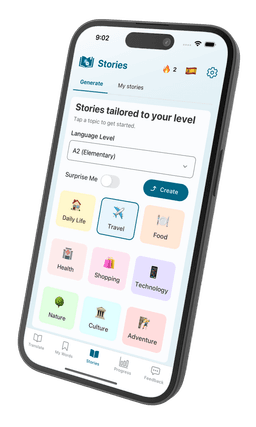
You're reading free stories on our website. Get the mobile app for audio narration, speaking practice, vocabulary saving, personalised stories, instant translations, and progress tracking.

Download on the App StoreGet it on Google Play
Audio
Translations
Progress

Un día extraño en la escuela

Beginner (A1)
5 min read

📖 You are reading the free text version. Get our mobile app for 🎧 audio narration, 💬 speaking practice, 🔄 instant translations, and 💾 vocabulary saving to enhance your learning experience.

Hoy en la escuela, Marta vio algo muy raro.

En la clase de matemáticas, el maestro escribió un número gigante en la pizarra, pero nadie entendía por qué. Marta miró a sus compañeros, y todos estaban confundidos.

La maestra dijo que era un juego nuevo para aprender números, pero nadie jugaba. En lugar de eso, los niños empezaron a reír y a contar historias tontas sobre números que no existen.

Marta pensó que era divertido ver cómo todos hablaban y se reían sin hacer la lección.

Cuando terminó la clase, la maestra preguntó si alguien quería explicar el número gigante. Pero nadie sabía qué decir, incluso la maestra sonrió y dijo que ella tampoco estaba segura.

En la siguiente clase, nadie habló del número grande y todo volvió a la normalidad. Marta pensó que a veces la escuela puede ser un lugar muy extraño, y eso también está bien.

Ella salió de la escuela pensando en lo divertido que fue ese día raro y esperando qué sorpresa tendrá mañana.


Practise this Spanish story

Vocabulary in context

Important words and phrases

  • escuela

    noun

    school

    Voy a la escuela.

    I go to school.

  • clase de matemáticas

    noun phrase

    math class

    La clase de matemáticas empieza a las ocho.

    Math class starts at eight.

  • pizarra

    noun

    board; chalkboard

    Escribo la palabra en la pizarra.

    I write the word on the board.

  • número gigante

    noun phrase

    huge number

    Veo un número gigante.

    I see a huge number.

  • compañeros

    noun

    classmates

    Mis compañeros son simpáticos.

    My classmates are nice.

  • confundidos

    adjective

    confused

    Todos están confundidos.

    Everyone is confused.

  • juego nuevo

    noun phrase

    new game

    Jugamos un juego nuevo.

    We play a new game.

  • reír

    verb

    to laugh

    Los niños empiezan a reír.

    The children start to laugh.

  • lección

    noun

    lesson

    La maestra explica la lección.

    The teacher explains the lesson.

  • normalidad

    noun

    normality; normal state

    Todo vuelve a la normalidad.

    Everything goes back to normal.

  • sorpresa

    noun

    surprise

    Tengo una sorpresa para ti.

    I have a surprise for you.

Check your understanding

Comprehension questions

Choose an answer, check it, then move to the next question.

Question 1 of 3

  1. Question 1: current not answered
  2. Question 2: not answered
  3. Question 3: not answered
¿Qué escribió el maestro en la pizarra?What did the teacher write on the board?

Notice the language

Language notes

grammar

nadie + verbo

Use nadie before a verb to mean "nobody" or "no one." This pattern is very common and easy to reuse with many verbs. For example: "Nadie habló en clase." In the story, it appears in sentences like "nadie entendía," "nadie jugaba," and "nadie sabía."

  • Nadie habló en clase.

    Nobody spoke in class.

Keep reading

More Beginner (A1) Stories
SpanishBeginner (A1)