


Back to Beginner (A1) stories

Unlock the Complete Learning Experience

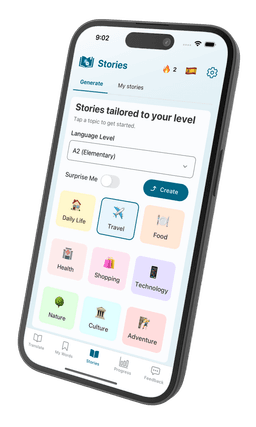
You're reading free stories on our website. Get the mobile app for audio narration, speaking practice, vocabulary saving, personalised stories, instant translations, and progress tracking.

Download on the App StoreGet it on Google Play
Audio
Translations
Progress

La sorpresa en el mercado

Beginner (A1)
5 min read

📖 You are reading the free text version. Get our mobile app for 🎧 audio narration, 💬 speaking practice, 🔄 instant translations, and 💾 vocabulary saving to enhance your learning experience.

Camila va al mercado para comprar frutas frescas.

En el mercado, hay muchas personas y colores. Camila mira y elige manzanas rojas y plátanos maduros.

De repente, ve un puesto que vende flores. Camila decide comprar una flor para su mamá. Le parece una buena idea para hacerla feliz.

Cuando Camila paga, la señora del puesto le da una flor extra como regalo. Camila sonríe mucho. No esperaba esa sorpresa.

Mientras camina hacia la salida, se siente contenta y piensa en la cara de su mamá al ver la flor.

En casa, Camila pone las frutas en la mesa y le da la flor a su mamá. Ella abraza a Camila y le dice que es un día especial.

Camila aprende que a veces, las pequeñas cosas y las sorpresas hacen que un día sea mejor.

Al final, no solo llevó frutas a casa, sino también alegría y cariño para su familia.

Practise this Spanish story

Vocabulary in context

Important words and phrases

  • mercado

    noun

    market

    El mercado está lleno de frutas.

    The market is full of fruit.

  • comprar

    verb

    to buy

    Voy a comprar pan.

    I’m going to buy bread.

  • frutas frescas

    phrase

    fresh fruit

    Quiero frutas frescas.

    I want fresh fruit.

  • mira

    verb

    looks

    Ella mira la mesa.

    She looks at the table.

  • elige

    verb

    chooses

    Él elige una fruta.

    He chooses a piece of fruit.

  • manzanas rojas

    phrase

    red apples

    Compro manzanas rojas.

    I buy red apples.

  • plátanos maduros

    phrase

    ripe bananas

    Los plátanos maduros son dulces.

    Ripe bananas are sweet.

  • puesto

    noun

    stall

    El puesto vende flores.

    The stall sells flowers.

  • regalo

    noun

    gift

    Es un regalo para mi mamá.

    It is a gift for my mom.

  • sonríe

    verb

    smiles

    Mi amiga sonríe mucho.

    My friend smiles a lot.

  • sorpresa

    noun

    surprise

    Tengo una sorpresa para ti.

    I have a surprise for you.

Check your understanding

Comprehension questions

Choose an answer, check it, then move to the next question.

Question 1 of 3

  1. Question 1: current not answered
  2. Question 2: not answered
  3. Question 3: not answered
¿A dónde va Camila?Where does Camila go?

Notice the language

Language notes

grammar

le da algo a alguien

Spanish often uses this pattern when one person gives something to another person. The little word le shows who receives the thing, and a + person makes the receiver clear. You can reuse it with many verbs of giving: "Le doy un libro a mi hermano." In the story, "le da una flor a su mamá" follows the same pattern.

  • Le doy un libro a mi hermano.

    I give my brother a book.

Keep reading

More Beginner (A1) Stories
SpanishBeginner (A1)