
Photo: Lee Dunican on Pexels
La veste oubliée
The Forgotten Jacket
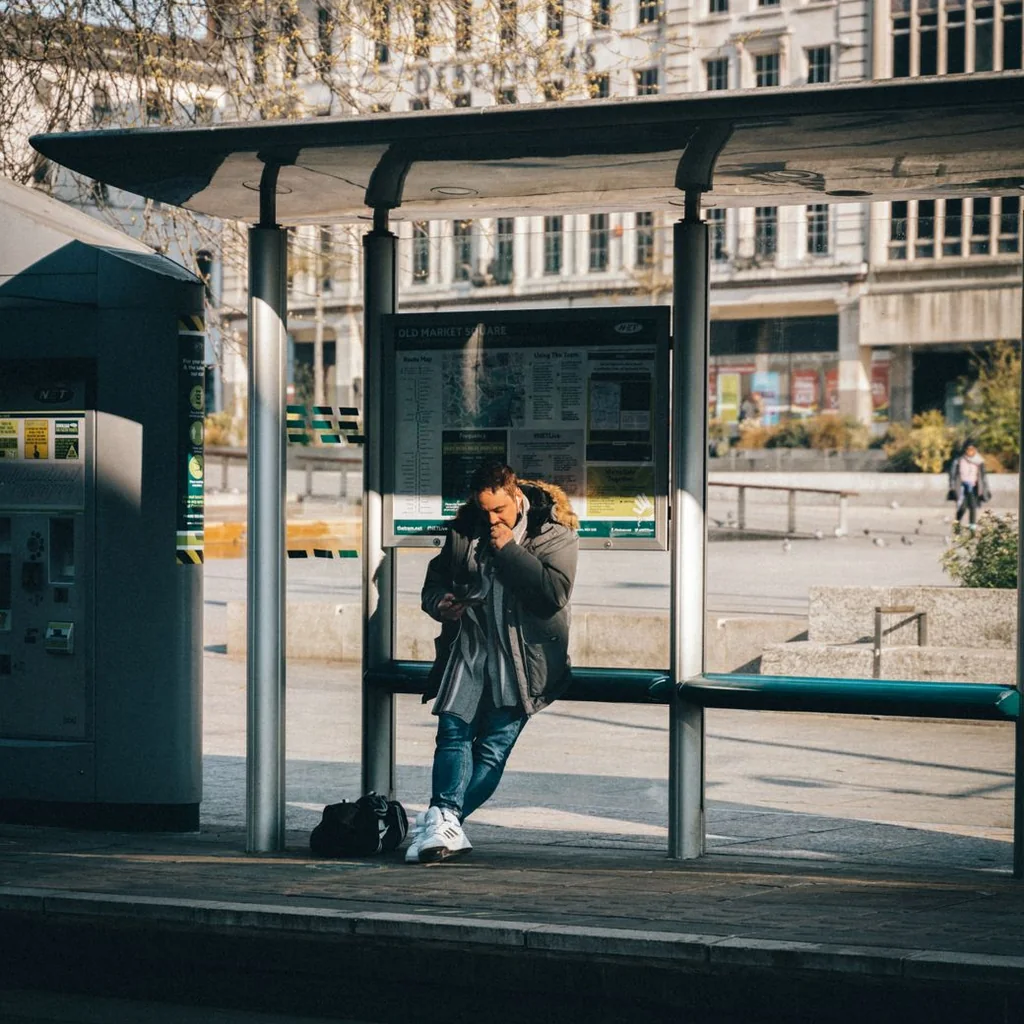
At a rainy bus stop, Alice notices a shivering man in a soaked shirt, a sodden newspaper over his head, and lends him her jacket.
Three short parts. Read each part in French first; tap “Show English” under a paragraph when you need the translation.


Part 1
À l’arrêt de bus, Alice remarque d’abord les dents de l’homme : elles claquent si fort qu’elle se demande s’il mâche un glaçon. Il porte une chemise trempée et tient au-dessus de sa tête un journal devenu transparent.
Show EnglishHide English
At the bus stop, the first thing Alice notices is the man’s teeth: they’re chattering so loudly that she wonders if he’s chewing an ice cube. He’s wearing a soaked shirt and holding over his head a newspaper that has turned transparent.
— Vous savez que ça ne sert plus à grand-chose, votre parapluie ? — Si, dit-il. J’essaie de sauver les mots croisés.
Show EnglishHide English
“You know your umbrella isn’t doing much good anymore, don’t you?” “It is,” he says. “I’m trying to save the crossword.”
Le panneau annonce vingt minutes d’attente. Alice regarde sa veste, puis l’homme, puis de nouveau sa veste.
Show EnglishHide English
The sign says there’s a twenty-minute wait. Alice looks at her jacket, then at the man, then back at her jacket.
— Tenez. J’ai un pull, moi. — Ah non, vous allez avoir froid à votre tour. — Je descends deux arrêts plus loin. Vous pourrez me la rendre d’ici là.
Show EnglishHide English
“Here. I’ve got a sweater.” “Oh no, you’ll be cold yourself.” “I’m getting off two stops farther on. You can give it back to me by then.”
Il finit par l’enfiler. Les manches lui arrivent à mi-avant-bras, ce qui lui donne l’air d’un enfant qui aurait grandi pendant la nuit.
Show EnglishHide English
He finally puts it on. The sleeves come halfway down his forearms, making him look like a child who has grown overnight.
— Elle vous va comme un gant, dit Alice. — Un gant un peu serré aux épaules, mais je prends.
Show EnglishHide English
“It fits you like a glove,” Alice says. “A glove that’s a little tight at the shoulders, but I’ll take it.”
Le bus arrive enfin, bondé. Ils montent par des portes différentes ; Alice se fraie un chemin jusqu’au composteur et le perd de vue derrière une forêt de sacs à dos.
Show EnglishHide English
The bus finally arrives, packed. They board through different doors; Alice makes her way to the ticket validator and loses sight of him behind a forest of backpacks.
À son arrêt, elle l’aperçoit tout au fond, coincé contre la vitre. Elle lui fait signe ; il répond d’un grand sourire et d’un geste de la main, tandis que les portes se referment entre eux.
Show EnglishHide English
At her stop, she spots him all the way at the back, wedged against the window. She waves; he replies with a broad smile and a wave of his hand as the doors close between them.
La veste ! Alice tape à la vitre. Il baisse les yeux, comprend, puis fouille ses poches et brandit son téléphone ; trop tard, le bus démarre.
Show EnglishHide English
The jacket! Alice taps on the window. He looks down, understands, then rummages through his pockets and holds up his phone; too late—the bus pulls away.
Elle reste là, sous l’abribus, à regarder ses feux rouges disparaître. Dans la poche intérieure de la veste, il y a ses clés.
Show EnglishHide English
She stays there under the bus shelter, watching its red taillights disappear. Her keys are in the jacket’s inside pocket.
Part 2La veste et le café(The Jacket and the Coffee)
Alice refait mentalement le trajet de ses clés, du vide-poche de l’entrée à la poche intérieure de sa veste. Aucun doute : elles ont pris le bus sans elle.
Show EnglishHide English
Alice retraces the journey of her keys in her mind, from the bowl by the front door to the inside pocket of her jacket. There’s no doubt: they took the bus without her.
Elle consulte le panneau. Le prochain passe dans onze minutes ; elle pourrait tenter de rattraper l’homme au terminus, à condition qu’il aille jusque-là.
Show EnglishHide English
She checks the sign. The next bus is in eleven minutes; she could try to catch the man at the terminus, provided he goes all the way there.
Son téléphone sonne. Numéro inconnu.
Show EnglishHide English
Her phone rings. Unknown number.
— Bonjour, c’est votre passager clandestin, dit l’homme. J’ai trouvé votre trousseau et le numéro sur le porte-clés. — Ma mère insistait pour qu’il y soit. Je lui dirai qu’elle avait raison, ça lui fera son mois.
Show EnglishHide English
“Hello, it’s your stowaway,” the man says. “I found your key ring and the number on the keychain.” “My mother insisted I put it there. I’ll tell her she was right; that’ll make her month.”
Il s’appelle Lucas. Il vient de descendre à l’arrêt suivant et propose de revenir à pied. Alice accepte, puis précise qu’elle a les cheveux bouclés et un pull vert.
Show EnglishHide English
His name is Lucas. He’s just got off at the next stop and offers to walk back. Alice agrees, then specifies that she has curly hair and is wearing a green sweater.
— Je vous reconnaîtrai. Vous êtes la seule personne à qui j’ai emprunté une veste aujourd’hui.
Show EnglishHide English
“I’ll recognize you. You’re the only person I’ve borrowed a jacket from today.”
Quand il arrive, il la porte encore. Il la retire aussitôt, lui rend ses clés et lui tend la veste avec une petite grimace.
Show EnglishHide English
When he arrives, he’s still wearing it. He takes it off at once, gives her back her keys, and hands her the jacket with a little grimace.
— Je crois que je vous dois aussi un nettoyage.
Show EnglishHide English
“I think I owe you a cleaning too.”
Sur la manche claire, une trace brune descend du coude au poignet. Lucas explique qu’en voulant sortir son téléphone, il a renversé le fond du café qu’il tenait à la main.
Show EnglishHide English
A brown stain runs down the light-colored sleeve from elbow to wrist. Lucas explains that when he tried to take out his phone, he spilled the dregs of the coffee he was holding.
Alice frotte la tache du pouce. Elle s’étale.
Show EnglishHide English
Alice rubs the stain with her thumb. It spreads.
— Magnifique. Je viens d’inventer une nouvelle couleur.
Show EnglishHide English
“Wonderful. I’ve just invented a new color.”
Lucas désigne la laverie, juste derrière l’arrêt. Par la vitrine, on voit une rangée de machines et un distributeur de lessive. Il sort quelques pièces de sa poche.
Show EnglishHide English
Lucas points to the laundromat just behind the stop. Through the window, they can see a row of machines and a detergent dispenser. He takes a few coins from his pocket.
— Je peux m’en occuper tout de suite, si vous avez le temps.
Show EnglishHide English
“I can take care of it right now, if you have time.”
Part 3La laverie et l’éclaircie(The Laundromat and the Break in the Clouds)
Alice regarde la manche, puis le bus qui approche. Elle fait signe à Lucas d’entrer dans la laverie ; le bus passe sans elle.
Show EnglishHide English
Alice looks at the sleeve, then at the approaching bus. She gestures for Lucas to go into the laundromat; the bus passes without her.
— Je vous préviens, dit-il, mes compétences se limitent au linge qui survit à quarante degrés. — Les miennes aussi. Ça nous fait un beau CV à deux.
Show EnglishHide English
“Just so you know,” he says, “my skills are limited to laundry that survives forty degrees.” “Mine too. Together, we make quite a résumé.”
Ils examinent l’étiquette. Trente degrés, programme délicat : Lucas glisse la veste dans une machine et achète une dose de lessive. Il introduit ses pièces une à une, sous l’œil d’Alice.
Show EnglishHide English
They examine the label. Thirty degrees, delicate cycle: Lucas puts the jacket in a machine and buys a dose of detergent. He feeds in his coins one by one under Alice’s watchful eye.
— Vous n’êtes pas obligée de surveiller. — Je sais. Mais maintenant que j’ai récupéré mes clés, je prends goût au contrôle.
Show EnglishHide English
“You don’t have to keep watch.” “I know. But now that I’ve got my keys back, I’m starting to enjoy being in control.”
Ils s’assoient sur le banc en plastique. À travers le hublot, la veste tourne lentement, puis disparaît sous la mousse.
Show EnglishHide English
They sit on the plastic bench. Through the porthole, the jacket turns slowly, then disappears beneath the suds.
Lucas lui raconte qu’il était sorti sans manteau parce que la météo annonçait une éclaircie. Alice lui montre son téléphone : le dessin du soleil est toujours là, au-dessus d’une grosse goutte de pluie.
Show EnglishHide English
Lucas tells her he went out without a coat because the forecast had promised a break in the clouds. Alice shows him her phone: the sun icon is still there, above a large raindrop.
— Il fallait lire les petites lignes, dit-il. — Ou regarder par la fenêtre.
Show EnglishHide English
“You should have read the small print,” he says. “Or looked out the window.”
Quand la machine s’arrête, Alice examine la manche. La trace a disparu ; la veste est humide, mais intacte. Elle l’enfile quand même, les épaules un peu rentrées.
Show EnglishHide English
When the machine stops, Alice examines the sleeve. The stain is gone; the jacket is damp but intact. She puts it on anyway, her shoulders drawn in a little.
— Vous êtes sûre ? — J’habite tout près. Et j’ai un pull, vous vous souvenez ?
Show EnglishHide English
“Are you sure?” “I live very close. And I’ve got a sweater, remember?”
Dehors, Lucas range les pièces qu’il n’a pas utilisées. Alice lui souhaite de rentrer avant la prochaine éclaircie. Il rit, remonte le col de sa chemise et traverse vers son arrêt.
Show EnglishHide English
Outside, Lucas puts away the coins he hasn’t used. Alice wishes him luck getting home before the next break in the clouds. He laughs, turns up the collar of his shirt, and crosses to his stop.
Alice vérifie une dernière fois que ses clés sont dans sa poche, puis attend le bus, les mains bien au chaud dans les manches de son pull.
Show EnglishHide English
Alice checks one last time that her keys are in her pocket, then waits for the bus with her hands tucked warmly into the sleeves of her sweater.
Practise this French story
Vocabulary in context
Important words and phrases
ne sert plus à grand-chose
phraseisn't of much use anymore
Ce vieux parapluie ne sert plus à grand-chose ; il fuit de partout.
This old umbrella isn't of much use anymore; it leaks everywhere.
trempée
adjectivesoaked
Je suis rentrée trempée après l’averse.
I got home soaked after the downpour.
se fraie un chemin
phrasemakes his way
Il se fraie un chemin entre les voyageurs pressés.
He makes his way through the hurried travelers.
à mi-avant-bras
phraseto mid-forearm
Les manches lui tombent à mi-avant-bras.
The sleeves fall to mid-forearm on him.
comme un gant
phraselike a glove
Cette robe lui va comme un gant.
That dress fits her like a glove.
passager clandestin
noun phrasestowaway
Le chat a voyagé comme un passager clandestin dans la valise.
The cat traveled like a stowaway in the suitcase.
trousseau
nounset of keys
J’ai accroché mon trousseau au crochet de l’entrée.
I hung my set of keys on the hook by the door.
prendre goût à
phraseto start enjoying; to develop a taste for
Elle a pris goût à ces trajets en bus.
She has started to enjoy those bus rides.
programme délicat
noun phrasedelicate cycle
Cette veste doit passer en programme délicat.
This jacket has to be washed on the delicate cycle.
remonte le col
phrasepulls up the collar
Il remonte le col de sa chemise avant de sortir.
He pulls up his shirt collar before going out.
Check your understanding
Comprehension questions
Choose an answer, check it, then move to the next question.
Question 1 of 3
- Question 1: current not answered
- Question 2: not answered
- Question 3: not answered
Notice the language
Language notes
à condition que + subjonctif
This construction introduces a necessary condition: the main action is possible only if the condition is met. In French, it is followed by the subjunctive. It is very useful for setting limits, permissions, or practical terms in a neutral or formal register. Example: “Elle pourrait tenter de rattraper l’homme au terminus, à condition qu’il aille jusque-là.” You can reuse it whenever one result depends on another event happening first.
Elle pourrait tenter de rattraper l’homme au terminus, à condition qu’il aille jusque-là.
She could try to catch up with the man at the terminus, provided he goes that far.
More French stories to read next
Le vase à deux euros
The Two-Euro Vase
In a charity shop, Emma finds a beautiful blue vase marked at two euros and suspects its price tag is a mistake.

Le pot de confiture
The Jar of Jam
At Émilie’s party, Antoine arrives with a jar of homemade apricot jam, while the other guests have brought expensive gifts.
L’affiche et le silence
The Poster and the Silence
At a museum, Philippe stands with Nathalie before a faded film poster as a guide tells the group that Jacques Tati drew it.
Jusqu’au banc
As Far as the Bench
In a public garden, Léna is learning to ride a bicycle while her grandfather Patrick holds the seat.