
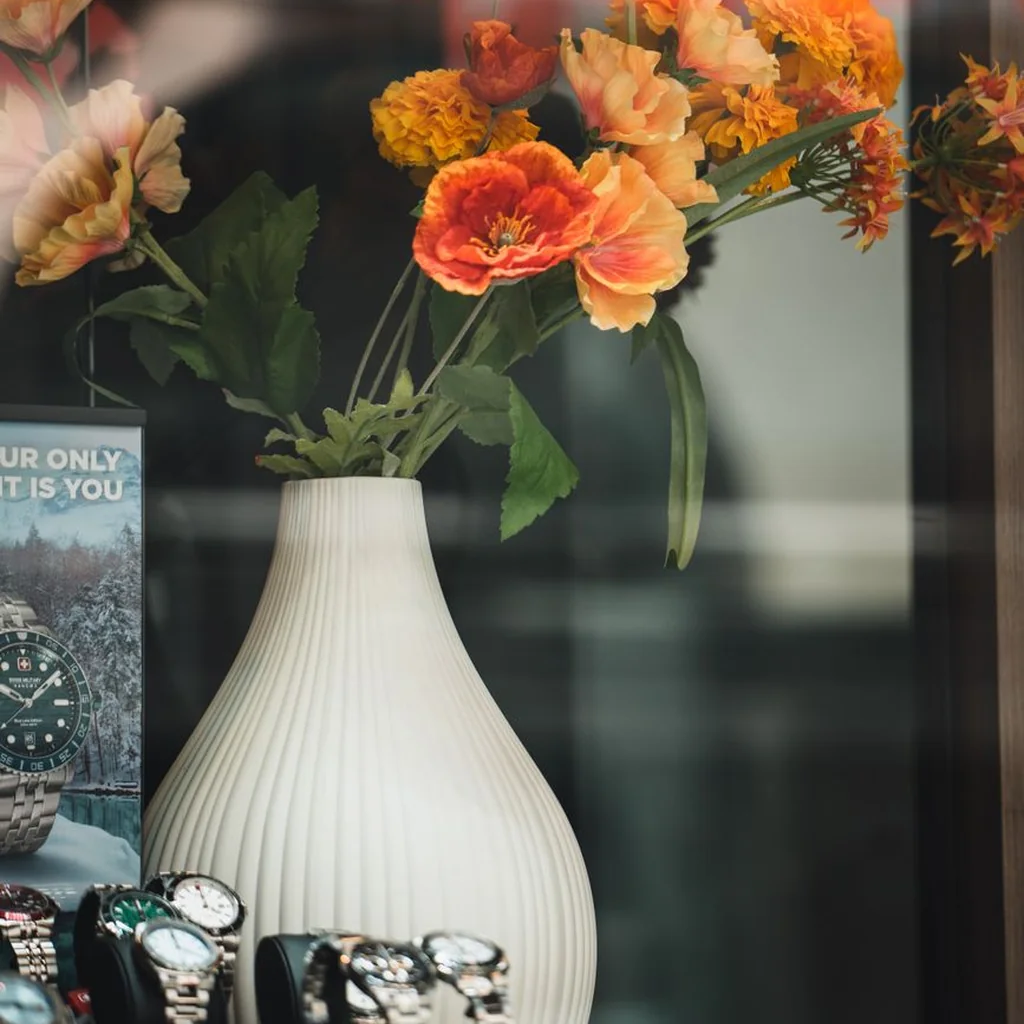
Photo: Oliver Schröder on Pexels
Le vase à deux euros
The Two-Euro Vase
In a charity shop, Emma finds a beautiful blue vase marked at two euros and suspects its price tag is a mistake.
Three short parts. Read each part in French first; tap “Show English” under a paragraph when you need the translation.


Part 1
Emma repéra le vase derrière une pile d’assiettes dépareillées, coincé entre une lampe sans abat-jour et un panier de pelotes. Il était d’un bleu profond, avec une petite irrégularité au bord qui lui donnait l’air d’avoir été façonné par quelqu’un, pas par une machine de mauvaise humeur.
Show EnglishHide English
Emma spotted the vase behind a stack of mismatched plates, wedged between a lamp without a shade and a basket of balls of yarn. It was a deep blue, with a slight irregularity around the rim that made it look as though it had been shaped by someone, not by a machine in a bad mood.
Elle le prit à deux mains et le souleva avec précaution. Sous le pied, une étiquette indiquait : « 2 € ».
Show EnglishHide English
She picked it up with both hands and lifted it carefully. Underneath the base, a label read: “€2.”
Deux euros ? Pour ce prix-là, la semaine précédente, elle avait eu droit à un café tiède servi dans un gobelet qui fuyait. Elle avait passé l’après-midi avec une tache sur sa manche pour tout souvenir.
Show EnglishHide English
Two euros? For that price, the week before, she had got a lukewarm coffee served in a leaky cup. All she had to show for the afternoon was a stain on her sleeve.
Derrière le comptoir de la boutique solidaire, une femme triait des boutons par couleur, l’air aussi concentré que si elle jouait sa réputation sur les nuances de vert. Emma posa le vase devant elle, en prenant soin de ne pas masquer l’étiquette.
Show EnglishHide English
Behind the counter of the charity shop, a woman was sorting buttons by color, looking as focused as if her reputation depended on the shades of green. Emma set the vase in front of her, taking care not to cover the label.
— Bonjour. C’est bien le prix ?
Show EnglishHide English
“Hello. Is that really the price?”
La femme jeta un coup d’œil au papier, puis à Emma.
Show EnglishHide English
The woman glanced at the paper, then at Emma.
— C’est ce qui est marqué, en tout cas.
Show EnglishHide English
“That’s what it says, anyway.”
— Oui, mais il est drôlement beau pour deux euros.
Show EnglishHide English
“Yes, but it’s awfully beautiful for two euros.”
— Vous préféreriez qu’il soit moche ? On a un rayon pour ça aussi.
Show EnglishHide English
“Would you prefer it to be ugly? We have a section for that, too.”
Emma sourit, sans lâcher le vase. Elle avait déjà imaginé les branches de mimosa qu’elle y mettrait, ce qui ne l’aidait pas à jouer les clientes parfaitement désintéressées.
Show EnglishHide English
Emma smiled, without letting go of the vase. She had already imagined the mimosa branches she would put in it, which did not help her play the perfectly disinterested customer.
— Je me disais qu’il manquait peut-être un zéro.
Show EnglishHide English
“I was thinking perhaps it was missing a zero.”
La femme posa sa boîte de boutons et prit le vase. Elle le tourna lentement, s’arrêta sur l’étiquette, puis appela vers l’arrière-boutique :
Show EnglishHide English
The woman set down her box of buttons and took the vase. She turned it slowly, paused at the label, then called toward the back room:
— Gérard, tu peux venir une seconde ? C’est toi qui as étiqueté celui-là ?
Show EnglishHide English
“Gérard, can you come here a second? Were you the one who put the label on this one?”
Part 2L’erreur de l’étiquette(The Wrong Price Tag)
Gérard apparut avec un rouleau de papier bulle sous le bras. Il examina le vase, plissa les yeux et hocha la tête, comme si l’affaire était entendue.
Show EnglishHide English
Gérard appeared with a roll of bubble wrap tucked under his arm. He examined the vase, narrowed his eyes, and nodded as if the matter were settled.
— Oui. Deux euros. Il était dans le carton des bibelots, avec une anse cassée.
Show EnglishHide English
“Yes. Two euros. It was in the knickknacks box, with a broken handle.”
Emma baissa les yeux vers le vase, dont les flancs étaient parfaitement lisses. Elle en fit presque le tour du regard, au cas où quelque chose lui aurait échappé.
Show EnglishHide English
Emma lowered her eyes to the vase, whose sides were perfectly smooth. She looked almost all the way around it, in case she had missed something.
— Une anse ?
Show EnglishHide English
“A handle?”
Gérard le regarda de nouveau, puis se gratta le menton.
Show EnglishHide English
Gérard looked at it again, then scratched his chin.
— Ah non. Celui avec l’anse, c’était un pichet. Même bleu, cela dit.
Show EnglishHide English
“Oh, no. The one with the handle was a pitcher. The same blue, though.”
Derrière Emma, une cliente qui attendait avec un sac de livres toussota. La femme du comptoir lui adressa un sourire d’excuse, tandis que Gérard décollait doucement un coin de l’étiquette, comme si la réponse pouvait se cacher dessous.
Show EnglishHide English
Behind Emma, a customer waiting with a bag of books cleared her throat. The woman at the counter gave her an apologetic smile, while Gérard gently peeled up one corner of the label, as if the answer might be hiding underneath.
— J’ai dû intervertir les deux. Le vase était à quinze.
Show EnglishHide English
“I must have switched the two. The vase was fifteen.”
Quinze euros, c’était encore une affaire, pensa Emma. Son sourire se raidit tout de même ; derrière elle, la cliente avait soudain l’air très occupée à lire les titres des livres qui dépassaient de son sac.
Show EnglishHide English
Fifteen euros was still a bargain, Emma thought. Even so, her smile stiffened; behind her, the customer suddenly looked very busy reading the titles of the books sticking out of her bag.
— Je peux vous le laisser à deux, dit Gérard. C’est notre erreur.
Show EnglishHide English
“I can let you have it for two,” Gérard said. “It was our mistake.”
— Et le pichet, demanda Emma, vous l’avez vendu quinze ?
Show EnglishHide English
“And the pitcher,” Emma asked, “did you sell that for fifteen?”
— Non, il est toujours là. Je vais lui remettre son étiquette à deux euros.
Show EnglishHide English
“No, it’s still here. I’ll put its two-euro label back on.”
La cliente étouffa un rire. Emma sortit son portefeuille, hésita à peine et tendit un billet de vingt euros.
Show EnglishHide English
The customer stifled a laugh. Emma took out her wallet, hesitated only briefly, and handed over a twenty-euro bill.
— Je vais le prendre à quinze. Autant éviter que le pichet se sente lésé.
Show EnglishHide English
“I’ll take it for fifteen. Might as well keep the pitcher from feeling slighted.”
Gérard ouvrit la caisse, fouilla le tiroir et releva la tête.
Show EnglishHide English
Gérard opened the cash register, rummaged in the drawer, and looked up.
— Alors là, évidemment, je n’ai plus un seul billet de cinq.
Show EnglishHide English
“Well, of course, I don’t have a single five-euro bill left.”
Part 3Le compte est bon(The Numbers Add Up)
Gérard compta les pièces dans le tiroir pendant qu’Emma regardait son billet de vingt, comme s’il allait se décider à faire l’appoint tout seul.
Show EnglishHide English
Gérard counted the coins in the drawer while Emma watched her twenty-euro bill, as if it might decide to become the exact amount on its own.
— J’ai de quoi vous rendre, dit-il, mais ça va faire un petit paquet.
Show EnglishHide English
“I have enough to give you your change,” he said, “but it’ll be quite a little pile.”
Il aligna sur le comptoir deux pièces de deux euros, puis quatre pièces de vingt centimes et deux de dix. La cliente aux livres suivait l’opération d’un air sérieux, comme devant une finale de jeu télévisé.
Show EnglishHide English
He lined up two two-euro coins on the counter, then four twenty-cent coins and two ten-cent coins. The customer with the books followed the proceedings with a serious expression, as if watching the final of a game show.
— Le compte est bon, dit-elle.
Show EnglishHide English
“The numbers add up,” she said.
— Et sans calculatrice, ajouta Gérard. On ne se refuse rien.
Show EnglishHide English
“And without a calculator,” Gérard added. “We spare no expense.”
Emma ouvrit son porte-monnaie, déjà plein de tickets de caisse qu’elle promettait depuis des semaines de jeter. La fermeture résista un instant, puis céda avec un bruit sec.
Show EnglishHide English
Emma opened her purse, already full of receipts she had been promising for weeks to throw away. The clasp resisted for a moment, then gave way with a sharp click.
La femme du comptoir lui tendit un petit sachet en papier pour les pièces. Emma les y fit glisser une à une, sous l’œil approbateur de la cliente.
Show EnglishHide English
The woman at the counter handed her a small paper bag for the coins. Emma slid them in one by one, under the customer’s approving gaze.
— Merci. Je vais finir par repartir avec plus d’emballage que de vase.
Show EnglishHide English
“Thank you. I’m going to end up leaving with more packaging than vase.”
— Attendez de voir ce que Gérard lui prépare.
Show EnglishHide English
“Just wait until you see what Gérard has in store for it.”
Il avait déroulé une grande feuille de papier bulle et y enveloppait le vase avec l’application de quelqu’un qui borde un enfant. Emma lui proposa de le porter contre elle, mais il secoua la tête.
Show EnglishHide English
He had unrolled a large sheet of bubble wrap and was wrapping the vase with the care of someone tucking in a child. Emma offered to carry it against her, but he shook his head.
— Avec vos cinq euros en pièces, vous aurez déjà les mains prises.
Show EnglishHide English
“With your five euros in coins, your hands will already be full.”
Dehors, elle glissa le sachet dans sa poche et serra le paquet sous son bras. En passant devant le fleuriste, elle s’arrêta devant les bottes de mimosa.
Show EnglishHide English
Outside, she slipped the bag into her pocket and tucked the package under her arm. Passing the florist, she stopped in front of the bunches of mimosa.
Les pièces étaient là, justement. Elle entra et en ressortit avec quelques branches, qu’elle imaginait déjà dans le vase bleu.
Show EnglishHide English
She had the coins, after all. She went in and came back out with a few branches, already picturing them in the blue vase.
Practise this French story
Vocabulary in context
Important words and phrases
repéra
verbspotted
Elle repéra la faute dans le devis dès la première lecture.
She spotted the mistake in the estimate on the first reading.
d’assiettes dépareillées
noun phraseof mismatched plates
La table était couverte d’assiettes dépareillées.
The table was covered with mismatched plates.
en tout cas
expressionin any case
En tout cas, je ne vais pas me plaindre.
In any case, I'm not going to complain.
intervertir
verbto swap
Ils ont interverti les étiquettes par erreur.
They swapped the labels by mistake.
l’affaire était entendue
expressionthe matter was settled
Après des heures de discussion, l’affaire était entendue.
After hours of discussion, the matter was settled.
faire l’appoint
expressionto pay the exact amount
Le client a fait l’appoint avec des pièces.
The customer paid the exact amount with coins.
Le compte est bon
expressionthe total is correct
Le compte est bon, vous pouvez vérifier.
The total is correct; you can check.
on ne se refuse rien
expressionwe don't deny ourselves anything
On ne se refuse rien ce soir : nous avons pris un dessert.
We're not denying ourselves anything tonight: we had dessert.
lésé
adjectivewronged; shortchanged
Elle s’est sentie lésée par le changement de tarif.
She felt wronged by the price change.
Check your understanding
Comprehension questions
Choose an answer, check it, then move to the next question.
Question 1 of 3
- Question 1: current not answered
- Question 2: not answered
- Question 3: not answered
Notice the language
Language notes
comme si + imparfait
This pattern introduces an unreal or merely imagined comparison. It helps the speaker describe an impression rather than a literal fact, and it is common in narrative prose and careful speech. Use it to make a description more vivid or to hint at attitude: « Il examina le vase, plissa les yeux et hocha la tête, comme si l’affaire était entendue. » To imagine something that happened before the main action, use the pluperfect instead: « Il tremblait comme s’il avait vu un fantôme. »
Il examina le vase, plissa les yeux et hocha la tête, comme si l’affaire était entendue.
He examined the vase, narrowed his eyes, and nodded as if the matter were settled.
More French stories to read next
Le pot de confiture
The Jar of Jam
At Émilie’s party, Antoine arrives with a jar of homemade apricot jam, while the other guests have brought expensive gifts.
L’affiche et le silence
The Poster and the Silence
At a museum, Philippe stands with Nathalie before a faded film poster as a guide tells the group that Jacques Tati drew it.
Jusqu’au banc
As Far as the Bench
In a public garden, Léna is learning to ride a bicycle while her grandfather Patrick holds the seat.
Le gratin de poireaux
The Leek Gratin
Louise sets the table with cloth napkins and serves her old friend Jade, a vegetarian, a leek and potato gratin.