
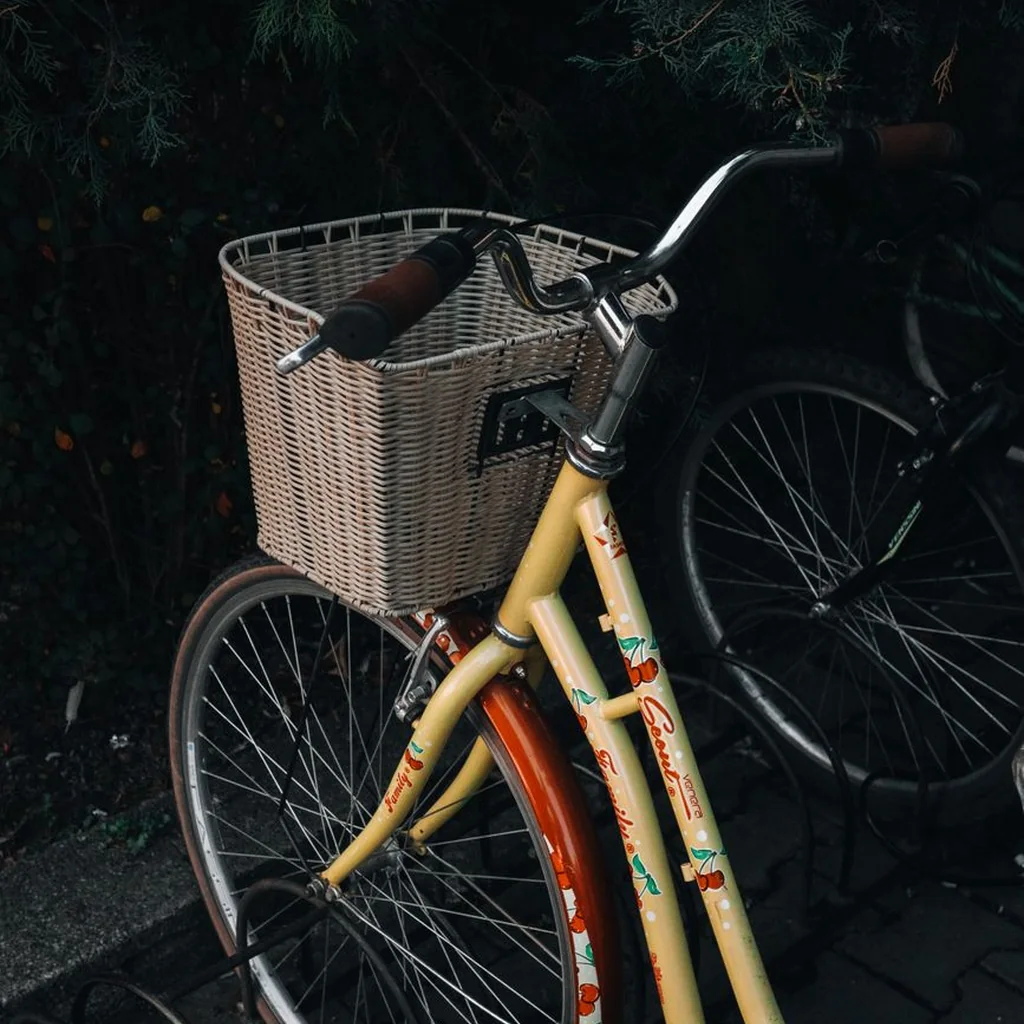
Photo: Aleksandar Spasojevic on Pexels
Jusqu’au banc
As Far as the Bench
In a public garden, Léna is learning to ride a bicycle while her grandfather Patrick holds the seat.
Three short parts. Read each part in French first; tap “Show English” under a paragraph when you need the translation.


Part 1
— Tu tiens toujours ?
Show EnglishHide English
— Are you still holding on?
— Comme à la prunelle de mes yeux.
Show EnglishHide English
— Like you’re the apple of my eye.
Léna tourne la tête pour vérifier. Aussitôt, le guidon part à gauche et la roue avant mord dans l’herbe. Son grand-père retient la selle juste à temps ; lui, en revanche, met le pied dans une flaque.
Show EnglishHide English
Léna turns her head to check. At once, the handlebars veer left and the front wheel bites into the grass. Her grandfather catches the seat just in time; he, on the other hand, steps into a puddle.
— Regarde devant toi, dit-il.
Show EnglishHide English
— Look straight ahead, he says.
— Facile à dire, t’es derrière.
Show EnglishHide English
— Easy for you to say. You’re behind me.
Dans l’allée du jardin public, deux enfants filent sur leurs vélos sans roulettes. Léna les suit des yeux jusqu’à ce qu’ils disparaissent, puis scrute ses chaussures. Patrick essuie son pantalon d’une main, sans lâcher la selle de l’autre.
Show EnglishHide English
Along the path in the public garden, two children zip by on their bikes without training wheels. Léna follows them with her eyes until they disappear, then studies her shoes. Patrick wipes his trousers with one hand, without letting go of the seat with the other.
— On avait dit jusqu’au banc, rappelle-t-elle.
Show EnglishHide English
— We said as far as the bench, she reminds him.
— Et je suis encore là.
Show EnglishHide English
— And I’m still here.
— Oui, mais t’as dit pareil quand tu m’as emmenée chez le dentiste, et après t’es resté dans la salle d’attente.
Show EnglishHide English
— Yes, but you said the same thing when you took me to the dentist, and then you stayed in the waiting room.
Patrick ouvre la bouche, la referme. Il remet la pédale à hauteur du pied de Léna. Elle appuie, il trottine ; le vélo avance par petits coups, comme s’il hésitait à leur faire confiance.
Show EnglishHide English
Patrick opens his mouth, then closes it. He moves the pedal to the level of Léna’s foot. She presses down, he trots alongside; the bike moves forward in little jolts, as if it were hesitating to trust them.
À trois mètres du banc, il sent la selle se stabiliser sous sa paume. Léna pédale enfin sans zigzaguer. Il desserre les doigts, puis les referme quand elle crie :
Show EnglishHide English
Three metres from the bench, he feels the seat steady beneath his palm. Léna is finally pedalling without zigzagging. He loosens his fingers, then closes them again when she calls out:
— Tu me préviens avant de lâcher, hein ?
Show EnglishHide English
— You’ll tell me before you let go, right?
— Promis.
Show EnglishHide English
— I promise.
Elle freine près du banc et pose un pied par terre. Patrick profite de la pause pour reprendre son souffle et jette un coup d’œil à sa chaussure trempée. Léna se retourne, les joues rouges.
Show EnglishHide English
She brakes near the bench and puts one foot on the ground. Patrick takes advantage of the pause to catch his breath and glances at his soaked shoe. Léna turns around, her cheeks red.
— Bon. Maintenant, tu me dis quand tu comptes le faire.
Show EnglishHide English
— All right. Now tell me when you’re planning to do it.
Part 2Apprendre à rouler(Learning to Ride)
Patrick s’assoit sur le banc et regarde l’allée. À cette heure-ci, elle est presque vide ; il y a bien le monsieur qui promène son chien, mais il prend toujours le chemin près des arbres.
Show EnglishHide English
Patrick sits on the bench and looks down the path. At this time of day, it is almost empty; there’s the man walking his dog, to be sure, but he always takes the path by the trees.
— Quand tu rouleras assez vite pour tenir toute seule, dit-il.
Show EnglishHide English
— When you’re going fast enough to balance on your own, he says.
— Et comment je saurai que je roule assez vite ?
Show EnglishHide English
— And how will I know I’m going fast enough?
— Je te le dirai.
Show EnglishHide English
— I’ll tell you.
Léna plisse les yeux, comme si elle cherchait la petite ligne en bas du contrat. Elle fait avancer le vélo à pied jusqu’au début de l’allée, puis remonte en selle. Patrick se remet derrière elle, une main posée sur le petit croissant de plastique rose.
Show EnglishHide English
Léna narrows her eyes, as if she were looking for the small print at the bottom of a contract. She walks the bike to the start of the path, then climbs back onto the seat. Patrick gets behind her again, one hand resting on the little pink plastic crescent.
— Prête ?
Show EnglishHide English
— Ready?
— Attends. Si je tombe, tu dis pas « c’est le métier qui rentre ».
Show EnglishHide English
— Wait. If I fall, you’re not going to say, “That’s how you learn.”
— Je n’ai jamais dit ça.
Show EnglishHide English
— I’ve never said that.
— Tu l’as dit quand j’ai cassé une assiette.
Show EnglishHide English
— You said it when I broke a plate.
— C’est vrai. Et ta mère m’a regardé comme si j’allais payer le service entier.
Show EnglishHide English
— That’s true. And your mother looked at me as if I were going to have to pay for the whole set.
Léna sourit malgré elle. Elle pousse sur la pédale, prend de la vitesse. Patrick court à côté, courbé en deux ; au bout de quelques mètres, sa main ne fait plus que suivre la selle.
Show EnglishHide English
Léna smiles despite herself. She pushes down on the pedal and picks up speed. Patrick runs alongside, bent double; after a few metres, his hand is only following the seat.
— Là, tu pourrais presque y aller toute seule.
Show EnglishHide English
— There, you could almost do it on your own.
— Presque, ça compte pas !
Show EnglishHide English
— Almost doesn’t count!
Elle se crispe et le vélo se met à danser. Patrick le rattrape avant qu’il ne parte dans l’herbe. Elle freine net et descend, furieuse.
Show EnglishHide English
She tenses, and the bike starts to wobble. Patrick catches it before it veers into the grass. She brakes abruptly and gets off, furious.
— Tu vois bien que j’y arrive pas.
Show EnglishHide English
— You can see I can’t do it.
Il voudrait lui répondre, mais elle s’accroupit près de la roue arrière. Un lacet s’est défait et traîne dangereusement près des rayons.
Show EnglishHide English
He wants to answer her, but she squats beside the back wheel. A shoelace has come undone and is dangling dangerously close to the spokes.
— Bouge pas, dit-elle. Je vais le coincer sous ma chaussette.
Show EnglishHide English
— Don’t move, she says. I’ll tuck it under my sock.
Part 3Le lâcher-prise à vélo(Letting Go on a Bike)
Léna fourre le lacet sous sa chaussette, puis tire dessus pour vérifier qu’il ne ressort pas. Patrick tient le vélo droit pendant qu’elle se remet en selle et replace ses pieds sur les pédales.
Show EnglishHide English
Léna tucks the shoelace under her sock, then gives it a tug to check that it won’t come loose. Patrick holds the bike steady while she climbs back onto the seat and puts her feet on the pedals again.
— Cette fois, tu me préviens vraiment ?
Show EnglishHide English
— This time, you really will tell me?
— Vraiment. Et dès que tu veux t’arrêter, tu serres les freins doucement.
Show EnglishHide English
— Really. And as soon as you want to stop, squeeze the brakes gently.
Elle démarre. Patrick la suit, la main sur la selle. Il connaît maintenant le moment où elle cesse de peser contre ses doigts : le vélo file droit, les épaules de Léna s’abaissent.
Show EnglishHide English
She sets off. Patrick follows her, his hand on the seat. He now knows the moment when she stops pressing against his fingers: the bike goes straight, Léna’s shoulders relax.
Il pourrait la retenir encore jusqu’au banc, puis recommencer demain. Rien ne l’en empêche, à part peut-être son souffle qui commence déjà à lui manquer.
Show EnglishHide English
He could keep holding her until the bench, then try again tomorrow. Nothing is stopping him, except perhaps that he is already starting to run out of breath.
— Je vais lâcher, dit-il.
Show EnglishHide English
— I’m going to let go, he says.
— Pas tout de suite !
Show EnglishHide English
— Not yet!
Il garde la main en place. Léna pédale encore ; sa roue passe sur une feuille sans dévier. Patrick sent son souffle se raccourcir.
Show EnglishHide English
He keeps his hand in place. Léna keeps pedalling; her wheel rolls over a leaf without veering. Patrick feels his breath shortening.
— Là ? demande-t-il.
Show EnglishHide English
— Now? he asks.
— Là.
Show EnglishHide English
— Now.
Il ouvre la main. Léna continue, raide comme un piquet, puis prend un peu d’aisance. Arrivée au banc, elle freine trop fort, pose les deux pieds par terre et manque de s’asseoir sur le cadre. Patrick la rejoint en boitant légèrement.
Show EnglishHide English
He opens his hand. Léna keeps going, stiff as a post, then begins to loosen up. When she reaches the bench, she brakes too hard, puts both feet on the ground, and nearly sits on the frame. Patrick catches up with her, limping slightly.
— T’as vu ? lance-t-elle.
Show EnglishHide English
— Did you see? she calls.
— J’étais aux premières loges.
Show EnglishHide English
— I had a front-row seat.
Elle regarde la distance parcourue, puis son grand-père. Il masse discrètement son genou et fait mine de s’intéresser à sa chaussure mouillée.
Show EnglishHide English
She looks at the distance she has travelled, then at her grandfather. He discreetly rubs his knee and pretends to take an interest in his wet shoe.
— Pour revenir, je peux marcher à côté de toi.
Show EnglishHide English
— On the way back, I can walk beside you.
— Tu pourrais aussi rouler. Je t’attends ici, mais compte pas sur moi pour te courir après.
Show EnglishHide English
— You could ride, too. I’ll wait for you here, but don’t count on me to run after you.
Elle repart en riant. Cette fois, il la regarde s’éloigner, les mains dans les poches.
Show EnglishHide English
She sets off again, laughing. This time, he watches her ride away, his hands in his pockets.
Practise this French story
Vocabulary in context
Important words and phrases
Comme à la prunelle de mes yeux
idiomWith extreme care; as something very precious
Je tiens à ce carnet comme à la prunelle de mes yeux.
I treasure this notebook like the apple of my eye.
en revanche
connective adverbon the other hand; by contrast
Il aime le vélo ; en revanche, il déteste courir.
He likes cycling; on the other hand, he hates running.
reprendre son souffle
verbal phraseto catch one's breath
Il s’arrête un instant pour reprendre son souffle.
He stops for a moment to catch his breath.
jeter un coup d’œil
verbal idiomto glance
Elle jette un coup d’œil à l’écran avant de répondre.
She glances at the screen before answering.
prendre de la vitesse
verbal phraseto pick up speed
Après le virage, le vélo prend de la vitesse.
After the turn, the bike picks up speed.
aux premières loges
idiomin the best position to see something; with a front-row view
J’étais aux premières loges pour voir sa réaction.
I had a front-row view of his reaction.
faire mine de
constructionto pretend; to act as if
Il fait mine de ne pas entendre la remarque.
He pretends not to hear the remark.
se crisper
verbto tense up
Elle se crispe dès qu’elle entend le bruit.
She tenses up as soon as she hears the noise.
raide comme un piquet
similestiff as a board; very stiffly
Il est resté raide comme un piquet pendant l’annonce.
He stood stiff as a board during the announcement.
Check your understanding
Comprehension questions
Choose an answer, check it, then move to the next question.
Question 1 of 3
- Question 1: current not answered
- Question 2: not answered
- Question 3: not answered
Notice the language
Language notes
faire mine de + infinitif
This construction means to act as if you were doing something, often with a hint of pretense or understatement. It is reusable with many verbs: for example, "Patrick fait mine de s’intéresser à sa chaussure mouillée." The phrase is useful when someone wants to appear unconcerned, neutral, or only partly engaged while actually noticing everything.
Patrick fait mine de s’intéresser à sa chaussure mouillée.
Patrick pretends to be interested in his wet shoe.
More French stories to read next
Le gratin de poireaux
The Leek Gratin
Louise sets the table with cloth napkins and serves her old friend Jade, a vegetarian, a leek and potato gratin.
La veste oubliée
The Forgotten Jacket
At a rainy bus stop, Alice notices a shivering man in a soaked shirt, a sodden newspaper over his head, and lends him her jacket.
Le vase à deux euros
The Two-Euro Vase
In a charity shop, Emma finds a beautiful blue vase marked at two euros and suspects its price tag is a mistake.
Le pot de confiture
The Jar of Jam
At Émilie’s party, Antoine arrives with a jar of homemade apricot jam, while the other guests have brought expensive gifts.