Back to Elementary (A2) stories

Unlock the Complete Learning Experience

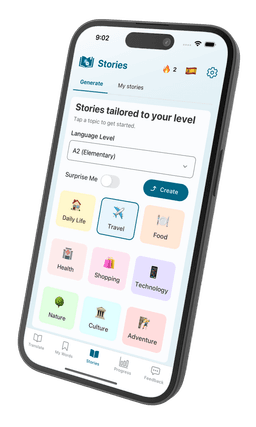
You're reading free stories on our website. Get the mobile app for audio narration, speaking practice, vocabulary saving, personalised stories, instant translations, and progress tracking.

Download on the App StoreGet it on Google Play
Audio
Translations
Progress

Ein Tag ohne Smartphone

Elementary (A2)
5 min read

📖 You are reading the free text version. Get our mobile app for 🎧 audio narration, 💬 speaking practice, 🔄 instant translations, and 💾 vocabulary saving to enhance your learning experience.

Lena ist 22 Jahre alt und lebt in einer kleinen Stadt. Sie benutzt jeden Tag ihr Smartphone, um Nachrichten zu lesen, Musik zu hören und Fotos zu machen.

Eines Tages fühlt sie sich müde und ihr Kopf tut weh. Lena entscheidet, dass sie eine Pause vom Handy machen muss. Sie legt es in eine Schublade und geht spazieren.

Im Park sieht sie Kinder spielen und Menschen, die sportlich sind. Lena läuft auch ein bisschen und merkt, dass ihr Körper sich besser fühlt. Sie spürt die frische Luft und die Sonne auf ihrer Haut.

Nach dem Spaziergang trinkt sie Wasser und isst einen Apfel. Ihr Kopf fühlt sich leichter an. Lena erkennt, wie wichtig es ist, sich zu bewegen und nicht nur am Handy zu sitzen.

Am Abend nimmt sie ihr Smartphone wieder, aber sie beschließt, nicht die ganze Zeit darauf zu schauen. Sie will gesünder leben und mehr Zeit draußen verbringen.

Lena fühlt sich am nächsten Tag viel besser und ist glücklich über ihre Entscheidung.

Practise this German story

Vocabulary in context

Important words and phrases

  • Smartphone

    noun

    smartphone

    Ich benutze jeden Tag mein Smartphone.

    I use my smartphone every day.

  • Nachrichten lesen

    verb phrase

    to read the news/messages

    Ich lese morgens Nachrichten.

    I read the news in the morning.

  • Musik hören

    verb phrase

    to listen to music

    Ich höre gern Musik.

    I like listening to music.

  • Fotos machen

    verb phrase

    to take photos

    Wir machen Fotos im Park.

    We take photos in the park.

  • müde

    adjective

    tired

    Nach der Arbeit bin ich müde.

    After work, I am tired.

  • eine Pause machen

    verb phrase

    to take a break

    Ich mache jetzt eine Pause.

    I am taking a break now.

  • Schublade

    noun

    drawer

    Die Schlüssel liegen in der Schublade.

    The keys are in the drawer.

  • spazieren gehen

    verb phrase

    to go for a walk

    Am Abend gehe ich oft spazieren.

    In the evening, I often go for a walk.

  • frische Luft

    noun phrase

    fresh air

    Die frische Luft tut gut.

    The fresh air feels good.

  • sich zu bewegen

    verb phrase

    to move around / exercise

    Es ist wichtig, sich jeden Tag zu bewegen.

    It is important to move every day.

  • draußen verbringen

    verb phrase

    to spend time outside

    Wir wollen heute mehr Zeit draußen verbringen.

    We want to spend more time outside today.

  • gesund leben

    verb phrase

    to live healthily

    Ich möchte gesünder leben.

    I want to live more healthily.

Check your understanding

Comprehension questions

Choose an answer, check it, then move to the next question.

Question 1 of 3

  1. Question 1: current not answered
  2. Question 2: not answered
  3. Question 3: not answered
Was macht Lena mit ihrem Smartphone?What does Lena do with her smartphone?

Notice the language

Language notes

grammar

sich besser fühlen

This reflexive pattern means that someone feels better in body or mood. The pronoun changes with the subject: Ich fühle mich besser. Du fühlst dich besser. Er/Sie fühlt sich besser. You can reuse it after rest, exercise, or a good meal. Example: Nach dem Spaziergang fühle ich mich besser.

  • Nach dem Spaziergang fühle ich mich besser.

    After the walk, I feel better.

Keep reading

More Elementary (A2) Stories
GermanElementary (A2)