
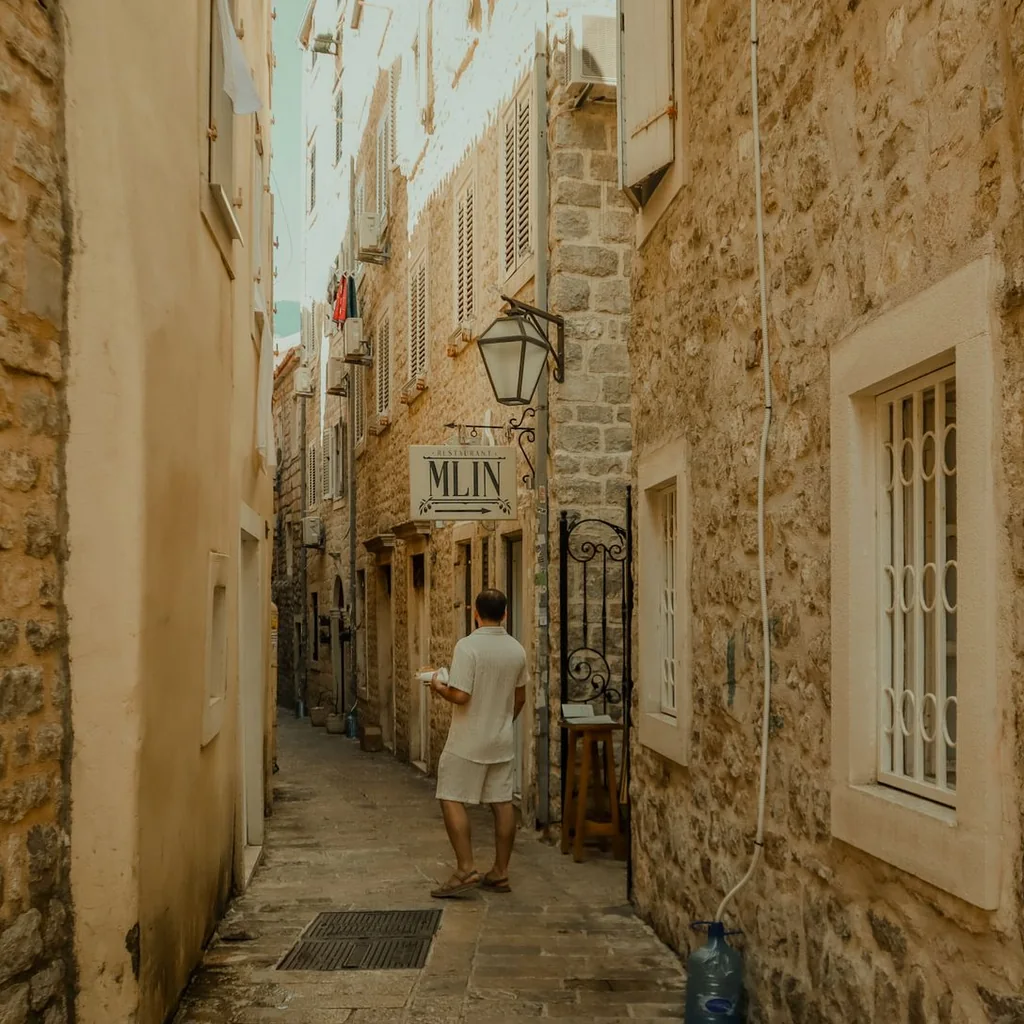
Perdue dans les ruelles
Lost in the Alleyways
Camille wanders through the old town after leaving the market square, then realizes she cannot find her way back to meet her friend at a café.
Three short parts. Read each part in French first; tap “Show English” under a paragraph when you need the translation.


Part 1
Camille avait quitté la place du marché pour suivre une petite rue bordée de maisons aux volets bleus. Elle s’était promis une promenade de dix minutes avant de retrouver son amie à la terrasse d’un café.
Show EnglishHide English
Camille had left the market square to follow a narrow street lined with houses with blue shutters. She had promised herself a ten-minute walk before meeting her friend at a café terrace.
Mais chaque rue l’avait menée vers une autre, plus jolie encore. Une fenêtre débordait de fleurs, un chat dormait sur un banc et l’odeur du pain chaud s’échappait d’une boulangerie.
Show EnglishHide English
But each street led her to another, even prettier one. Flowers spilled from a window, a cat slept on a bench, and the smell of fresh bread drifted out of a bakery.
Quand elle consulta l’heure, vingt minutes avaient passé. Camille fit demi-tour, sûre de reconnaître le chemin.
Show EnglishHide English
When she checked the time, twenty minutes had passed. Camille turned around, sure she would recognize the way back.
Au premier croisement, elle hésita. Les deux rues descendaient entre des murs clairs, et aucune indication ne mentionnait la place du marché.
Show EnglishHide English
At the first crossroads, she hesitated. Both streets descended between pale walls, and neither had a sign pointing to the market square.
Elle choisit celle de gauche et arriva devant une fontaine. Elle était certaine de ne pas l’avoir vue auparavant.
Show EnglishHide English
She chose the one on the left and reached a fountain. She was certain she had not seen it before.
Elle sortit son téléphone, mais la batterie était presque vide et l’appareil s’éteignit aussitôt. Camille leva les yeux vers les panneaux : ils indiquaient la mairie, l’église et un parking, mais toujours pas la place.
Show EnglishHide English
She took out her phone, but its battery was almost dead, and the device switched off at once. Camille looked up at the signs: they pointed to the town hall, the church, and a parking lot, but still not to the square.
Devant une petite boutique, une femme disposait des cartes postales sur un présentoir. Camille s’approcha, un peu gênée.
Show EnglishHide English
In front of a small shop, a woman was arranging postcards on a display stand. Camille went over, feeling a little embarrassed.
« Excusez-moi, je cherche la place du marché. Je crois que je tourne en rond. »
Show EnglishHide English
“Excuse me, I’m looking for the market square. I think I’m going round in circles.”
La femme sourit et posa les cartes qu’elle tenait.
Show EnglishHide English
The woman smiled and put down the cards she was holding.
« Vous êtes passée devant la fontaine ? » demanda-t-elle.
Show EnglishHide English
“Have you passed the fountain?” she asked.
Part 2Sous l’arche(Under the Archway)
« Je viens juste de la quitter », répondit Camille. La femme lui expliqua qu’il fallait revenir à la fontaine, prendre la rue à droite, puis tourner devant une boulangerie.
Show EnglishHide English
“I just left it,” Camille replied. The woman explained that she needed to go back to the fountain, take the street on the right, and then turn in front of a bakery.
« Vous verrez la place au bout. Ce n’est pas loin. »
Show EnglishHide English
“You’ll see the square at the end. It’s not far.”
Camille la remercia et repartit d’un pas décidé. À la fontaine, elle prit bien la rue de droite et retrouva l’odeur du pain chaud.
Show EnglishHide English
Camille thanked her and set off with determination. At the fountain, she did take the street on the right and found the smell of fresh bread again.
Mais devant la boulangerie, deux passages s’ouvraient côte à côte. Elle choisit celui qui descendait et déboucha, quelques minutes plus tard, devant le présentoir de cartes postales.
Show EnglishHide English
But in front of the bakery, two passageways opened side by side. She chose the one that went downhill and, a few minutes later, came out in front of the postcard display stand.
La commerçante était toujours là. En voyant Camille, elle porta la main à sa bouche pour cacher son sourire.
Show EnglishHide English
The shopkeeper was still there. When she saw Camille, she raised a hand to her mouth to hide her smile.
« Je suis désolée, dit Camille. Je crois que je suis revenue au point de départ. »
Show EnglishHide English
“I’m sorry,” Camille said. “I think I’ve come back to where I started.”
« C’est moi qui aurais dû être plus précise. Il y a un passage sous l’arche, juste après la boulangerie. »
Show EnglishHide English
“I should have been more precise. There’s a passage under the arch, just past the bakery.”
Cette fois, la femme s’éloigna un peu de sa boutique et lui montra l’arche au bout de la rue. Camille l’aperçut enfin : elle avait pris l’entrée pour la porte d’une maison.
Show EnglishHide English
This time, the woman moved a little way from her shop and pointed out the arch at the end of the street. Camille finally spotted it: she had mistaken the entrance for the door of a house.
Elle allait remercier la commerçante quand celle-ci regarda l’heure sur sa montre.
Show EnglishHide English
She was about to thank the shopkeeper when the woman looked at her watch.
« Quelqu’un vous attend depuis longtemps ? »
Show EnglishHide English
“Has someone been waiting for you for a long time?”
« Une bonne demi-heure, je pense. Mon téléphone est éteint et je n’ai pas pu la prévenir. »
Show EnglishHide English
“About half an hour, I think. My phone is off, and I couldn’t let her know.”
La femme réfléchit un instant, puis rentra dans sa boutique.
Show EnglishHide English
The woman thought for a moment, then went back into her shop.
Part 3Retrouver le café(Finding the Café Again)
La commerçante revint avec son téléphone. « Si vous connaissez son numéro, vous pouvez l’appeler d’ici. »
Show EnglishHide English
The shopkeeper came back with her phone. “If you know her number, you can call her from here.”
Camille connaissait le numéro par cœur. Son amie répondit presque aussitôt.
Show EnglishHide English
Camille knew the number by heart. Her friend answered almost at once.
« Je suis désolée, dit Camille. Je me suis perdue dans les petites rues, et mon téléphone s’est éteint. Tu es toujours au café ? »
Show EnglishHide English
“I’m sorry,” Camille said. “I got lost in the little streets, and my phone went dead. Are you still at the café?”
Son amie éclata de rire. Elle avait commandé une deuxième boisson et observait les passants en attendant.
Show EnglishHide English
Her friend burst out laughing. She had ordered a second drink and was watching passers-by as she waited.
« Je commençais à me demander si tu avais trouvé une boutique de chaussures. »
Show EnglishHide English
“I was starting to wonder if you’d found a shoe shop.”
« Non, seulement une fontaine, une boulangerie et la même boutique de cartes postales deux fois. J’arrive dans quelques minutes. »
Show EnglishHide English
“No, just a fountain, a bakery, and the same postcard shop twice. I’ll be there in a few minutes.”
Après avoir rendu le téléphone, Camille suivit les indications de la commerçante. Elle passa sous l’arche et reconnut aussitôt le café, de l’autre côté de la place.
Show EnglishHide English
After giving the phone back, Camille followed the shopkeeper’s directions. She passed under the arch and immediately recognized the café on the other side of the square.
Son amie lui fit signe depuis la terrasse. Camille s’assit en face d’elle et posa son sac avec un soupir de soulagement.
Show EnglishHide English
Her friend waved to her from the terrace. Camille sat down opposite her and put her bag down with a sigh of relief.
« J’ai voulu faire un petit tour, dit-elle. Finalement, j’ai rencontré la personne la plus patiente du quartier. »
Show EnglishHide English
“I wanted to take a little walk,” she said. “In the end, I met the most patient person in the neighborhood.”
Son amie poussa la carte des boissons vers elle. Camille commanda un café, puis lui raconta comment elle s’était retrouvée devant la boutique.
Show EnglishHide English
Her friend pushed the drinks menu toward her. Camille ordered a coffee, then told her how she had ended up in front of the shop.
Elles rirent toutes les deux, avant de choisir tranquillement leur prochaine promenade sur le plan posé sur la table.
Show EnglishHide English
They both laughed, then calmly chose their next walk on the map lying on the table.
Practise this French story
Vocabulary in context
Important words and phrases
quitter la place du marché
verb phraseto leave the market square
Nous avons quitté la place du marché après le déjeuner.
We left the market square after lunch.
suivre les indications
verb phraseto follow the directions
Pour arriver au musée, il faut suivre les indications sur la carte.
To get to the museum, you have to follow the directions on the map.
faire demi-tour
verb phraseto turn back
Après le mauvais virage, nous avons dû faire demi-tour.
After the wrong turn, we had to turn back.
hésiter
verbto hesitate
J’ai hésité avant de prendre le bus.
I hesitated before taking the bus.
tourner en rond
verb phraseto go round in circles
Sans plan, on peut facilement tourner en rond.
Without a map, you can easily go round in circles.
au premier croisement
prepositional phraseat the first intersection
Tournez à gauche au premier croisement.
Turn left at the first intersection.
prendre la rue à droite
verb phraseto take the street on the right
Prenez la rue à droite après la boulangerie.
Take the street on the right after the bakery.
au bout
prepositional phraseat the end
Le café est au bout de la rue.
The café is at the end of the street.
batterie presque vide
noun phrasebattery almost empty
Mon téléphone a une batterie presque vide.
My phone has almost no battery left.
passer sous l’arche
verb phraseto go under the arch
Nous sommes passés sous l’arche pour rejoindre la place.
We went under the arch to reach the square.
d’un pas décidé
adverbial phrasewith a determined stride
Elle est entrée d’un pas décidé pour demander son chemin.
She walked in with a determined stride to ask for directions.
Check your understanding
Comprehension questions
Choose an answer, check it, then move to the next question.
Question 1 of 3
- Question 1: current not answered
- Question 2: not answered
- Question 3: not answered
Notice the language
Language notes
Il faut + infinitif
This structure is used to give instructions or say what is necessary. It is impersonal, so it does not name a specific person as the subject. Learners can reuse it for directions, advice, and notices. Example: « Il faut revenir à la fontaine, prendre la rue à droite, puis tourner devant une boulangerie. »
Il faut revenir à la fontaine, prendre la rue à droite, puis tourner devant une boulangerie.
You have to go back to the fountain, take the street on the right, then turn by the bakery.
More French stories to read next
Le plongeon d'Alain
Alain’s Dive
At the pool with his daughter Émilie, Alain hesitates to enter the water, fearing it may be cold.
L’oiseau dans la cheminée
The Bird in the Chimney
Sylvie is tidying her living room when she hears a bird trapped in the chimney and sees it behind the closed glass.
La vieille barque
The Old Boat
Benoît and his brother Stéphane stand by their late father's old fishing boat, which the landowner wants moved before the end of the month.

La première course de Léa
Léa’s First Race
Léa, a 30-year-old woman, is at the start of her first five-kilometer race in a park, where the other runners seem faster than she is.