Back to Beginner (A1) stories

Unlock the Complete Learning Experience

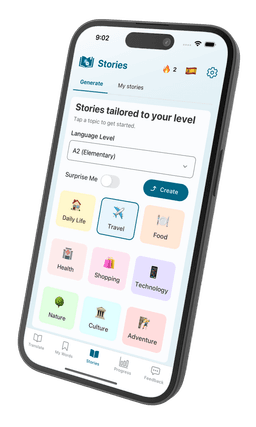
You're reading free stories on our website. Get the mobile app for audio narration, speaking practice, vocabulary saving, personalised stories, instant translations, and progress tracking.

Download on the App StoreGet it on Google Play
Audio
Translations
Progress

Le voyage en bateau de Clara

Beginner (A1)
5 min read

📖 You are reading the free text version. Get our mobile app for 🎧 audio narration, 💬 speaking practice, 🔄 instant translations, and 💾 vocabulary saving to enhance your learning experience.

Clara regarde le grand bateau. C'est son premier voyage en mer. Elle est un peu nerveuse.

Le bateau commence à bouger doucement. Le vent souffle. Clara voit des oiseaux et beaucoup d'eau.

Dans le bateau, il y a des gens qui parlent et rient. Clara essaie de comprendre les voix autour d'elle.

Après un moment, le bateau change de direction. Clara regarde la mer. Elle voit un grand nuage blanc.

Soudain, le bateau s'arrête. Le moteur fait un bruit fort, mais il ne bouge plus. Clara se demande ce qui se passe.

Un homme vient et dit : « Il y a un problème, il faut attendre. » Les gens sur le bateau parlent avec peur.

Clara regarde les nuages. Elle pense que la mer est comme la vie : parfois calme, parfois surprenante.

Elle ne sait pas combien de temps ils vont rester là, mais elle sent la force du vent et les vagues autour.

Clara comprend que ce moment sans mouvement est aussi un voyage, différent et calme.

Le soleil commence à briller à nouveau. Clara sourit, prête pour la suite du voyage en mer, sans savoir ce qu'elle va découvrir.


Practise this French story

Vocabulary in context

Important words and phrases

  • grand bateau

    noun phrase

    big boat

    Clara regarde le grand bateau.

    Clara looks at the big boat.

  • premier voyage

    noun phrase

    first trip

    C'est son premier voyage en mer.

    It is her first trip at sea.

  • en mer

    prepositional phrase

    at sea

    C'est son premier voyage en mer.

    It is her first trip at sea.

  • bouger doucement

    verb phrase

    move gently

    Le bateau commence à bouger doucement.

    The boat starts to move gently.

  • vent

    noun

    wind

    Le vent souffle.

    The wind is blowing.

  • changer de direction

    verb phrase

    change direction

    Après un moment, le bateau change de direction.

    After a moment, the boat changes direction.

  • problème

    noun

    problem

    Il y a un problème.

    There is a problem.

  • attendre

    verb

    wait

    Il faut attendre.

    We have to wait.

  • vagues

    noun

    waves

    Elle voit les vagues.

    She sees the waves.

  • sourit

    verb

    smiles

    Clara sourit.

    Clara smiles.

Check your understanding

Comprehension questions

Choose an answer, check it, then move to the next question.

Question 1 of 3

  1. Question 1: current not answered
  2. Question 2: not answered
  3. Question 3: not answered
Que voit Clara dans le ciel ?What does Clara see in the sky?

Notice the language

Language notes

grammar

il faut + infinitif

This impersonal pattern means "it is necessary to..." or "you have to...". Put it before an infinitive to give advice, instructions, or a general rule. Example: "Il faut attendre le train." = "You have to wait for the train." This is the same pattern used in the story: "Il faut attendre."

  • Il faut attendre le train.

    You have to wait for the train.

Keep reading

More Beginner (A1) Stories
FrenchBeginner (A1)