Back to Advanced (C1) stories

Unlock the Complete Learning Experience

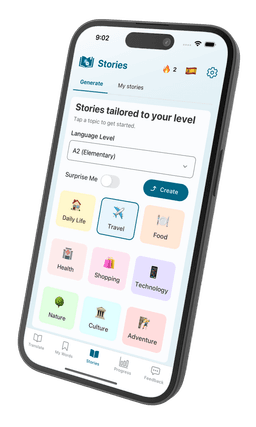
You're reading free stories on our website. Get the mobile app for audio narration, speaking practice, vocabulary saving, personalised stories, instant translations, and progress tracking.

Download on the App StoreGet it on Google Play
Audio
Translations
Progress

Entre las sombras del café

Advanced (C1)
5 min read

📖 You are reading the free text version. Get our mobile app for 🎧 audio narration, 💬 speaking practice, 🔄 instant translations, and 💾 vocabulary saving to enhance your learning experience.

Nunca imaginé que una pequeña cafetería escondida en las calles de Madrid pudiera cambiar mi percepción del amor.

Eran las ocho de la noche cuando decidí entrar a refugiarme del frío. Allí estaba Sofía, una mujer de sonrisa reservada y ojos que parecían guardar secretos. Nos sentamos en mesas opuestas, pero nuestras miradas coincidían frecuentemente.

En medio de la charla tímida, Sofía confesó que ella evitaba el amor porque una relación anterior le había dejado heridas profundas. Sus palabras me hicieron sentir que debía tener paciencia y no apresurar nada.

Las semanas siguieron, y visité la cafetería casi todos los días, esperando esos instantes tranquilos a su lado. Compartíamos historias, risas, pero nunca hablamos de nosotros con claridad.

Una tarde, el lugar estaba vacío y la luz del atardecer iluminaba sus ojos. "Quizás no siempre se trata de encontrar a alguien, sino de aprender a confiar de nuevo", dijo con voz baja.

No hubo promesas ni planes para el futuro, solo un entendimiento tácito. Sofía y yo dejamos que el tiempo y la complicidad fueran el único lenguaje entre nosotros.

A veces, el amor no se revela con gestos grandiosos, sino en pequeños momentos compartidos donde las sombras del pasado se vuelven menos densas.


Practise this Spanish story

Vocabulary in context

Important words and phrases

  • cambiar mi percepción del amor

    verb phrase

    to change my perception of love

    Esa experiencia cambió mi percepción del trabajo.

    That experience changed my perception of work.

  • refugiarme del frío

    verb phrase

    to take refuge from the cold

    Entré al café para refugiarme del frío.

    I went into the café to take refuge from the cold.

  • sonrisa reservada

    noun phrase

    reserved smile

    Tenía una sonrisa reservada que me intrigó.

    She had a reserved smile that intrigued me.

  • guardar secretos

    verb phrase

    to keep secrets

    La casa parecía guardar secretos.

    The house seemed to keep secrets.

  • charla tímida

    noun phrase

    shy conversation

    Tuvimos una charla tímida al principio.

    We had a shy conversation at first.

  • heridas profundas

    noun phrase

    deep wounds

    Aún llevaba heridas profundas del pasado.

    He was still carrying deep wounds from the past.

  • no apresurar nada

    verb phrase

    not to rush anything

    Prefiero no apresurar nada y observar.

    I prefer not to rush anything and observe.

  • entendimiento tácito

    noun phrase

    tacit understanding

    Entre ellos había un entendimiento tácito.

    There was a tacit understanding between them.

  • complicidad

    noun

    closeness; complicity

    Con el tiempo, nació una complicidad evidente.

    Over time, an evident closeness developed.

  • se revela

    verb phrase

    reveals itself; becomes apparent

    La verdad se revela poco a poco.

    The truth reveals itself little by little.

  • sombras del pasado

    noun phrase

    shadows of the past

    Todavía arrastraba las sombras del pasado.

    He was still carrying the shadows of the past.

Check your understanding

Comprehension questions

Choose an answer, check it, then move to the next question.

Question 1 of 3

  1. Question 1: current not answered
  2. Question 2: not answered
  3. Question 3: not answered
¿Qué motivo parece tener el narrador para volver casi cada día a la cafetería?What reason does the narrator seem to have for returning to the café almost every day?

Notice the language

Language notes

grammar

dejar que + subjuntivo

This structure means to allow or let something happen, often without direct control. The verb after "que" is typically in the subjunctive because the action is permitted rather than stated as a fact. In past narration, that often appears as the imperfect subjunctive. It is reusable whenever one person or circumstance lets another action unfold naturally.

  • Dejamos que el tiempo y la complicidad fueran el único lenguaje entre nosotros.

    We let time and closeness become the only language between us.

Keep reading

More Advanced (C1) Stories
SpanishAdvanced (C1)