Back to Intermediate (B1) stories

Unlock the Complete Learning Experience

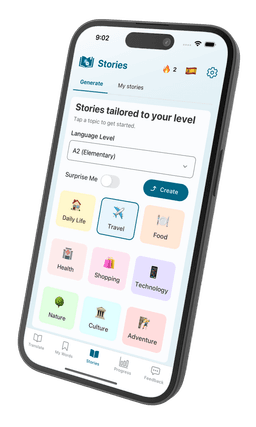
You're reading free stories on our website. Get the mobile app for audio narration, speaking practice, vocabulary saving, personalised stories, instant translations, and progress tracking.

Download on the App StoreGet it on Google Play
Audio
Translations
Progress

Un día sin palabras en casa

Intermediate (B1)
5 min read

📖 You are reading the free text version. Get our mobile app for 🎧 audio narration, 💬 speaking practice, 🔄 instant translations, and 💾 vocabulary saving to enhance your learning experience.

La mañana comenzó con un silencio extraño en la casa de la familia Gómez. Ana, la madre, notó que ni su esposo ni sus dos hijos dijeron una palabra desde que se despertaron.

Al principio pensó que era una broma, pero pasaron las horas y el silencio se mantuvo. El desayuno, normalmente lleno de charlas y risas, fue una comida sin sonidos. Ana trató de hablar, pero nadie respondió; sólo miraban fijamente sus tazas.

Cuando llegó la tarde, Ana intentó entender qué pasaba. Pensó que tal vez estaban enojados, cansados o simplemente aburridos. Intentó hacer juegos, poner música, pero nada cambió.

Decidió entonces escribir una nota en un papel: "¿Qué sucede?" y la puso en la mesa. Su hijo mayor escribió una respuesta: "Queremos probar un día sin palabras."

Ana se sorprendió, pero decidió participar. Pasaron el resto del día comunicándose sólo con gestos y miradas. Muchos momentos que normalmente se daban por sentado se hicieron más importantes. Ana vio en sus hijos y esposo una nueva forma de estar juntos.

Al anochecer, las palabras volvieron poco a poco, pero con ellas también un significado diferente. No era sólo hablar, sino escuchar y entender sin prisas.

Ana pensó que a veces el silencio puede decir más que mil palabras y que en la familia, lo importante no es llenar el aire con ruido, sino compartir momentos que realmente importan.


Practise this Spanish story

Vocabulary in context

Important words and phrases

  • un silencio extraño

    noun phrase

    a strange silence

    Hubo un silencio extraño en la reunión.

    There was a strange silence at the meeting.

  • se mantuvo

    verb phrase

    remained / stayed

    El acuerdo se mantuvo durante meses.

    The agreement remained in place for months.

  • charlas y risas

    noun phrase

    conversation and laughter

    La cena estuvo llena de charlas y risas.

    Dinner was full of conversation and laughter.

  • miraban fijamente

    verb phrase

    were staring fixedly

    Los niños lo miraban fijamente.

    The children were staring at him.

  • intentó entender

    verb phrase

    tried to understand

    Intenté entender la explicación antes de preguntar.

    I tried to understand the explanation before asking.

  • poner música

    verb phrase

    to put on music

    Voy a poner música para limpiar la casa.

    I'm going to put on music to clean the house.

  • una nota

    noun phrase

    a note

    Le dejé una nota en la mesa.

    I left him a note on the table.

  • probar un día sin palabras

    verb phrase

    to try a day without words

    Queremos probar un día sin palabras.

    We want to try a day without words.

  • comunicándose sólo con gestos y miradas

    verb phrase

    communicating only with gestures and looks

    Pasaron la clase comunicándose solo con gestos y miradas.

    They spent the class communicating only with gestures and looks.

  • se daban por sentado

    idiom

    were taken for granted

    A veces damos por sentado el tiempo en familia.

    Sometimes we take family time for granted.

  • compartir momentos

    verb phrase

    to share moments

    Lo importante es compartir momentos con la familia.

    What matters is sharing moments with family.

Check your understanding

Comprehension questions

Choose an answer, check it, then move to the next question.

Question 1 of 3

  1. Question 1: current not answered
  2. Question 2: not answered
  3. Question 3: not answered
¿Qué escribió el hijo mayor?What did the older son write?

Notice the language

Language notes

grammar

ni... ni...

Use ni... ni... to connect two people, things, or actions in a negative sentence. It means 'neither... nor...' and is very useful when you want to say that two things did not happen or are not true. You can reuse it with nouns or with verbs. Example: "Ni Ana ni sus hijos dijeron nada."

  • Ni Ana ni sus hijos dijeron nada.

    Neither Ana nor her children said anything.

Keep reading

More Intermediate (B1) Stories
SpanishIntermediate (B1)