
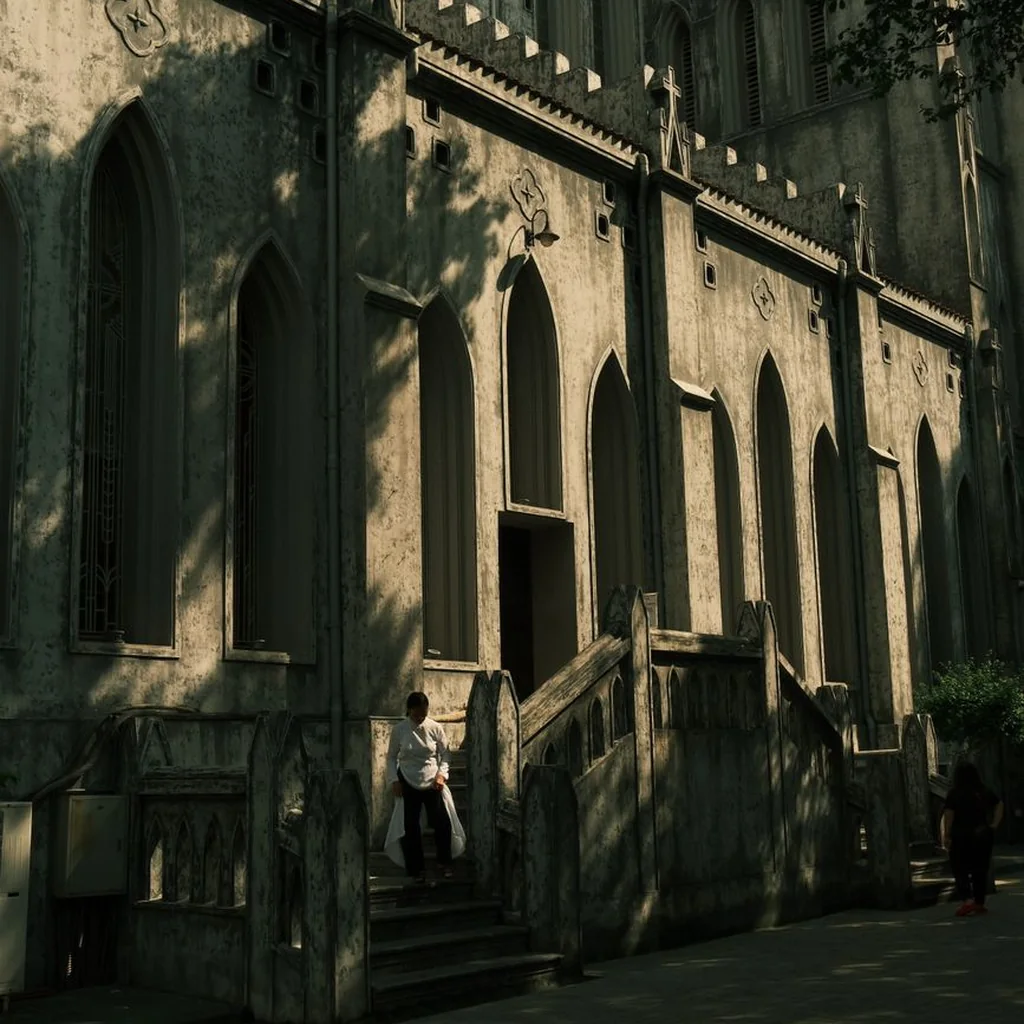
Photo: Thuan Pham on Pexels
Die Tür nach außen
The Door That Opens Outward
Jana ducks into a cathedral to escape the rain, but the service has begun and she is unsure whether to stay or quietly leave.
Three short parts. Read each part in German first; tap “Show English” under a paragraph when you need the translation.


Part 1
Jana hatte eigentlich nur kurz in den Dom gewollt. Draußen schüttete es, und der Schirm, den sie morgens noch für überflüssig gehalten hatte, lag trocken zu Hause im Flur.
Show EnglishHide English
Jana had only meant to pop into the cathedral for a moment. Outside, rain was pouring down, and the umbrella she had thought unnecessary that morning was lying at home, dry in the hallway.
Drinnen war es so still, dass die schwere Tür hinter ihr klang wie ein umgekippter Kleiderschrank. Vorn am Altar verstummte eine Stimme. Jana blieb mit der Hand an der Klinke stehen.
Show EnglishHide English
Inside, it was so quiet that the heavy door behind her sounded like a wardrobe falling over. A voice at the altar fell silent. Jana stood with her hand on the handle.
Ein paar Köpfe drehten sich. Offenbar hatte der Gottesdienst schon angefangen; durch den Regen hatte sie die Glocken nicht gehört.
Show EnglishHide English
A few heads turned. Apparently the service had already begun; she hadn’t heard the bells over the rain.
Sie hob entschuldigend die Hand, was sich sofort falsch anfühlte. Als hätte sie eine Besprechung gestört und wollte sagen: Macht ruhig ohne mich weiter.
Show EnglishHide English
She raised a hand apologetically, which immediately felt wrong. As if she had interrupted a meeting and wanted to say: Please, carry on without me.
Die Stimme am Altar setzte wieder ein. Jana drehte sich zur Tür, drückte die Klinke herunter und zog. Nichts. Sie zog fester, diesmal mit beiden Händen.
Show EnglishHide English
The voice at the altar started again. Jana turned toward the door, pressed the handle down, and pulled. Nothing. She pulled harder, this time with both hands.
„Die geht nach außen“, flüsterte eine Frau in der letzten Bank.
Show EnglishHide English
“It opens outward,” whispered a woman in the last pew.
Jana ließ die Klinke los und nickte. Natürlich. Sie drückte sie wieder herunter und schob vorsichtig gegen das Holz. Die Tür gab ein Stück nach, und mit dem Regen kam ein Schwall kalter Luft herein. Vorn raschelten Papiere; jemand hustete demonstrativ.
Show EnglishHide English
Jana let go of the handle and nodded. Of course. She pressed it down again and carefully pushed against the wood. The door gave way a little, and a gust of cold air came in with the rain. Papers rustled at the front; someone coughed pointedly.
Jana zog die Tür wieder zu. Die Frau in der Bank rückte ein Stück zur Seite und nahm ihre Handtasche auf den Schoß.
Show EnglishHide English
Jana pulled the door shut again. The woman in the pew shifted over a little and placed her handbag on her lap.
„Setzen Sie sich doch erst mal“, sagte sie leise. „Sonst stehen Sie gleich noch bis zum Segen im Durchzug.“
Show EnglishHide English
“Why don’t you sit down for now?” she said quietly. “Otherwise you’ll be standing in a draft until the blessing.”
Jana wollte gerade ablehnen, als die Gemeinde aufstand. Die Frau erhob sich ebenfalls und deutete auf das Buch in der Halterung vor ihnen. Sie schlug es auf und hielt Jana eine Seite hin.
Show EnglishHide English
Jana was just about to refuse when the congregation stood up. The woman rose too and pointed to the book in the holder in front of them. She opened it and showed Jana a page.
Part 2Die falsche Melodie(The Wrong Tune)
Jana stellte sich neben sie und sah auf das Buch. Die Gemeinde sang bereits; sie brauchte ein paar Zeilen, um die richtige Stelle zu finden.
Show EnglishHide English
Jana stood beside her and looked at the book. The congregation was already singing; it took her a few lines to find the right place.
Bei der nächsten Strophe bewegte sie vorsichtshalber nur die Lippen. Die Frau neben ihr sang mit kräftiger Stimme und lag, wie Jana nach einem Blick auf die Nachbarbank feststellte, eine Zeile voraus.
Show EnglishHide English
For the next verse, she prudently only mouthed the words. The woman beside her sang in a strong voice and, as Jana saw with a glance at the neighboring pew, was a line ahead.
Als alle sich wieder setzten, beugte sich die Frau zu ihr. „Ich bin heute zum ersten Mal hier“, flüsterte sie. „Meine Schwester wollte eigentlich mitkommen. Die kennt sich aus.“
Show EnglishHide English
When everyone sat down again, the woman leaned toward her. “This is my first time here,” she whispered. “My sister was supposed to come with me. She knows her way around.”
Jana musste lachen und fing sich gerade noch. „Ich dachte schon, Sie hätten hier einen Stammplatz.“
Show EnglishHide English
Jana had to laugh, and just managed to catch herself. “I thought you had a regular seat here.”
„So kann man sich täuschen.“ Die Frau strich die Seiten des Gesangbuchs glatt. „Ich bin Katharina.“
Show EnglishHide English
“Looks can be deceiving.” The woman smoothed the pages of the hymnal. “I’m Katharina.”
„Jana. Ich bin nur wegen des Regens rein.“
Show EnglishHide English
“Jana. I only came in because of the rain.”
„Auch ein Grund.“ Katharina deutete auf Janas Ärmel. Wasser tropfte von der Jacke auf den Steinboden. Jana zog sie aus und legte sie über ihre Knie. Wenigstens würde jetzt niemand mehr frieren, weil sie die Tür offen hielt.
Show EnglishHide English
“That’s a reason too.” Katharina gestured at Jana’s sleeve. Water was dripping from her jacket onto the stone floor. Jana took it off and laid it across her knees. At least no one would freeze now because she was holding the door open.
Vorn begann eine Lesung. Jana lehnte sich zurück. Die Stimme trug bis nach hinten, und obwohl sie nicht jeden Satz mitbekam, war es angenehm, eine Weile sitzen zu bleiben, ohne irgendwohin zu müssen.
Show EnglishHide English
A reading began at the front. Jana leaned back. The voice carried all the way to the back, and although she didn’t catch every sentence, it was pleasant to sit for a while without having to go anywhere.
Dann ging Katharinas Handy los. Nicht laut, aber in der Stille unverkennbar: ein fröhliches Pfeifen, gefolgt von einem Schlagzeugwirbel. Katharina fuhr zusammen und griff nach ihrer Handtasche.
Show EnglishHide English
Then Katharina’s phone went off. It wasn’t loud, but in the silence it was unmistakable: a cheerful whistle followed by a drumroll. Katharina started and reached for her handbag.
Das Pfeifen setzte erneut ein. Die Tasche stand offen auf ihrem Schoß, doch das Handy war darin nicht zu sehen.
Show EnglishHide English
The whistling started again. The bag was open on her lap, but the phone wasn’t visible inside.
Part 3Die Banane in der Tasche(The Banana in the Bag)
Katharina zog ein Taschentuchpäckchen heraus, dann einen Schlüsselbund und schließlich eine Banane. Jana nahm ihr die Sachen ab und legte sie nebeneinander auf die Bank.
Show EnglishHide English
Katharina pulled out a packet of tissues, then a bunch of keys, and finally a banana. Jana took the things from her and laid them side by side on the pew.
„Die Tasche ist ein Fass ohne Boden“, murmelte Katharina. Das Handy pfiff zum dritten Mal. Diesmal kam das Geräusch aus ihrer Jackentasche.
Show EnglishHide English
“This bag is a bottomless pit,” Katharina muttered. The phone whistled for the third time. This time the sound came from her jacket pocket.
Sie zog es heraus und drückte hastig auf den Bildschirm. Ruhe. Vorn las die Frau am Mikrofon weiter, ohne aufzusehen.
Show EnglishHide English
She pulled it out and hastily tapped the screen. Silence. At the front, the woman at the microphone continued reading without looking up.
Katharina hielt Jana das Handy kurz hin. Auf dem Display stand: „Tut mir leid, schaffe es nicht mehr. Ruf mich nachher an.“
Show EnglishHide English
Katharina briefly held the phone out to Jana. On the screen it said: “Sorry, I can’t make it after all. Call me later.”
„Ihre Schwester?“, flüsterte Jana.
Show EnglishHide English
“Your sister?” Jana whispered.
Katharina nickte und steckte das Handy ausgeschaltet zurück. Dann sah sie auf die Banane zwischen ihnen. „Immerhin hätten wir Proviant gehabt.“
Show EnglishHide English
Katharina nodded and put the phone back, switched off. Then she looked at the banana between them. “At least we’d have had provisions.”
Jana biss sich auf die Lippe. Sie schob Katharina die Sachen zu, und beide wandten sich wieder nach vorn. Als die Gemeinde später erneut sang, fand Jana die Stelle diesmal rechtzeitig. Katharina setzte ebenfalls richtig ein und warf ihr einen zufriedenen Seitenblick zu.
Show EnglishHide English
Jana bit her lip. She pushed the things back toward Katharina, and they both turned to the front again. When the congregation sang again later, Jana found the right place in time. Katharina came in correctly too and gave her a satisfied sideways glance.
Nach dem Segen blieben sie sitzen, während die ersten Leute nach draußen gingen. Durch die offene Tür war nur noch ein leises Tropfen zu hören.
Show EnglishHide English
After the blessing, they stayed seated while the first people went outside. Through the open door, all they could hear was a faint dripping.
„Na also“, sagte Katharina. „Der Regen hat aufgehört. Ganz ohne Ihr Zutun.“
Show EnglishHide English
“There you are,” Katharina said. “The rain has stopped. And you didn’t have to do a thing.”
„Ich hätte vorhin einfach drücken müssen.“ Jana nahm ihre Jacke vom Schoß. „Aber dann hätte ich die Banane verpasst.“
Show EnglishHide English
“I should have just pushed earlier.” Jana picked up her jacket from her lap. “But then I would have missed the banana.”
Am Ausgang hielt Katharina ihr die Tür auf. Draußen glänzte das Pflaster; unter der Dachrinne schüttelte jemand seinen Schirm aus. Jana zog die Jacke an und ging neben Katharina die Stufen hinunter.
Show EnglishHide English
At the exit, Katharina held the door open for her. Outside, the paving stones gleamed; beneath the gutter, someone shook out an umbrella. Jana put on her jacket and went down the steps beside Katharina.
Practise this German story
Vocabulary in context
Important words and phrases
für überflüssig halten
verb phraseto consider unnecessary
Ich hatte die zusätzliche Erklärung zunächst für überflüssig gehalten, bis ich sah, wie viele Rückfragen sie verhinderte.
At first I had considered the extra explanation unnecessary, until I saw how many follow-up questions it prevented.
nach außen
adverbial phraseoutward; to the outside
Die Tür öffnet nach außen, deshalb stößt sie im Flur manchmal gegen den Schrank.
The door opens outward, which is why it sometimes hits the cupboard in the hallway.
vorsichtshalber
adverbjust to be safe
Wir haben die Unterlagen vorsichtshalber noch einmal überprüft.
We checked the documents once more just to be safe.
im Durchzug
noun phrasein a draft
Ich sitze nicht gern im Durchzug, weil ich davon sofort friere.
I don't like sitting in a draft because I get cold immediately.
Fass ohne Boden
idiombottomless pit
Unser Archiv ist ein Fass ohne Boden: Kaum ist es geordnet, tauchen schon neue Akten auf.
Our archive is a bottomless pit: as soon as it is organized, new files appear again.
sich täuschen
verb phraseto be mistaken
Ich hielt die Situation für harmlos, doch da hatte ich mich getäuscht.
I thought the situation was harmless, but I was mistaken.
ohne Ihr Zutun
prepositional phrasewithout your intervention
Das Problem löste sich ohne unser Zutun, was uns alle überraschte.
The problem solved itself without our intervention, which surprised us all.
unverkennbar
adjectiveunmistakable; clearly evident
In seiner Stimme lag unverkennbar Erleichterung.
There was unmistakable relief in his voice.
sich auf die Lippe beißen
verb phraseto bite one's lip
Sie biss sich auf die Lippe, um nicht laut loszulachen.
She bit her lip so as not to start laughing out loud.
sich fangen
verb phraseto pull oneself together; to recover
Er war kurz verlegen, fing sich aber sofort wieder.
He was briefly embarrassed but quickly pulled himself together again.
Check your understanding
Comprehension questions
Choose an answer, check it, then move to the next question.
Question 1 of 3
- Question 1: current not answered
- Question 2: not answered
- Question 3: not answered
Notice the language
Language notes
hätte ... müssen
To say what someone should have done but didn't, use hätte + infinitive + müssen. With a modal verb, the past form uses two infinitives, not a past participle: Ich hätte drücken müssen (not *gemusst). In the story, Jana says: „Ich hätte vorhin einfach drücken müssen.“
Ich hätte vorhin einfach drücken müssen.
I should have just pushed earlier.
More German stories to read next

Der falsche Moment
The Wrong Moment
Finn waits at a bakery window, pretending to read the specials, while Ida, whom he has seen there for weeks, laughs with a man.

Der Absatz vor der Kasse
High Heels at the Checkout
In a shoe shop, Leyla tries on high heels and wonders whether they are right for her sister’s wedding, where she is giving a speech.

Der Frosch in der Unterhose
The Frog in the Underpants
Jürgen photographs his cheesecake in the kitchen and sends it to the family chat, unaware that a mirror reflects him wearing bright green underpants.

Die Birne im Zug
The Pear on the Train
Birgit boards a train and asks Niklas if the window seat, occupied by a scarf, is free.