
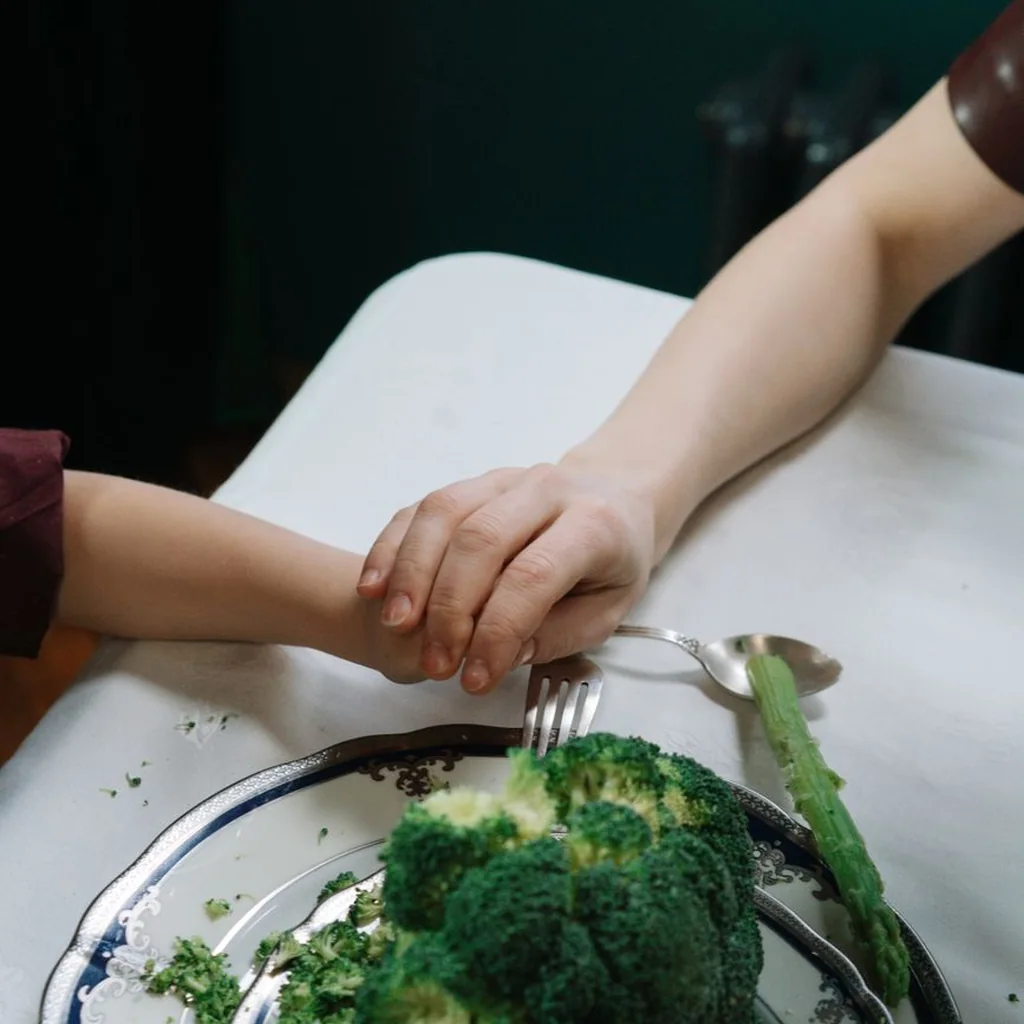
Photo: cottonbro studio on Pexels
Grünes Essen
Green Food
Julia puts two plates of green noodles, broccoli, and green sauce on the table, but her son Paul refuses to eat green food.
Three short parts. Read each part in German first; tap “Show English” under a paragraph when you need the translation.


Part 1
Julia stellt zwei Teller auf den Tisch. Auf jedem Teller liegen grüne Nudeln, Brokkoli und eine grüne Soße.
Show EnglishHide English
Julia puts two plates on the table. On each plate there are green noodles, broccoli, and green sauce.
Ihr Sohn Paul kommt in die Küche. Er hat Hunger und setzt sich schnell hin. Doch dann sieht er seinen Teller.
Show EnglishHide English
Her son Paul comes into the kitchen. He is hungry and quickly sits down. But then he sees his plate.
„Alles ist grün!“, ruft er. „Das esse ich nicht.“
Show EnglishHide English
“Everything is green!” he cries. “I won’t eat this.”
Julia setzt sich zu ihm. „Die Nudeln sind mit Spinat. Probier doch mal.“
Show EnglishHide English
Julia sits down beside him. “The noodles are made with spinach. Why don’t you try some?”
Paul schiebt den Teller ein Stück weg. „Ich mag nichts Grünes. Das weißt du doch.“
Show EnglishHide English
Paul pushes the plate a little farther away. “I don’t like anything green. You know that.”
Julia nimmt eine Nudel und isst sie. „Ich finde sie lecker.“
Show EnglishHide English
Julia takes a noodle and eats it. “I think it’s tasty.”
„Dann kannst du meinen Teller auch haben“, sagt Paul. Er verschränkt die Arme und schaut zum Fenster.
Show EnglishHide English
“Then you can have my plate too,” says Paul. He folds his arms and looks toward the window.
Eine Weile essen sie nicht. Dann knurrt Pauls Bauch so laut, dass Julia lächeln muss.
Show EnglishHide English
For a while, they don’t eat. Then Paul’s stomach rumbles so loudly that Julia has to smile.
„Ich habe noch eine Idee“, sagt sie. Sie steht auf und öffnet den Kühlschrank. Paul dreht sich neugierig um.
Show EnglishHide English
“I have another idea,” she says. She stands up and opens the fridge. Paul turns around, curious.
Julia nimmt eine kleine Schüssel heraus und stellt sie auf den Tisch.
Show EnglishHide English
Julia takes out a small bowl and puts it on the table.
Part 2Die Nudeln mit Käse(Noodles with Cheese)
Paul schaut in die Schüssel. Darin liegt geriebener Käse.
Show EnglishHide English
Paul looks in the bowl. There is grated cheese inside.
„Der ist ja gelb!“, sagt er. „Kann ich etwas davon haben?“
Show EnglishHide English
“It’s yellow!” he says. “Can I have some?”
„Natürlich“, sagt Julia. Sie gibt ihm einen Löffel, und Paul streut Käse über die Nudeln. Dann nimmt er vorsichtig eine Nudel auf die Gabel.
Show EnglishHide English
“Of course,” says Julia. She gives him a spoon, and Paul sprinkles cheese over the noodles. Then he carefully picks up a noodle with his fork.
Er steckt sie in den Mund und kaut langsam. Julia wartet, ohne etwas zu sagen.
Show EnglishHide English
He puts it in his mouth and chews slowly. Julia waits without saying anything.
„Die schmeckt wie eine Nudel“, sagt Paul überrascht. „Nur ein bisschen anders.“
Show EnglishHide English
“It tastes like a noodle,” Paul says, surprised. “Just a little different.”
Er isst noch eine. Dann zieht er ein kleines Stück Brokkoli unter den Nudeln hervor und legt es an den Rand des Tellers.
Show EnglishHide English
He eats another one. Then he pulls a small piece of broccoli out from under the noodles and puts it at the edge of the plate.
„Den esse ich aber nicht.“
Show EnglishHide English
“But I’m not eating that.”
Julia nickt. „Musst du auch nicht. Du kannst erst mal die Nudeln essen.“
Show EnglishHide English
Julia nods. “You don’t have to. You can just eat the noodles for now.”
Paul nimmt die Gabel wieder in die Hand. Doch beim nächsten Bissen sieht er etwas Grünes am Käse kleben.
Show EnglishHide English
Paul picks up his fork again. But with his next bite, he sees something green stuck to the cheese.
„Was ist das denn?“, fragt er und hält Julia die Gabel hin.
Show EnglishHide English
“What’s that?” he asks, holding his fork out to Julia.
Part 3Nudeln mit Käse und Brokkoli(Noodles with Cheese and Broccoli)
Julia schaut genau hin. „Das ist ein kleines Stück Brokkoli“, sagt sie.
Show EnglishHide English
Julia looks closely. “That’s a small piece of broccoli,” she says.
Paul legt die Gabel auf den Tisch. „Dann kann ich den Käse nicht essen.“
Show EnglishHide English
Paul puts his fork on the table. “Then I can’t eat the cheese.”
Julia nimmt ihren Löffel. „Soll ich das Stück wegnehmen?“ Paul nickt, und sie legt es zu dem anderen Brokkoli am Rand des Tellers.
Show EnglishHide English
Julia picks up her spoon. “Shall I take the piece off?” Paul nods, and she puts it with the other broccoli at the edge of the plate.
Nun isst Paul die Nudel mit dem Käse. Danach nimmt er noch ein paar Nudeln. Sein Teller wird langsam leerer.
Show EnglishHide English
Now Paul eats the noodle with the cheese. After that, he has a few more noodles. His plate slowly gets emptier.
Julia isst auch. „Nächstes Mal mache ich wieder Nudeln ohne Spinat“, sagt sie.
Show EnglishHide English
Julia eats too. “Next time I’ll make noodles without spinach again,” she says.
„Gut“, sagt Paul. Er sieht auf den Brokkoli. „Vielleicht probiere ich den irgendwann. Aber nicht heute.“
Show EnglishHide English
“Good,” says Paul. He looks at the broccoli. “Maybe I’ll try it sometime. But not today.”
„Das ist in Ordnung.“ Julia steht auf und holt eine kleine Schüssel aus dem Schrank. Paul legt den Brokkoli hinein und reicht Julia die Schüssel.
Show EnglishHide English
“That’s all right.” Julia stands up and gets a small bowl from the cupboard. Paul puts the broccoli in it and hands Julia the bowl.
„Für dich“, sagt er. Julia bedankt sich und isst den Brokkoli. Paul nimmt die letzte Nudel und lächelt. „Der gelbe Käse war eine gute Idee.“
Show EnglishHide English
“For you,” he says. Julia thanks him and eats the broccoli. Paul takes the last noodle and smiles. “The yellow cheese was a good idea.”
Practise this German story
Vocabulary in context
Important words and phrases
Teller
nounplate
Der Teller steht auf dem Tisch.
The plate is on the table.
Küche
nounkitchen
Julia ist in der Küche.
Julia is in the kitchen.
Hunger
nounhunger
Ich habe Hunger.
I am hungry.
grün
adjectivegreen
Das Auto ist grün.
The car is green.
probieren
verbto try; to taste
Ich probiere den Käse.
I try the cheese.
Käse
nouncheese
Der Käse ist gelb.
The cheese is yellow.
Löffel
nounspoon
Kann ich einen Löffel haben?
Can I have a spoon?
Gabel
nounfork
Paul nimmt die Gabel.
Paul takes the fork.
Kühlschrank
nounfridge
Der Käse ist im Kühlschrank.
The cheese is in the fridge.
lecker
adjectivetasty; delicious
Die Nudeln sind lecker.
The noodles are tasty.
Check your understanding
Comprehension questions
Choose an answer, check it, then move to the next question.
Question 1 of 3
- Question 1: current not answered
- Question 2: not answered
- Question 3: not answered
Notice the language
Language notes
erst mal
Erst mal means "for now" or "first." It is useful when you want to suggest a temporary step before something else. You can reuse it in sentences like: "Du kannst erst mal die Nudeln essen."
Du kannst erst mal die Nudeln essen.
You can eat the noodles first / for now.
More German stories to read next
Der falsche Chat
The Wrong Chat
Mia waits for her friend Melanie at her favorite café, but she accidentally sends Leon a message meant for Melanie.
Zahlung abgelehnt
Payment Declined
Ida, a sixteen-year-old cashier at a small supermarket, has a problem when regular customer Mr. Weber’s card is declined.
Das heruntergefallene Handy
The Dropped Phone
Andreas is waiting outside a café for his girlfriend Lisa, juggling a hot coffee and his phone as he tries to answer her message.
Die Kontrolle am Flughafen
Passport Control at the Airport
At passport control, Dieter, his wife Mia, and their daughter Sophie wait after a long flight, and Dieter is stopped while Mia and Sophie go through.