Back to Elementary (A2) stories

Unlock the Complete Learning Experience

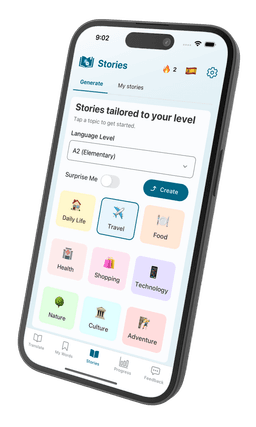
You're reading free stories on our website. Get the mobile app for audio narration, speaking practice, vocabulary saving, personalised stories, instant translations, and progress tracking.

Download on the App StoreGet it on Google Play
Audio
Translations
Progress

Linas geheimnisvolle Bootsfahrt

Elementary (A2)
5 min read

📖 You are reading the free text version. Get our mobile app for 🎧 audio narration, 💬 speaking practice, 🔄 instant translations, and 💾 vocabulary saving to enhance your learning experience.

Lina liebt Abenteuer, doch heute ist alles anders. Sie sitzt in ihrem kleinen Boot auf dem See, umgeben von Nebel und Stille.

Vor einer Stunde begann ihre Fahrt. Lina wollte nur ein bisschen entspannen, doch plötzlich hört sie ein seltsames Geräusch aus dem Wasser. Neugierig schaut sie nach unten, doch sie sieht nichts.

Der Nebel wird dichter, und Lina kann das Ufer kaum noch sehen. Ihr Herz schlägt schneller. Sie fühlt sich allein, aber auch gespannt auf das, was noch kommt.

Plötzlich trifft das Boot gegen etwas Hartes. Lina schaut unter sich und entdeckt eine kleine Holzkiste, die am Boden des Sees liegt. Mit Mühe zieht sie die Kiste ins Boot.

Die Kiste ist alt und schwer, genau wie eine Schatzkiste. Lina öffnet sie vorsichtig und findet ein altes Buch und eine kleine Karte. Das Buch erzählt von einem verschwundenen Schatz in der Nähe.

Lina liest aufmerksam und beschließt, die Karte zu Hause genau zu untersuchen. Der Nebel beginnt sich zu lichten, und das Boot driftet langsam zurück ans Ufer.

Zu Hause angekommen, fühlt sich Lina aufgeregt und nachdenklich. Sie hat keine Antwort, aber einen neuen Plan. Vielleicht führt sie das Abenteuer bald zu etwas Großem.

Heute endet Lina's Bootsfahrt ohne klaren Schatz, aber mit vielen neuen Fragen. Manchmal ist der Beginn eines Abenteuers wichtiger als das Ende.


Practise this German story

Vocabulary in context

Important words and phrases

  • Abenteuer

    noun

    adventure

    Jeden Sommer erlebt sie ein neues Abenteuer.

    Every summer she has a new adventure.

  • Boot

    noun

    boat

    Das Boot ist klein.

    The boat is small.

  • See

    noun

    lake

    Der See ist heute ruhig.

    The lake is calm today.

  • Nebel

    noun

    fog

    Im Nebel sieht man wenig.

    You can see little in the fog.

  • Ufer

    noun

    shore

    Wir gehen ans Ufer.

    We are going to the shore.

  • Geräusch

    noun

    noise

    Ich höre ein Geräusch im Wasser.

    I hear a noise in the water.

  • Kiste

    noun

    box

    Die Kiste ist sehr schwer.

    The box is very heavy.

  • Karte

    noun

    map

    Die Karte zeigt den Weg.

    The map shows the way.

  • Schatz

    noun

    treasure

    Sie sucht nach dem Schatz.

    She is looking for the treasure.

  • vorsichtig

    adverb

    carefully

    Sie öffnet die Schachtel vorsichtig.

    She opens the box carefully.

  • genau zu untersuchen

    verb phrase

    to examine closely

    Zu Hause will sie die Karte genau untersuchen.

    At home she wants to examine the map closely.

Check your understanding

Comprehension questions

Choose an answer, check it, then move to the next question.

Question 1 of 3

  1. Question 1: current not answered
  2. Question 2: not answered
  3. Question 3: not answered
Wo sitzt Lina am Anfang?Where is Lina at the beginning?

Notice the language

Language notes

usage

kaum noch sehen

The phrase "kaum noch" means that something is almost no longer possible. In the story, it describes how the fog makes the shore hard to see. You can reuse it when you want to say that seeing, hearing, or doing something is almost impossible now. Example: "Im dichten Nebel kann ich den Weg kaum noch sehen."

  • Im dichten Nebel kann ich den Weg kaum noch sehen.

    In the thick fog, I can barely see the path anymore.

Keep reading

More Elementary (A2) Stories
GermanElementary (A2)