Back to Beginner (A1) stories

Unlock the Complete Learning Experience

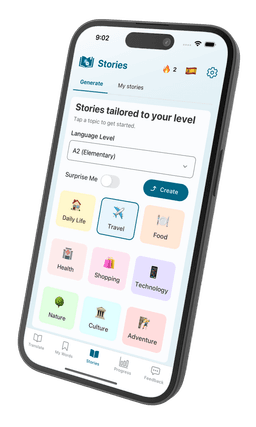
You're reading free stories on our website. Get the mobile app for audio narration, speaking practice, vocabulary saving, personalised stories, instant translations, and progress tracking.

Download on the App StoreGet it on Google Play
Audio
Translations
Progress

Le match inattendu au parc

Beginner (A1)
5 min read

📖 You are reading the free text version. Get our mobile app for 🎧 audio narration, 💬 speaking practice, 🔄 instant translations, and 💾 vocabulary saving to enhance your learning experience.

Ce dimanche matin, Ana décide d'aller au parc pour faire du sport.

Elle apporte un ballon de football. Ana aime jouer, mais aujourd'hui, il n'y a pas beaucoup de personnes.

Elle commence à passer le ballon seule. Ana rêve d'un vrai match avec des amis.

Soudain, un chien court vers elle avec le ballon. Ana rit. Elle essaie de prendre le ballon, mais le chien est rapide et joyeux.

Ana suit le chien dans le parc. D'autres personnes les regardent et sourient.

Une famille avec deux enfants approche. Les enfants veulent jouer aussi. Ana est surprise, elle se sent heureuse.

Le chien apporte le ballon aux enfants. Ils commencent à jouer tous ensemble, sans règles précises.

Ana pense que ce jeu est différent de ses matchs habituels. Ce n'est pas sérieux, mais c'est amusant et libre.

Le soleil est chaud. Tout le monde rit et court sans se soucier du score.

À la fin, Ana est contente de cette matinée sportive. Elle ne sait pas si elle reviendra ici, mais elle garde ce moment dans son cœur.

Parfois, le sport est juste pour le bonheur, pas pour gagner.

Practise this French story

Vocabulary in context

Important words and phrases

  • d'aller au parc

    phrase

    to go to the park

    Nous allons au parc le samedi.

    We go to the park on Saturdays.

  • faire du sport

    phrase

    to do sports

    Le matin, je fais du sport.

    In the morning, I do sports.

  • un ballon de football

    noun phrase

    a soccer ball

    Il a un ballon de football.

    He has a soccer ball.

  • jouer

    verb

    to play

    Les enfants aiment jouer.

    Children like to play.

  • passer le ballon

    phrase

    to pass the ball

    Je passe le ballon à mon ami.

    I pass the ball to my friend.

  • avec des amis

    phrase

    with friends

    Je vais au parc avec des amis.

    I go to the park with friends.

  • un chien

    noun phrase

    a dog

    Le chien court vite.

    The dog runs fast.

  • Les enfants

    noun phrase

    the children

    Les enfants jouent ensemble.

    The children play together.

  • Tout le monde

    noun phrase

    everyone

    Tout le monde rit.

    Everyone laughs.

  • rit

    verb

    laughs

    Ana rit avec ses amis.

    Ana laughs with her friends.

Check your understanding

Comprehension questions

Choose an answer, check it, then move to the next question.

Question 1 of 3

  1. Question 1: current not answered
  2. Question 2: not answered
  3. Question 3: not answered
Pourquoi Ana va-t-elle au parc ?Why does Ana go to the park?

Notice the language

Language notes

grammar

Il n'y a pas beaucoup de...

Use il n'y a pas beaucoup de... to say that there are only a small number of something. It is formed with il n'y a pas beaucoup de + noun. Example: Il n'y a pas beaucoup de personnes au parc. This is useful for talking about crowded or quiet places.

  • Il n'y a pas beaucoup de personnes au parc.

    There are not many people at the park.

Keep reading

More Beginner (A1) Stories
FrenchBeginner (A1)