Back to Beginner (A1) stories

Unlock the Complete Learning Experience

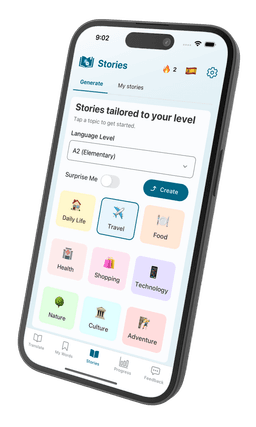
You're reading free stories on our website. Get the mobile app for audio narration, speaking practice, vocabulary saving, personalised stories, instant translations, and progress tracking.

Download on the App StoreGet it on Google Play
Audio
Translations
Progress

Een drukke dag met de bus

Beginner (A1)
5 min read

📖 You are reading the free text version. Get our mobile app for 🎧 audio narration, 💬 speaking practice, 🔄 instant translations, and 💾 vocabulary saving to enhance your learning experience.

Joris gaat elke dag met de bus naar zijn werk. Vandaag is het een speciale dag, want het is maandag en veel mensen reizen ook.

Joris staat op tijd op, eet snel zijn ontbijt en loopt naar de bushalte. De bus komt op tijd, maar hij is al vol met mensen. Joris moet wachten op de volgende bus. Hij kijkt naar de straat en ziet veel auto's en mensen die ook naar hun werk gaan.

De volgende bus komt na tien minuten. Nu is Joris blij dat hij mee kan. In de bus is het warm en druk. Joris voelt zich een beetje moe, maar hij leest een boek op zijn telefoon om tijd te maken.

Plotseling stopt de bus midden op de straat. De chauffeur zegt dat er een probleem is met de motor. Iedereen moet rustig blijven. Joris ziet dat mensen praten en wachten.

Na een kwartier komt er een nieuwe bus die iedereen meeneemt. Joris stapt opnieuw in en deze keer is er genoeg ruimte. Hij voelt zich gelukkig als hij zijn werkplek ziet.

Aan het einde van de dag denkt Joris terug aan de drukke morgen. Hij is blij dat hij rustig kon blijven en dat alles goed afliep.

Morgen hoopt Joris op een rustigere reis!

Practise this Dutch story

Vocabulary in context

Important words and phrases

  • met de bus

    phrase

    by bus

    Ik ga met de bus naar school.

    I go to school by bus.

  • op tijd

    phrase

    on time

    De bus komt op tijd.

    The bus comes on time.

  • de bushalte

    noun

    the bus stop

    Ik sta bij de bushalte.

    I am standing at the bus stop.

  • vol met mensen

    phrase

    full of people

    De bus is vol met mensen.

    The bus is full of people.

  • wachten

    verb

    to wait

    Ik moet wachten op de bus.

    I have to wait for the bus.

  • de volgende bus

    phrase

    the next bus

    De volgende bus komt snel.

    The next bus comes soon.

  • de chauffeur

    noun

    the bus driver

    De chauffeur is vriendelijk.

    The bus driver is friendly.

  • rustig blijven

    phrase

    to stay calm

    Joris moet rustig blijven.

    Joris has to stay calm.

  • de motor

    noun

    the engine

    De motor is kapot.

    The engine is broken.

  • druk

    adjective

    crowded; busy

    De bus is druk.

    The bus is crowded.

Check your understanding

Comprehension questions

Choose an answer, check it, then move to the next question.

Question 1 of 3

  1. Question 1: current not answered
  2. Question 2: not answered
  3. Question 3: not answered
Waar gaat Joris elke dag naartoe met de bus?Where does Joris go every day by bus?

Notice the language

Language notes

grammar

moet + infinitief

Use moet + infinitive to say that someone has to do something. The verb stays in the infinitive at the end of the clause. In the story: 'Iedereen moet rustig blijven.' You can reuse this pattern in many everyday situations, for example: 'Ik moet wachten op de bus.'

  • Ik moet wachten op de bus.

    I have to wait for the bus.

Keep reading

More Beginner (A1) Stories
DutchBeginner (A1)